I am currently in my first year of the Mental Health Counseling Ed.M. program at Teachers College, and I came to TC really wanting to join a lab. As an Applied Psychology major in my undergrad, my experience of tight-knit research teams back in Boston College added a whole new dimension to my engagement with psychology and human services – one that transformed my sense of purpose. Over time, I found myself drawn to qualitative research, especially projects that explore the nuance of human experience through interviews, reflection, and meaning-making. I learned that research isn’t just about numbers and p-values; it’s about people, stories, and the relationships that make those stories worth studying. Coming into TC, I hoped to find that same mix of inquiry and community again.
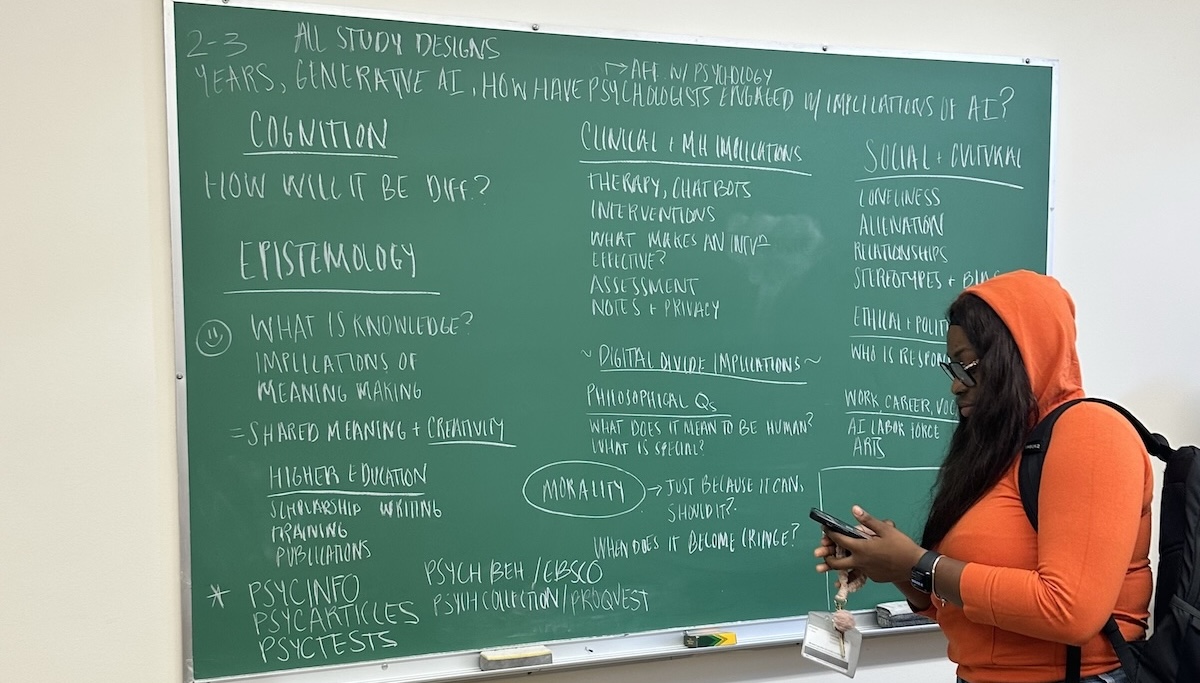
During our program orientation, I heard Dr. Laura Smith’s passionate spiel on her research interests in critical psychology, and my eyes lit up. A few days later, an email landed in my inbox: her lab was accepting new RAs. I applied within minutes. Now, almost a semester into being part of IncLab, our round-table discussions have become my weekly dose of purpose, justice, and advocacy – all held together by the rigor of academic inquiry. Currently, our lab is investigating the intersection of AI and Psychology. Not only do I know that our work will contribute to an important and timely area of scholarship, but it also gives me a front-row seat to conversations that will shape, for better or for worse, the future of our field.
Of course, the lived experience of this story was much less linear. Before joining IncLab, I applied to several other labs and got a mix of interviews followed by the infamous “We’ve decided to move forward with other applicants” and…crickets. At the time, it was discouraging. But in hindsight, those moments grounded me. They reminded me that joining a lab isn’t a race or a measure of competence or worth. They taught me that a lab that aligns with your values, curiosity, and questions is out there, and those rejections gave me space to find IncLab.
Lessons I learnt along the way
- You don’t need to be in a lab to thrive at TC.
- Research is one path, not the path – and your worth isn’t measured by whether you join a lab. Really think about the reason you want to join a lab before you commit your precious time to it.
- Research often requires intrinsic motivation.
- Most RA roles are unpaid and voluntary, which means the work is sustained by curiosity, commitment, and genuine investment in the topic.
- Rejection is part of the journey (and has nothing to do with your competence).
- I applied to several labs before joining IncLab. Sometimes it’s timing. Sometimes it’s capacity. Sometimes it’s misalignment. Most importantly, it’s never about your capability. You’re already at TC!
- Labs differ widely in size, focus, and timing.
- Some labs are very structured and hierarchical, while others operate more fluidly, with shared leadership and space for students to shape the direction of the work. Labs recruit at different times – some start during the summer, while others might operate on a rolling basis. Understanding these structural differences early on would have saved me a lot of anxiety.
- The best-fit lab feels like a community.
- The right lab is the one where your values, questions, and intellectual style truly belong. Once you find it, everything clicks more naturally. Remember, it’s not just the labs that are interviewing you; it’s also you who are picking the right lab to devote your time to. Talk to the lab members. Choose wisely!
Where to start
If you’re curious about joining a lab, start by browsing the full directory of TC’s research labs, reaching out to professors whose work interests you, or attending department info sessions. Most labs love hearing from motivated students – especially when you share why their work resonates with you.
By Annabel Lee