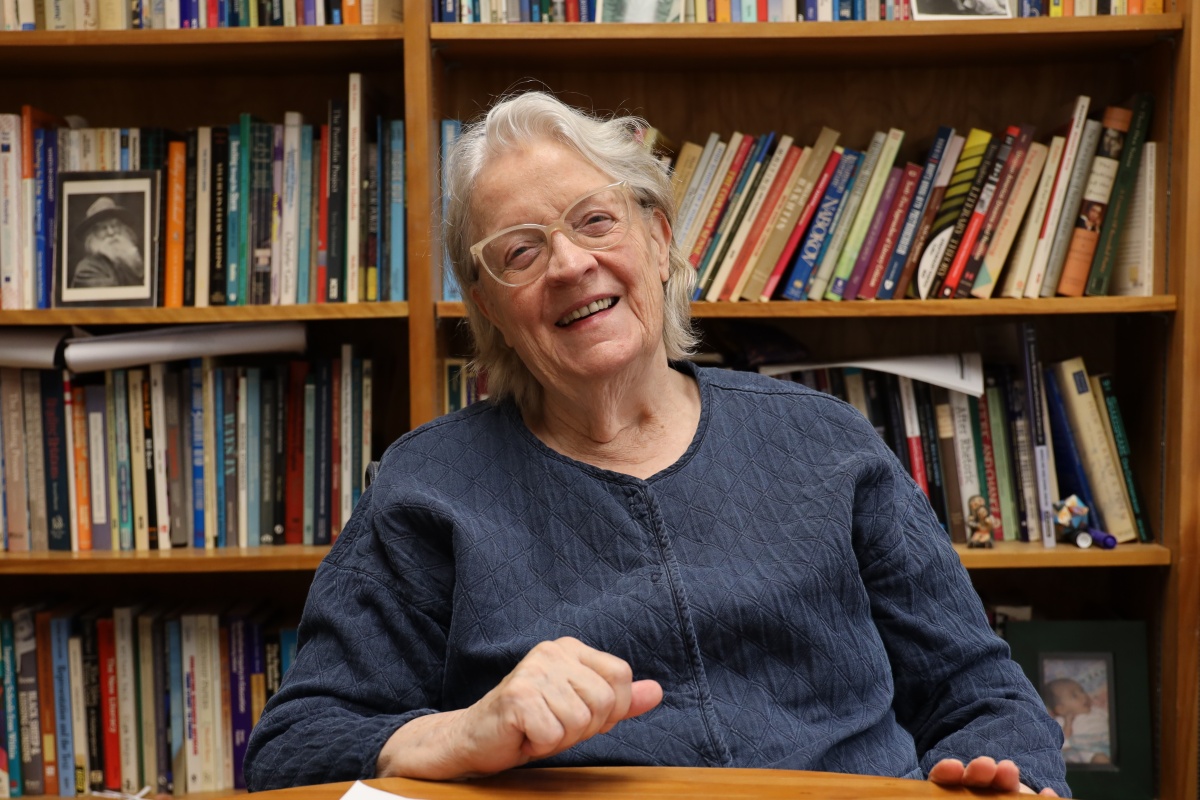
When TC’s Ruth Vinz stood in front of a classroom for the first time in 1966, she was just two years older than the high schoolers who looked back at her.
“I learned with them,” explained Vinz, who soon traded her post at the front of the room for a place alongside students in a circle. Vinz, today TC’s Enid & Lester Morse Professor in Teacher Education, spent the next 59 years shaping a pedagogy that resists hierarchy and embraces the shared imagination of the group—a practice grounded in listening, reciprocity and the belief that learning is something we compose together. Now, the treasured force in teacher education has won the Elizabeth Hurlock Beckman Award for her cascading impact on students who go on to make a difference in their communities.
“You live on in each other through the conversations, questions, imaginings and the work you have created together,” says Vinz, who often teaches alongside her former students, many of whom now lead their own schools and inspire their own pupils after graduating from TC
Established in 2010, the Beckman Award was created by Gail McKnight Beckman in memory of her mother, Dr. Elizabeth Hurlock Beckman, a pioneering educator and one of the first female psychology professors at Columbia University. Since its founding, the award has distributed more than $3.5 million to 148 professors in the U.S. whose students have gone on to establish their own organizations that have “demonstrably conferred a benefit” on broader communities.
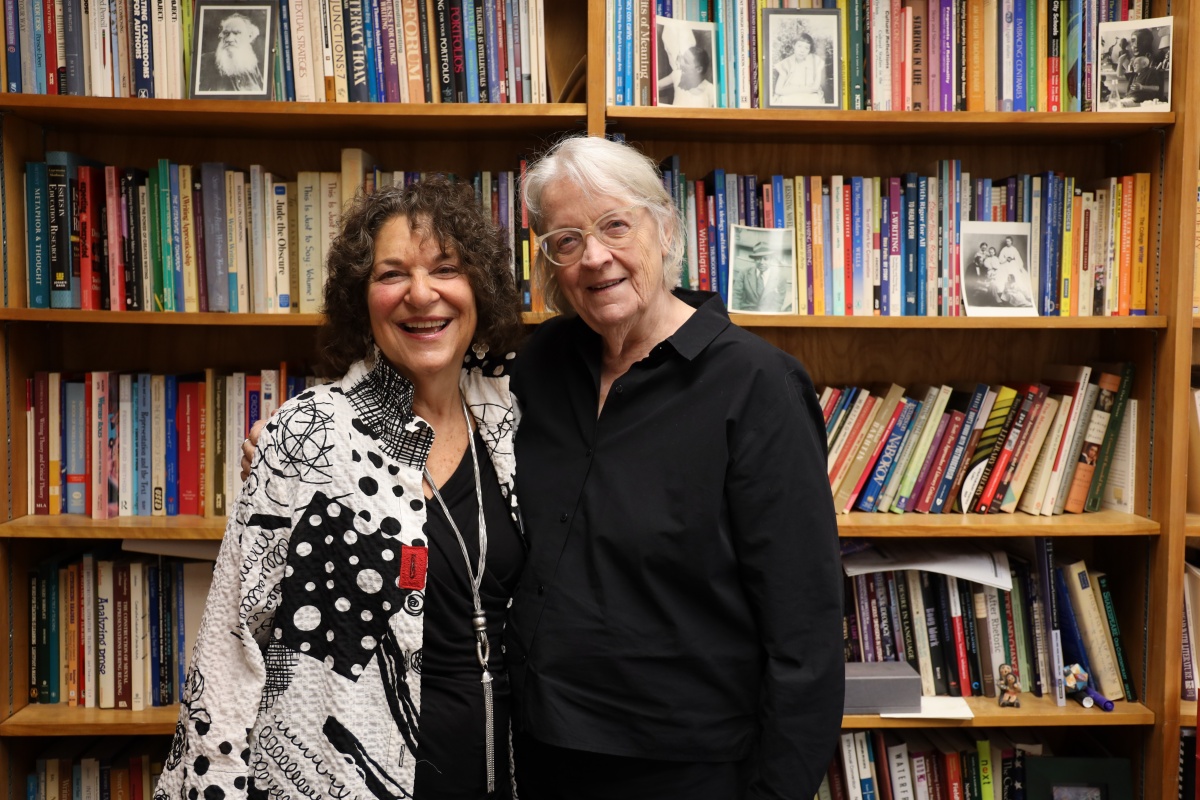
Mikki Shaw (Ed.D. ’99, left) nominated her former teacher and frequent collaborator Ruth Vinz (right) for the Elizabeth Beckman Award, which honors educators whose students have gone on to establish their own organizations that have “demonstrably conferred a benefit” on broader communities. (Photo: TC Archives)
“[Ruth] just had a way of being in the classroom. It wasn’t just what she was teaching, but how she was teaching,” says Mikki Shaw (Ed.D. ’99), who nominated Vinz for the Beckman Award, and applies Vinz’s collaborative approach in her writing classes at Sing Sing Correctional Facility. “Ruth taught us all to make our students partners in learning, to give them as much as possible a voice in the learning process.”
Vinz’s emphasis on helping students develop agency is particularly essential in Shaw’s highly-collaborative work with students who are incarcerated. “The ability to empower her students is Ruth's greatest gift,” says Shaw, who worked with her students Michael Shane Hale and Nigel Francis to establish Sing Sing’s Writing Center. “I see reflected in my students’ hard work the influence of my mentor.”
Shaw is just one of the TC alumni who remain close with Vinz, who joined the College’s faculty in 1992 and has mastered the art of building bonds in the classroom. Vinz learns her students’ names almost instantly and soon begins letter exchanges that anchor her teaching — sustained conversations in writing where she attends to each student’s ideas with care and curiosity. These letters become a space where students feel genuinely seen in their work, not only on difficult days but in the everyday shaping of thought. In these ways, Vinz cultivates a living dialogue, continually renewing readings and questions so that learning feels co-created — a shared exploration rather than a dictated path.
A hospitable imagination lets us step into another’s world and stay there long enough to be changed. That’s the quiet work of empathy.
“The expertise comes in developing your habits of listening,” explains Vinz, who sees connection as foundational to meaningful classroom experiences for literature and humanities. “A hospitable imagination lets us step into another’s world and stay there long enough to be changed. That’s the quiet work of empathy.”
When Vinz led Greg Hamilton (Ed.D. ’99) and his classmates through Six Walks in the Fictional Woods by Umberto Eco, “she framed literature as a journey — an exploration of the unknown, where stories become paths through which we can experience perspectives far removed from our own,” wrote Hamilton in his letter of support for the Beckman Award.
“She taught me that language is not only a means of communication, but a powerful tool that shapes perception and drives change,” said Hamilton, now a faculty member at the University of Redlands who sees Vinz deeply embedded in his own teaching philosophy. “Inspired by Ruth’s example, I show my students how literature can be a transformative force in the classroom, challenging assumptions, broadening perspectives and inspiring dialogue. Her teaching lives on through their work.”
[Ruth] taught me that language is not only a means of communication, but a powerful tool that shapes perception and drives change.
Vinz often hears of her impact, receiving notes from former students from more than 40 years ago who assume that Vinz won’t remember them. She does, associating each name with the student’s handwriting. ‘Their notes touch me,’ Vinz says. ‘They bring back the particularities of who they were — and who I was — in those shared moments of learning. It’s a quiet, enduring joy.’”
“They've shaped me as much or more than my impact on them. Everything I teach or think about, they're always there, says Vinz, who you might find in her cozy office on the fourth floor of Zankel Hall. “Their voices travel with me into every class I teach, every idea I explore — they’re woven into me, into the work.”
Carousel
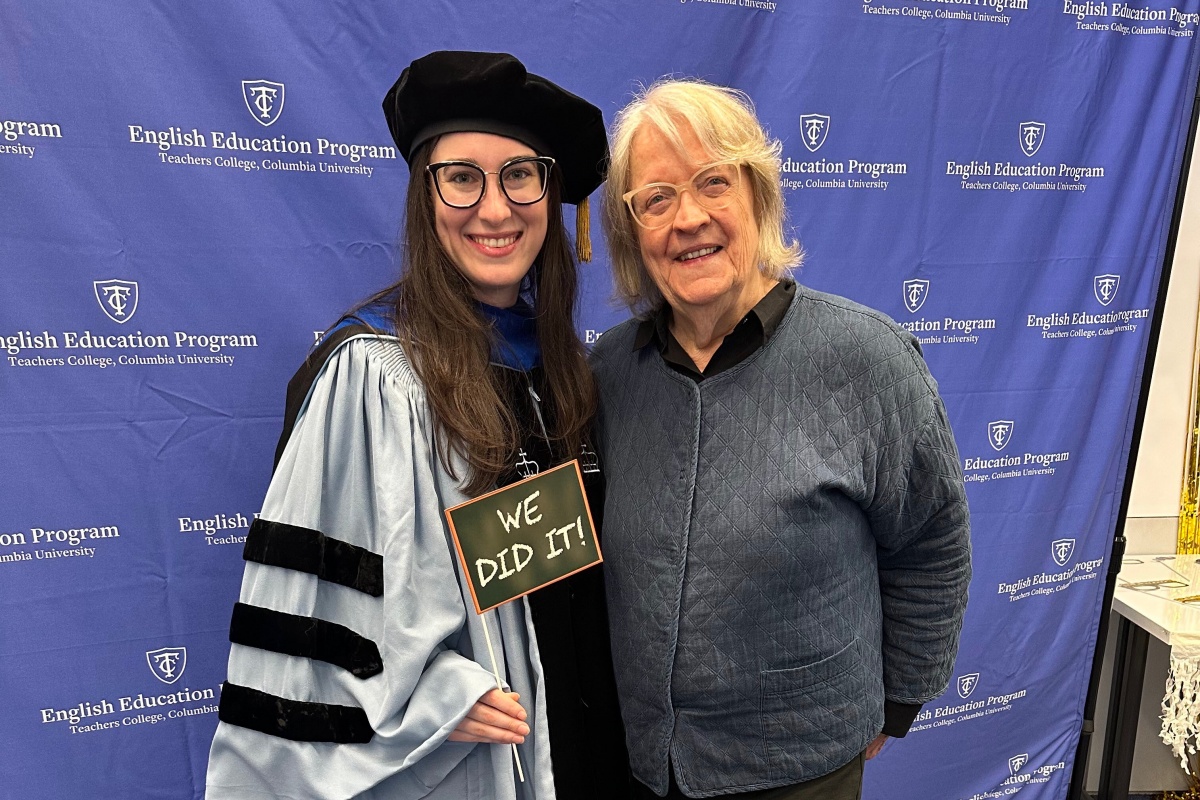
Vinz (right) with Kelsey Hammond (Ph.D. ’25), a professional development coach at CPET, at her graduation last spring. (Photo courtesy of CPET)
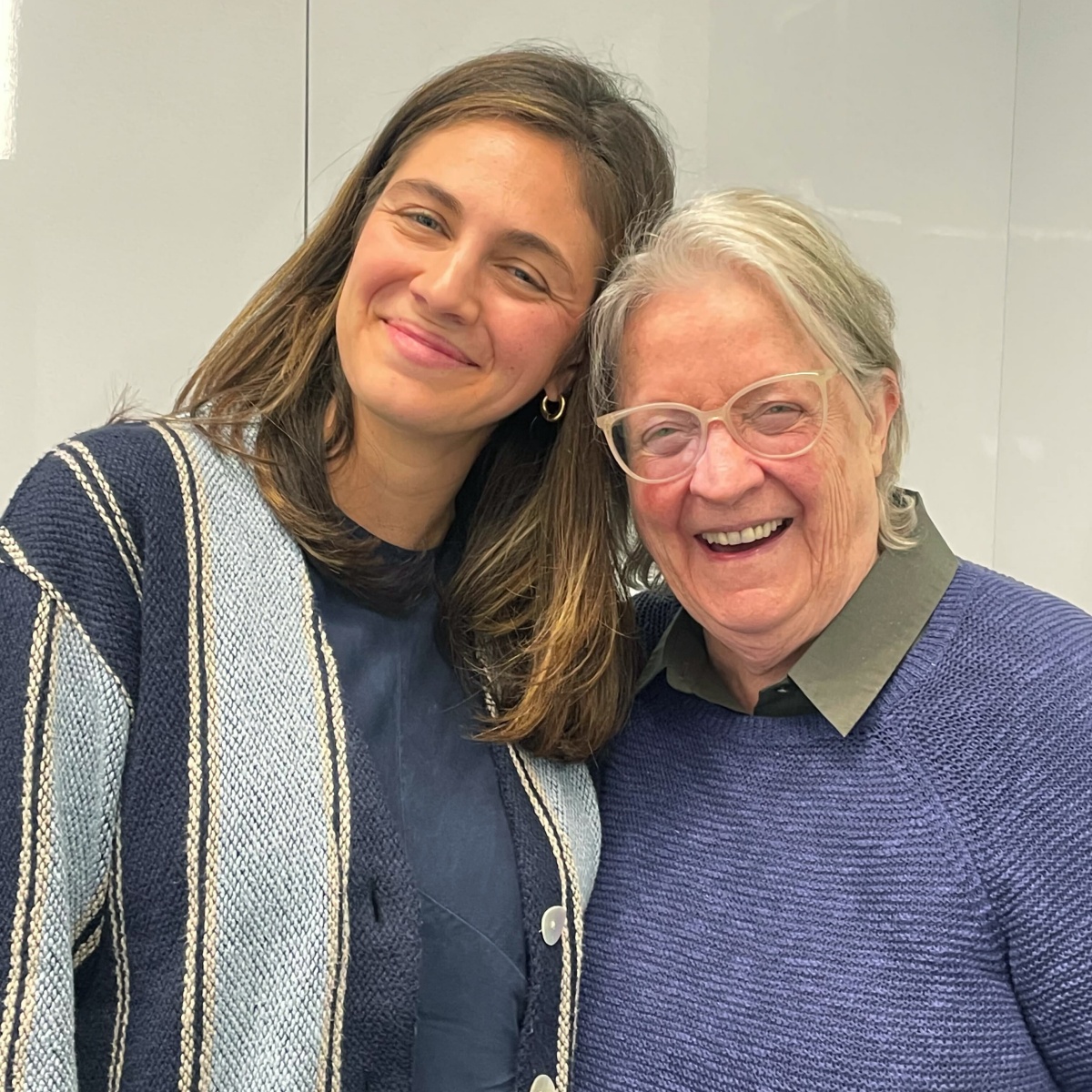
Jacqui Stolzer (Ed.D. ’25), Senior Professional Development Coach at CPET, and Vinz. (Photo courtesy of CPET)
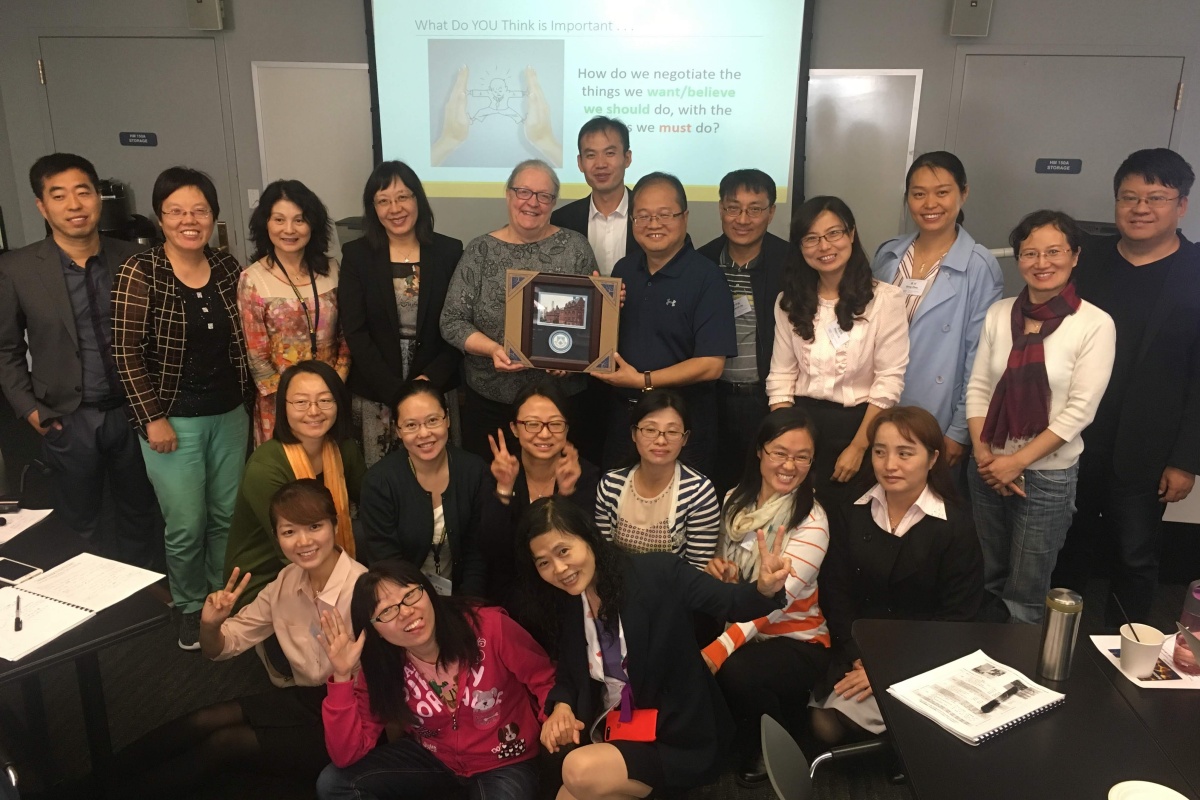
Vinz with professors and colleagues from China during a visit to TC in 2015. (Photo courtesy of CPET)
TC has also felt Vinz’s impact more broadly. In 2002, she established the Center for the Professional Education of Teachers (CPET), which bridges research-based theory and practice to help thousands of educators improve their practice. Vinz remains the founding director, advising on project-based literacy instruction, signature Initiatives, and supporting CPET’s school partnerships. She is the author of eighteen books, including A Poetry Pedagogy for Teachers, most recently, and the NCTE award-winning Composing A Teaching Life.
About a 20 minute subway ride from TC, Vinz is also felt in the halls of the NYC Lab School for Collaborative Studies, which Brooke Jackson (M.Ed. ’23) helped establish and where the TC alumna has served as principal for more than 20 years.
Ruth helped me accept the challenge of public school leadership, reminding me, her then doctoral student at Teachers College, that the work — whether in the secondary classroom, leading a graduate studies department, or in the principal’s seat — is about building community.
“Ruth is everywhere,” Jackson wrote in her letter on Vinz’s behalf for the Beckman Award. “Our core values and how we live them in each decision and interaction are a function of the formative time I spent with Ruth….Ruth helped me accept the challenge of public school leadership, reminding me, her then doctoral student at Teachers College, that the work — whether in the secondary classroom, leading a graduate studies department, or in the principal’s seat — is about building community.”
Just a few weeks ahead of the Beckman Award ceremony, Vinz had set the letters her former students wrote on her behalf aside, saving them for when she could greet them in person. For her, the real celebration is in the reunion. When Vinz is asked about how mentorship has informed her teaching, she pauses.
“I’ve never found a firm boundary between mentoring and teaching, if that makes sense,” says Vinz, who speaks about her ongoing classes with a spark. “Both are forms of accompaniment. Both ask us to listen, to imagine, to grow. Mentorship is reciprocal because teaching, at its best, always is.”
For Vinz, teaching has always been shaped by a single, enduring invitation — Mary Oliver’s question: ‘Tell me, what is it you plan to do with your one wild and precious life?’ “That question,” she says, “has guided my commitments to teaching, mentoring, and living.”