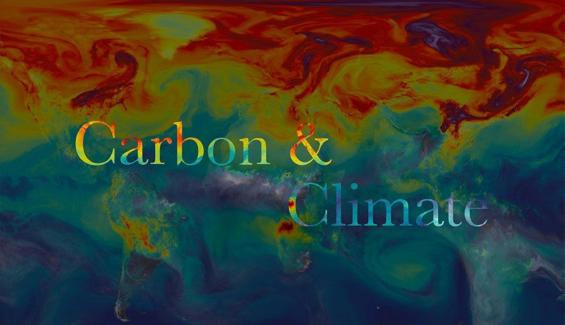
Trisha Barton is the lead designer of TC's Gottesman library, and one of her responsibilities is developing the artistic/creative expression of the book displays. Creations are done in collaboration with library staff. With the cooperation of other library staff, the team generates a book list and blurb that then Trisha brings to life in physical (cafe) and digital spaces. Everette Cafe's book displays are meant to touch on current trending topics ranging from politics to diversity. During the months of January and February 2022, the topic was Carbon and Climate Change.
My approach was to keep it classic, clear, and striking, just as the current statistics relating to global warming and carbon dioxide are. The main image was sourced from NASA, which in 2015 took note of the rapid rise of carbon where it's stated that " [The] Earth’s land and ocean currently absorb about half of all carbon dioxide emissions from the burning of fossil fuels. Still, it’s uncertain whether the planet can keep this up in the future" (NASA's Jet Propulsion Laboratory, 2015). The display invites readers to understand their position and contributions to the issue and ponder how it will affect their future existence, represented in the footprints fading into the distance.
Read below to learn more about the book display:
Activists, artists, citizens, diplomats, economists, lobbyists, media, political leaders, and scientists gathered together in Glasgow, Scotland, this past November at an historic and critical summit, the 26th annual climate conference, represented by countries bound by the United Nations Framework Convention on Climate Change. They were united with a common concern: our dependence on fossil fuels which heat our homes, run our vehicles, and generate power for industry and manufacturing, but which fundamentally place limits on life. Said Sir David Attenburgh, British documentarian, natural historian, and author, “We are, after all, the greatest problem solvers to have ever existed on Earth. If working apart, we are a force powerful enough to destabilize our planet. Surely working together, we are powerful enough to save it.”
Without carbon dioxide Earth would be unbearably cold since it traps heat close to our planet and helps keep us warm. However, too much carbon dioxide in the atmosphere serves to accelerate climate change to the detriment of our health; it causes compromised supplies of food and water; greater risk of illness and death from infectious diseases; and devastating weather events, like hurricanes, tornadoes, blizzards, droughts, and fires. Melting polar ice caps, rising sea levels, and disruptions in natural habitats are indicative of global warming which threatens the survival of species, ecological balance, and well-being of nature, as well as humans.
Did you know that carbon dioxide constitutes approximately four fifths of all greenhouse gasses, and that transportation, with the burning of fossil fuels (oil, coal, natural gas), geologically formed from the remains of dead plants and animals, generates the largest proportion of carbon emissions -- roughly 29%? Carbon dioxide emissions from cars, trucks, planes, and boats cause smog and pollution, harmful to humans, living creatures, and the environment. Passenger cars produce approximately 41% of global transportation emissions which equaled 7.3 billion metric tons in 2020 alone. Particularly in suburban United States where it's common for a family to have two, sometimes three vehicles, the car culture is consuming us with a deadlier price tag.
Cleaner modes of transport, including public transit, electric vehicles, biking, and walking, help reduce our carbon footprint, as will taking fewer flights in favor of trains or boats. Can we get to "net zero" emissions by taking certain steps in our daily lives to change our behavior and together work towards a smarter, more sensible way of living? Carbon and Climate invites us to examine the overarching question of CO2 emissions, from individual to corporate responsibility, educational to economic concern, political to health implication, present to future life.