Oren Pizmony-Levy
This article is an extended version of a contribution to Buckner and McCowan’s (2026) report, Beyond 2030: What Role for Higher Education in the New Global Agenda? Policy Insights No. 07, NORRAG.
Scholars have used various metaphors to conceptualize the role of higher education. In their extensive review of the literature, Stevens, Armstrong, and Arum (2008) identify three dominant metaphors: universities as sieves that regulate mobility and determine access to privileged social positions; as incubators that prepare competent social actors; and as temples that legitimize formal knowledge (p. 128). They add a fourth metaphor—that of a hub—to emphasize higher education’s capacity to connect multiple social processes and institutional domains that are typically treated as separate, such as the family, economy, politics, science, professional sectors, and the nation-state. Relatedly, Frank and colleagues (Frank et al., 2000; Frank & Meyer, 2020) describe higher education institutions as receptor sites that serve as intermediaries, translating global norms, ideas, and frameworks into locally meaningful knowledge and practices.
In the face of escalating sustainability challenges and the intensifying climate crisis, I argue that higher education institutions must actively lean into these established roles—particularly those of hub and receptor site. One effective way to do so is through the creation of well-networked centers for sustainability that operate outside traditional departmental or programmatic structures. Such centers offer the institutional flexibility needed to address complex, rapidly evolving problems; they draw on diverse “funds of knowledge” across disciplines and fields, and promote genuinely multi-, inter-, and transdisciplinary approaches to sustainability and education.
To maximize their impact, sustainability centers should adopt a whole-school approach, working across academic, administrative, and community-facing units. This includes supporting the development of new courses and curricula; collaborating with stakeholders such as student organizations and mission-aligned staff to strengthen institutional sustainability performance and climate action; and “connecting the dots” among faculty and staff already engaged in sustainability work. In doing so, these centers facilitate both innovation and coordination, helping institutions move from isolated efforts to systemic transformation. While I recognize that such structures may pose challenges—for example, with regard to management, resources, and visibility (e.g., Stahler and Tash, 1994)—I believe their potential impact is significant. Rather than avoiding these challenges, we should focus on developing strategies to navigate them in ways that support innovation and collaboration.
In the field of education, several institutions have established centers dedicated to advancing sustainability learning and practice. At New York University, the Wallerstein Collaborative for Urban Environmental Education and Sustainability promotes environmental literacy by working with educators across primary, secondary, and higher education. Through year-round programs, curriculum support, internships, and field-based learning, the Collaborative equips teachers with the tools and strategies needed to meaningfully integrate sustainability in classrooms, leveraging partnerships with schools, environmental organizations, and science institutions. At the UCL Institute of Education, the Centre for Climate Change and Sustainability Education provides research-informed professional development for teachers and school leaders at all career stages. Its work extends beyond the science of climate change to address the social and emotional dimensions, including growing eco-anxiety among young people. The Centre collaborates across faculties to ensure its materials are grounded in current research and embedded across the curriculum.
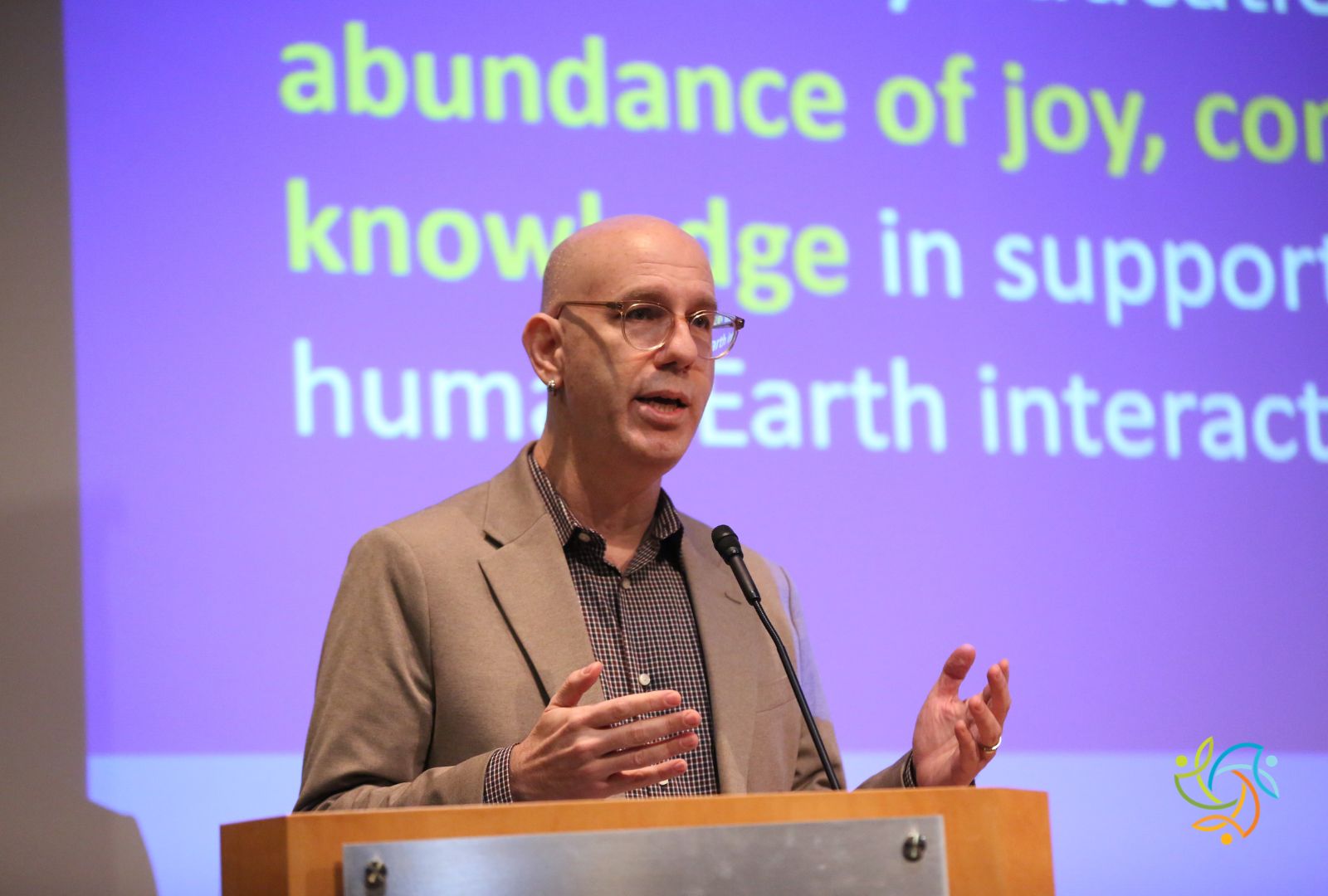
To illustrate how these centers can function as hubs that connect institutional actors, translate global goals into local action, and amplify the experiences of local actors within international discourse, I turn to a case I know well: the Center for Sustainable Futures (CSF) at Teachers College, Columbia University. Established formally in 2020, CSF grew out of informal faculty collaboration that began in 2014. The Center’s vision is “a future with quality informal and formal environmental and sustainability education that centers an abundance of joy, community, and knowledge in support of regenerative human–Earth interactions.” Its mission is “to explore new ways to transform education through original research and the exchange of ideas to empower all people to solve global and local environmental challenges.” Operating outside the formal academic structure of the university, CSF convenes students and faculty from across departments; supports the development of new sustainability- and climate-focused courses; and collaborates with stakeholders (e.g., student organizations) to improve institutional sustainability performance. It acts as a connector among institutional actors committed to sustainability and climate action.
At the local level, CSF maintains research–practice partnership with the NYC Public Schools Office of Energy and Sustainability, working with schools, teachers, and community-based organizations to advance sustainability education (Pizmony-Levy et. al., 2021). Its portfolio combines research—such as mapping the needs and attitudes of teachers (Pizmony-Levy and Wagner, 2025) —and practice, including professional learning opportunities. Beyond this partnership, the Center also leads additional research initiatives, including national and international public opinion studies on climate change education, cross-national analyses using data from international large-scale assessments (ILSAs), and surveys of organizations engaged in climate change education and communication (e.g., Pizmony-Levy et. al, 2023). Together, these projects extend the Center’s impact by generating timely evidence, informing policy and practice, and amplifying practitioner and community perspectives in broader sustainability conversations. CSF disseminates this work nationally and internationally through conferences (e.g., Comparative and International Education Society), invited presentations at United Nations agencies, and broader knowledge mobilization strategies (e.g., international web-based seminar). Its research contributes to international discourse on climate change education, informing initiatives such as the 2024 OECD Teaching and Learning International Survey (TALIS), which now incorporates a substantial set of items on how teachers and school leaders engage with climate change and sustainability education.
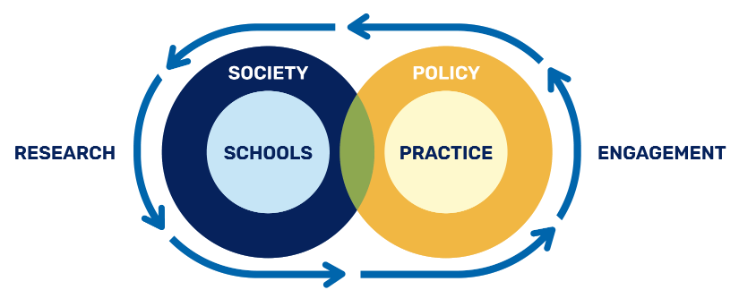
Centering on sustainability means moving beyond fragmented initiatives and instead embracing sustainability as a unifying, institution-wide priority. Academic centers—when intentionally designed, well-networked, and empowered to operate across traditional boundaries—can serve as catalysts for this transformation. They connect research with practice, global frameworks with local action, and faculty expertise with student engagement. As higher education institutions confront the climate crisis, the opportunity is clear: we must invest in and strengthen structures that enable collaboration, experimentation, and long-term commitment. Establishing and supporting sustainability centers is not merely an administrative choice—it is a strategic decision to prepare our institutions, and our students, for a rapidly changing world.
Looking ahead, this argument also speaks directly to the future of the global sustainable development agenda. As the international community begins to imagine the next chapter in the collective effort to protect our only home—Earth—and to improve quality of life and life of dignity for all, it is essential to place higher education at the center of that vision. This requires a comprehensive understanding of higher education that includes not only research universities but also teaching-oriented institutions, community colleges, and other postsecondary sectors. It also calls for moving beyond treating higher education as relevant only to a single “education” goal, and instead recognizing it as a cross-cutting institutional actor embedded throughout the international strategic framework for sustainable development.
Such an agenda could build on earlier global commitments, such as the 1990 Talloires Declaration, by more explicitly calling on—and empowering—higher education institutions to take a proactive, systemic role in sustainability and climate action. In particular, explicitly naming and encouraging the development of well-networked sustainability centers could inspire ministries, funders, and institutions to think more deliberately about local–global partnerships in research, teaching, and engagement. One could even imagine new indicators framed in the language of networks—focusing on partnerships, linkages, and the density of collaboration across sectors and scales—rather than only on isolated activities or outputs.
To be sure, some stakeholders will rightly argue for including targets related to access, participation, and enrollment in higher education. While important, that discussion lies beyond the scope of this argument. The central claim here is different: if the next generation of the global sustainability agenda is to succeed, it must treat higher education not only as a site of teaching and learning, but as a critical institutional infrastructure for coordination, innovation, and systemic change—and sustainability centers as one of its key organizational engines.
References
Frank, D. J., & Meyer, J. W. (2020). The University and the Global Knowledge Society (Vol. 6). Princeton University Press.
New York University (2025). Wallerstein Collaborative for Urban Environmental Education and Sustainability. Website: https://steinhardt.nyu.edu/wallerstein
Pizmony-Levy, O., Koch, P. A., & Rivet, A. E. (2023). Green light for comprehensive climate change education. Research Report. New York: Teachers College, Columbia University. https://academiccommons.columbia.edu/doi/10.7916/jmzp-ay10
Pizmony-Levy, O., & Wagner, S. A. (2025). Between Urgency and Uncertainty: The Challenge of Being a Human and an Educator in the Age of Climate Change. Current Issues in Comparative Education, 27(1).
Pizmony-Levy, O., McDermott, M., & Copeland, T. T. (2021). Improving ESE policy through research-practice partnerships: Reflections and analysis from New York City. Environmental Education Research, 27(4), 595-613.
Stahler, G. J., & Tash, W. R. (1994). Centers and institutes in the research university: Issues, problems, and prospects. The Journal of Higher Education, 65(5), 540-554.
Stevens, M. L., Armstrong, E. A., & Arum, R. (2008). Sieve, incubator, temple, hub: Empirical and theoretical advances in the sociology of higher education. Annual Review of Sociology, 34(1), 127-151.
UCL Institute of Education (2025). Centre for Climate Change and Sustainability Education. Website: https://www.ucl.ac.uk/ioe/departments-and-centres/ucl-centre-climate-change-and-sustainability-education
About
Oren Pizmony-Levy is an Associate Professor of International and Comparative Education at Teachers College, Columbia University. He is the Founding Director of the Center for Sustainable Futures. His scholarship explores the emergence and diffusion of global education movements, with empirical wok on international large-scale assessments, environmental sustainability education, and LGBTQ+ education.