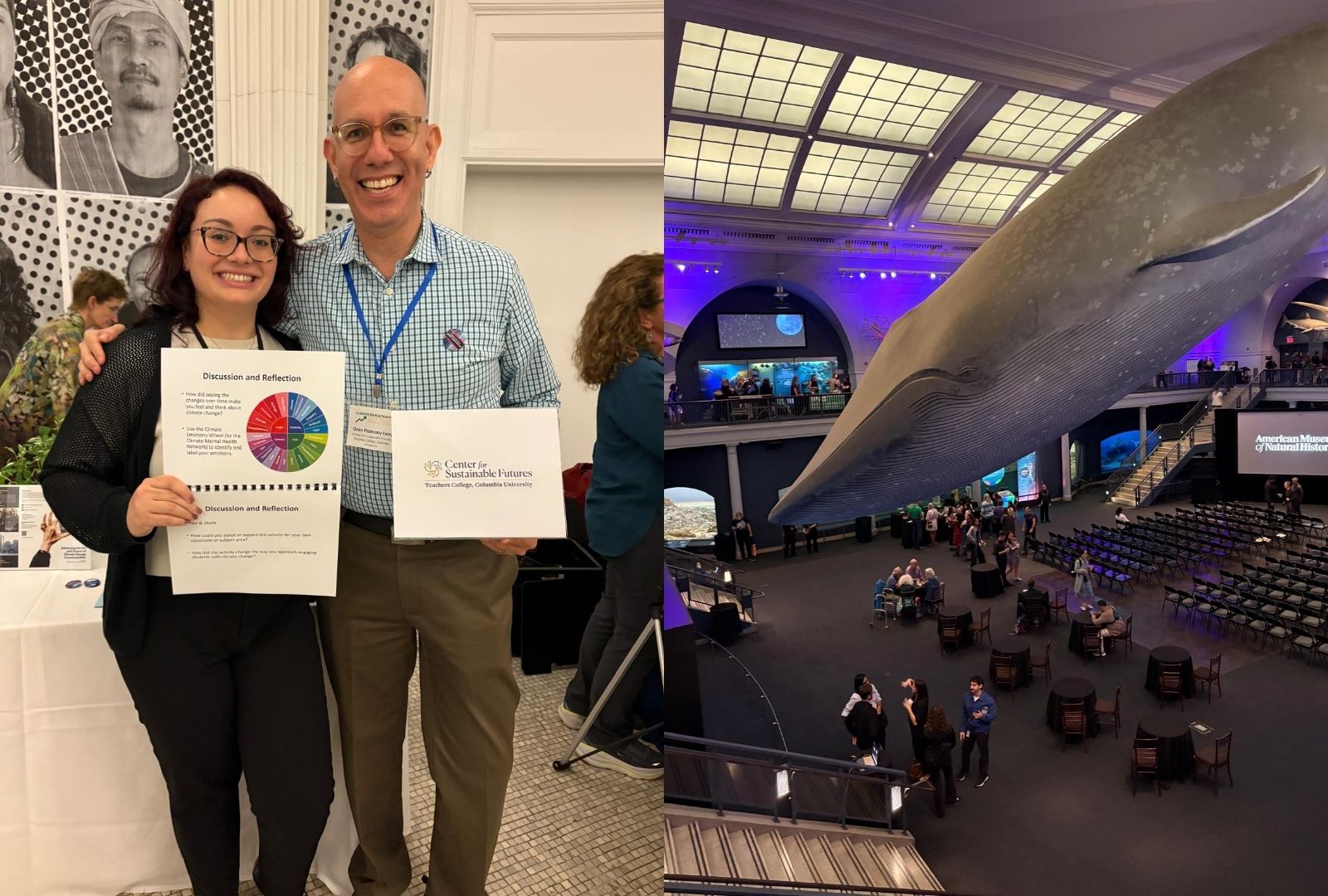
As part of New York City Climate Week, the Center for Sustainable Futures organized and participated in events that explored how climate change and education intersect—asking what it means to prepare students, teachers, and communities for a rapidly changing world. Our panels and presentations highlighted the urgency of embedding climate education into classrooms and teacher preparation, while also addressing equity and the lived experiences of educators and students in NYC.
On Thursday, September 25, we hosted the panel “Turning Up the Heat on Climate Change Education” at Teachers College, Columbia University. The conversation brought together voices from across the educational spectrum—city leaders, teachers, and higher education—to explore how climate change education is being shaped in New York City and beyond.
Panelists included Judith Felice, a classroom teacher sharing her firsthand experience of bringing climate change into her lessons; Meredith McDermott and Kailyn Fox from the NYC Public Schools Office of Energy & Sustainability, who spoke about the opportunities and constraints of embedding climate education system-wide; and Colby Tofel-Grehl,TC AND Vice Dean for Teacher Education and School & Community Partnerships, representing higher education, who reflected on the role of teacher preparation in making climate education a mainstream priority.
The discussion was guided by a set of reflective questions that grounded the panel in both practice and vision. Participants considered what it looks like to teach climate change in New York City classrooms, examining not only the successes already taking shape but also the areas where schools continue to fall short. They asked one another to imagine what a single policy change could do to accelerate climate education and, looking ahead, to define what success might look like in five years. A recurring theme was how to ensure equitable access so that all students can benefit from these efforts. Together, these questions sparked an energizing exchange that connected lived classroom experiences with the broader possibilities of bold, systemic change.
On Friday, September 26, we continued our Climate Week presence at the American Museum of Natural History during the Climate Education in Action event. There, we shared our research on public opinion toward climate change education and key findings from our recent publication: “Between Urgency and Uncertainty: The Challenge of Being a Human and an Educator in the Age of Climate Change”. We also invited teachers to explore how climate change data can be discussed through the life course of a family. Using our lesson plan, “Climate Change as a Family Story,” we encouraged educators to connect global trends with personal and intergenerational experiences, making the topic more tangible and emotionally resonant for students.
Across both events, our goal was to spotlight the importance of climate change education at every level—from the classroom to city policy—and to ensure that the conversation remains rooted in equity, practice, and collective imagination for the future.