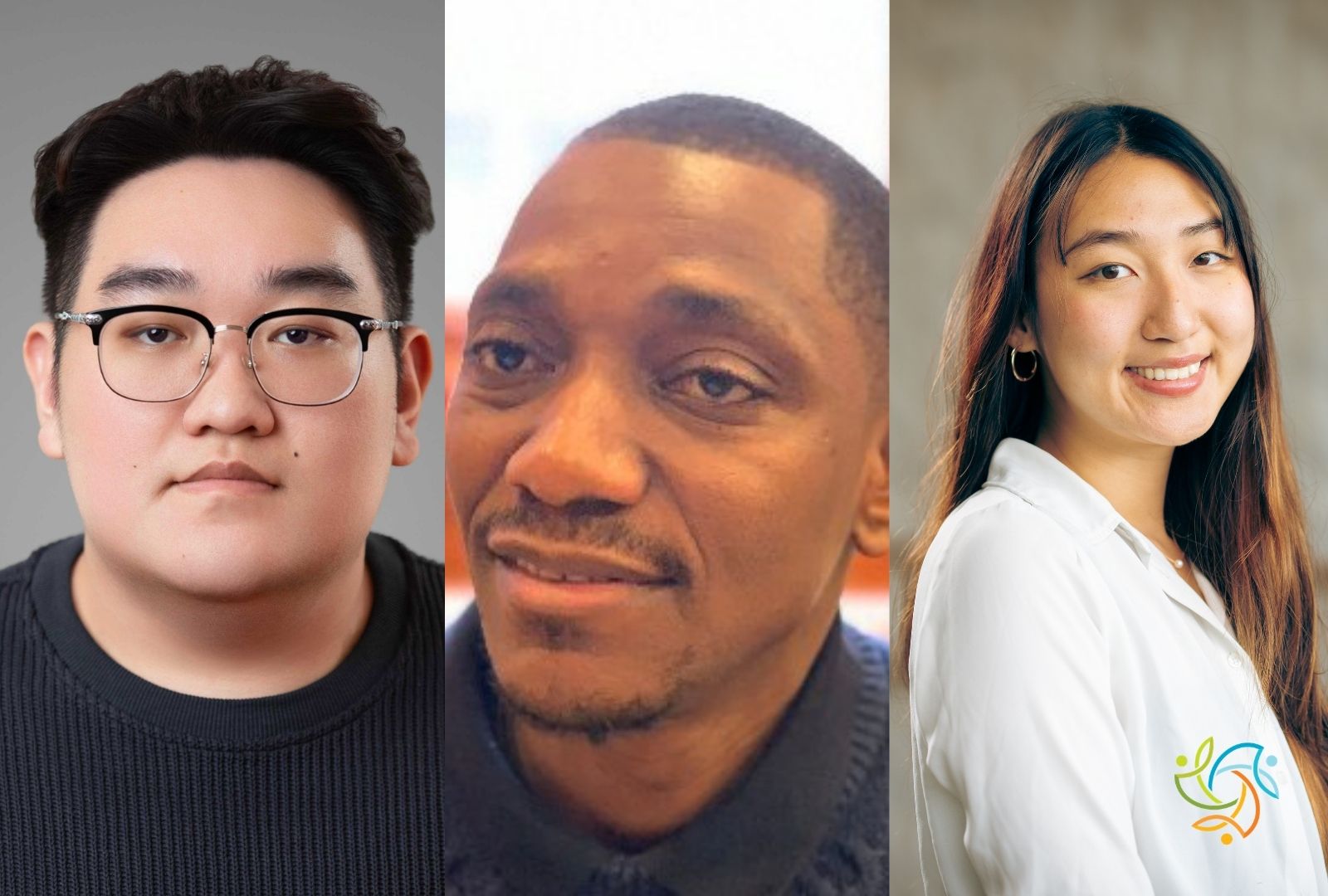
We’re excited to introduce this year’s Global Policy Fellows in Education, Environment & Sustainable Development at Teachers College, led by CSF’s Dr. Oren Pizmony-Levy: Moisa Saidu (PhD student, International and Comparative Education), Renda Sun (PhD student, Science Education), and Emy Yamamoto (Master’s student, Learning Analytics). Together, they bring a diverse range of academic, professional, and global perspectives to the program.
Moisa Saidu
Can you share your background and the skills you bring to the fellowship, and how they shape the unique perspective you contribute to this cohort?
My journey into global policy and advocacy began in Sierra Leone. I was involved in youth organizing and human rights work in the years following the civil conflict. As a young activist, I championed a national youth campaign that promoted peaceful elections and civic participation in communities where tensions were still rife. That experience showed me early on how dialogue, trust-building, and youth leadership can play a powerful role in strengthening democratic processes.
I later joined Amnesty International in Sierra Leone, where I worked on issues such as the death penalty and female genital cutting. Through that work, I gained firsthand insight into how global human rights frameworks are translated into local advocacy and how governments, civil society, and international actors negotiate change.
Over the past seventeen years, my work has expanded across education, human rights, and development programs in Africa and the United States. Most recently, I served as Education Chief for an emergency migrant youth education program in Texas, where I helped design educational programming for thousands of unaccompanied migrant youth while leading a multicultural team of educators and staff.
Alongside this professional work, my current doctorate pursuit at TC sits at the intersection of youth, education, and migration. I want to explore how evidence, narratives, and lived experience shape global policy scripts and decisions. From these experiences, I can bring a perspective that bridges field practice, research, and policy conversations. I hope to contribute insights rooted in real-world experience while learning from the diverse expertise within the UN-TC fellowship community.
What inspired you to apply to the Global Policy Fellowship, and how does this opportunity align with your personal and professional goals?
Throughout my professional journey, I have worked in contexts where global policy decisions have very real consequences for people's lives and communities. Whether working in human rights advocacy or in education programs serving migrant youth, I have seen how international frameworks can shape national policies and local realities.
At the same time, I have also witnessed the gaps that often exist between global commitments and what unfolds on the ground. Those experiences sparked my interest in how international institutions make decisions and how research and field-based knowledge can better shape those processes. This is an enduring conversation in the field.
For me, the UN-TC Policy Fellowship represents a chance to deepen my ability to connect research, advocacy, and policy engagement so that the voices and experiences of communities most affected by global decisions are not left out of those conversations.
Looking ahead, what do you want to take away from this fellowship — in terms of skills, networks, or future opportunities — and how do you plan to apply it in your next steps?
Through this fellowship, I hope to gain a deeper understanding of how international policy processes work in practice. I'm particularly interested in how multilateral institutions evaluate evidence, build consensus among diverse stakeholders, and translate complex global challenges into policy action on the ground. I was honored to serve as one of the thematic coordinators at the recent EUniWell & TC Conference, in which participants presented a host of initiatives and projects. Still, it was hard to miss that a key challenge was this: how are people impacted by these initiatives? At which point were they included in the conceptualization and design of the initiative? How is this meaningful to them? What is missing, and can this be sustained?
I also want to strengthen my collaborative and teamwork skills by working closely with peers and faculty. Currently, I am exchanging ideas with two colleagues, and my cluster faculty lead under the theme of Education, Environment, and Sustainable Development. The goal is to align our ideas and get more support from our Cluster Lead. Just engaging with these two colleagues on WhatsApp is showing me how interdisciplinary collaboration (sometimes in informal spaces) can generate meaningful ideas and solutions.
Much of this work connects directly to initiatives I am involved in in Sierra Leone. This includes research on community culture, local governance, and practices around mangrove use, as well as the development of a human rights education for climate curriculum for schools. Through the fellowship, I plan to further develop the skills, networks, and policy insight to help translate these kinds of local initiatives into broader policy conversations. Specifically, I envision developing a flagship project on Education and Environment for my cluster. With my colleagues, I want to commit the next couple of months to developing a framework to determine whether to adapt or create something from the ground up that will be meaningful to communities and decision-makers.
What advice would you offer to prospective fellows who are considering applying to the program?
For current fellows, our experiences have been different because the fellowship is in its inaugural stage, where a lot of flexibility is expected regarding scheduling and the specific scope of work. My advice would be to approach the application process with honesty, highlighting the experiences that have shaped your interest in global policy (or related fields). People arrive in this field from many different paths, and those diverse experiences often bring valuable perspectives to global conversations. It's also helpful to reflect on how your work connects to larger global systems and institutions (whether your background is in research, community work, advocacy, or government). Finally, stay open to learning from others.
.
Renda Sun

Can you share your background and the skills you bring to the fellowship, and how they shape the unique perspective you contribute to this cohort?
I’m currently a second-year PhD student in Science Education and also serve as a research associate at both the Center for Sustainable Futures (CSF) and Teachers College. Before beginning my doctoral studies, I completed a Master’s degree in Environmental Conservation Education with a specialization in the United Nations at NYU and dual bachelor’s degrees in Environmental Policy and Psychology at UC Davis. These experiences provided me with an interdisciplinary foundation connecting education research, environmental policy, and global affairs.
My current research mainly focuses on how education can better prepare individuals to engage with complex global environmental challenges. In particular, I explore how emerging technologies, such as generative AI, can support this process in two ways. First, I design AI-assisted tools that help teachers build climate change lesson plans that are accurate, pedagogically coherent, and aligned with sustainability goals. Second, I develop simulation-based learning environments, including a multi-agent model of the United Nations Security Council, to help learners understand global governance, negotiation, and decision-making.
What I bring to this cohort is the ability to connect three domains that are often siloed: education, policy, and technology. I approach global policy not only as a system of governance, but also as a learning process that depends on how people understand complex issues, negotiate across differences, and build shared solutions. This perspective allows me to contribute both analytically and creatively to discussions around global challenges.
What inspired you to apply to the Global Policy Fellowship, and how does this opportunity align with your personal and professional goals?
I was inspired to apply to the Global Policy Fellowship because it provides a direct pathway to connect my work in education and environmental sustainability with real-world policy and diplomacy.
My interest in global governance has been shaped not only by my academic research but also by my professional experiences. I am currently a Global Thought Leadership Fellow, jointly supported by Columbia University and UNICEF. Beyond Columbia, I am also a research fellow at the International Centre for UNESCO ASPnet (ICUA), where I conduct qualitative research on global education initiatives and support efforts to promote youth engagement in sustainable development across diverse international contexts. Through this work, I have seen both the potential and the limitations of global frameworks such as the Sustainable Development Goals, particularly the gap between high-level commitments and local implementation.
These experiences have made me realize that to create meaningful impact, it is not enough to conduct research or design educational programs. In addition, the opportunity to engage with UN representatives, participate in policy drafting, and learn from practitioners will allow me to bridge the gap between research and policy. It also supports my long-term aspiration to contribute to organizations such as UNESCO or UNICEF.
Looking ahead, what do you want to take away from this fellowship — in terms of skills, networks, or future opportunities — and how do you plan to apply it in your next steps?
Through this fellowship, I hope to develop practical policy-making skills, expand my professional network, and strengthen the real-world relevance of my research.
First, I want to deepen my skills in policy writing, negotiation, and diplomatic communication. These are areas that are essential for working in global governance but are not fully developed through academic research alone.
Second, I hope to build relationships with peers and professionals working in education, sustainability, and international policy. Being part of an interdisciplinary cohort will help me better understand how different sectors approach environmental challenges and identify opportunities for collaboration.
Most importantly, I want to use this experience to refine my current projects. For example, insights from the fellowship can help improve the design of my AI simulations of the UN Security Council, making them more grounded in actual diplomatic practices. Similarly, it can inform how AI tools for teachers incorporate global policy perspectives into climate change education.
In the long term, I see this fellowship as a stepping stone toward working within international organizations, where I can contribute to advancing education as a key strategy for environmental sustainability.
What advice would you offer to prospective fellows who are considering applying to the program?
My main advice to prospective fellows is to approach the application with a clear sense of how your work connects to global policy, even if your background is not traditionally in international relations or diplomacy.
The fellowship values interdisciplinary perspectives, so it is important to articulate not just what you study, but why it matters in a global context. For me, that meant framing climate change education and AI not just as academic topics, but as issues that shape how societies understand and respond to global challenges.
I would also encourage applicants to demonstrate both curiosity and initiative. The program is not only about learning from experts, but also about actively engaging, asking questions, and contributing to collaborative work. Showing that you are willing to take ideas beyond theory and into practice can make a strong impression.
Finally, be authentic about your motivations. From my perspective, the strongest applications are those that clearly communicate a sense of purpose: why this work matters to you, and how you hope to contribute to broader global efforts.
Emy Yamamoto
Can you share your background and the skills you bring to the fellowship, and how they shape the unique perspective you contribute to this cohort?
I was born and raised in São Paulo, Brazil, graduated from Wake Forest University with a double major in Business and Psychology, and I am now pursuing a master’s degree in Learning Analytics at Teachers College, Columbia University. My background includes sustainability education, data analysis, and community engagement through work with nonprofits and schools. As an international student and Lemann Fellow, I bring a global and interdisciplinary perspective shaped by a strong commitment to education, climate action, and using data to support meaningful social impact. I also work part-time at the Graduate Student Life and Development office where I advise student organizations and help organize community programming events.
What inspired you to apply to the Global Policy Fellowship, and how does this opportunity align with your personal and professional goals?
I was inspired to apply because the fellowship brings together the issues I care most about: social impact, climate action, education, and global cooperation. It aligns with my academic interest in data-informed decision-making and my long-term goal of contributing to global policy work that connects research with community needs and international collaboration.
Looking ahead, what do you want to take away from this fellowship — in terms of skills, networks, or future opportunities — and how do you plan to apply it in your next steps?
I hope to continue deepening my understanding of diplomacy and global policymaking, expand my ability to work across cultures and sectors and build meaningful relationships with mentors and peers. I plan to apply these experiences in future work at the intersection of education, sustainability and emerging technologies especially in ways that help turn research into practical and equitable solutions.
What advice would you offer to prospective fellows who are considering applying to the program?
Be honest about what drives you and the perspective you bring. You don’t have to be a policy expert to apply but show that you have curiosity, commitment to global collaboration and causes as well as a clear sense of how you want to create impact.