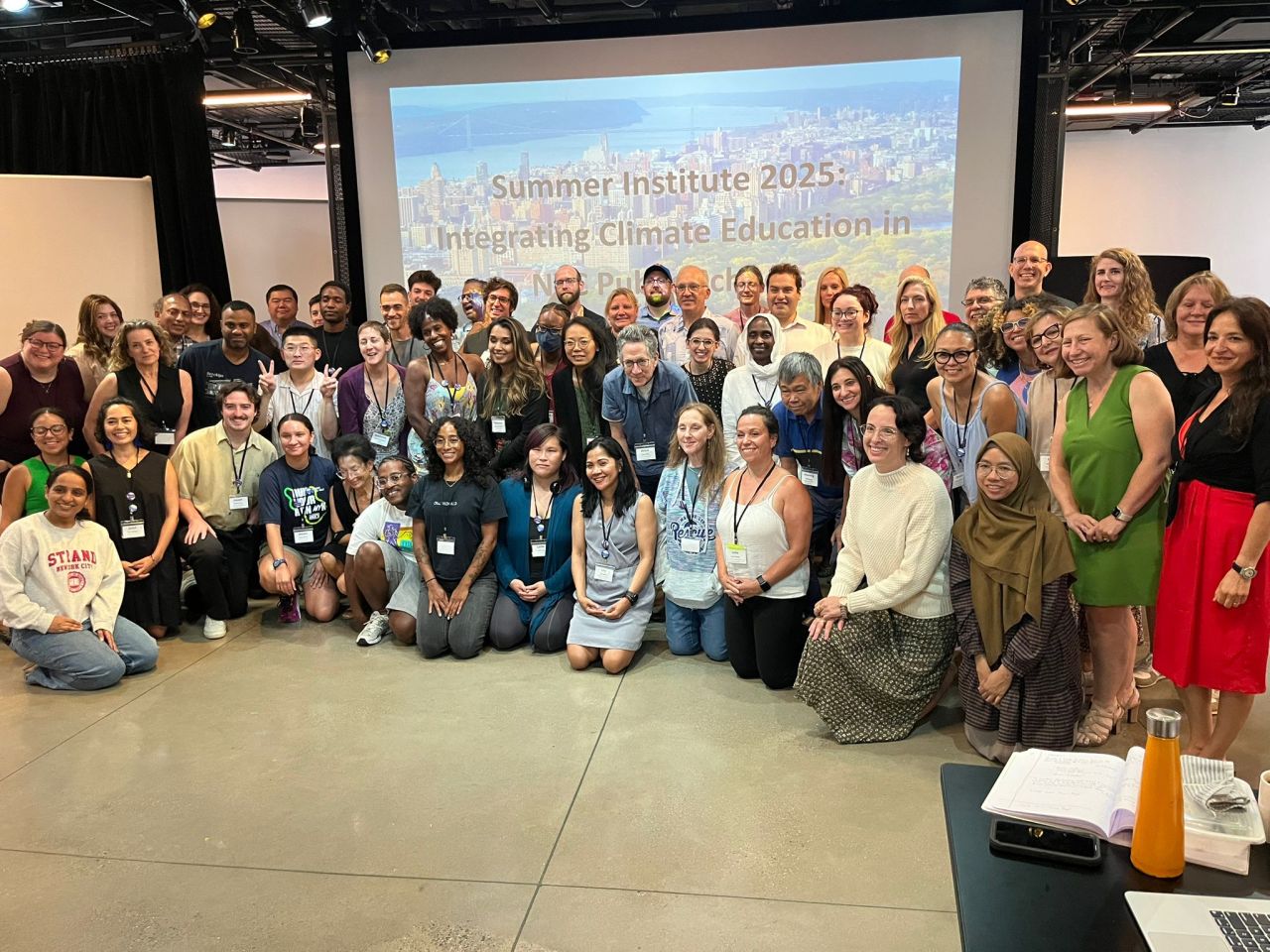
A new five-year phase of the National Science Foundation (NSF)-funded center will build on a partnership connecting climate science, education research, and New York City classrooms.
The National Science Foundation has renewed funding for Learning the Earth with Artificial Intelligence and Physics (LEAP), extending the Columbia University-based center for another five years and continuing a partnership that has helped the Center for Sustainable Futures at Teachers College bring climate data science into New York City classrooms. LEAP was established in 2021 through a $25 million NSF Science and Technology Center grant to improve Earth system projections by bringing together climate science, physics, data science, and artificial intelligence. While much of its research focuses on developing more precise and computationally efficient models of the Earth system, education and public engagement have also been central to LEAP’s mission and mandate. At Teachers College, that mission has taken shape through a multi-year partnership between LEAP, the Center for Sustainable Futures (CSF), and New York City Public Schools. Together, the partners have worked to connect advances in climate science with the educators responsible for helping young people understand a rapidly changing planet.
“Over the past few years, this partnership has given us a meaningful way to connect the work happening at Teachers College with the broader Columbia and New York City communities. Through LEAP, we’ve been able to bring climate scientists, education researchers, NYC Public Schools leaders, and teachers into sustained conversation with one another, and to see those relationships translate into real learning experiences. For me, one of the most powerful parts of this work has been seeing how much becomes possible when we create spaces for people across institutions and disciplines to learn from one another.” - Christina Torres, Ph.D.
Connecting climate research with classrooms
One of the partnership’s central initiatives has been the Summer Institute on Climate Education, which brought cohorts of New York City public school educators to Teachers College for intensive professional learning from 2023-2025. Rather than treating climate change as a subject confined to science classrooms, the Institute developed an interdisciplinary model that encouraged teachers in English language arts, mathematics, social studies, the arts, and science to consider how climate change could become part of their own teaching. Across the Institutes, educators worked directly with researchers, faculty, fellow teachers, and NYC Public Schools leaders to strengthen their understanding of climate change, develop approaches suited to their students and disciplines, and design teaching materials that could be implemented in their classrooms.
For the Center for Sustainable Futures, the partnership represents an effort to bridge a persistent divide between the production of climate knowledge and the settings in which people learn how to make sense of it. The Summer Institute has served as one such bridge, creating opportunities for teachers to engage with researchers while giving scientists greater insight into the questions educators and students bring to climate change. The program has also emphasized that climate education involves more than transferring scientific information. It requires translating research into meaningful learning experiences that connect climate change to students’ disciplines and everyday lives. Over the first phase of its funding, its education initiatives reached more than 100 New York City public school teachers, alongside broader workforce training and community-facing programs.
Building on the partnership
With LEAP’s renewal, CSF now has an opportunity to extend the work developed during the first five years of the partnership. The focus is no longer only on bringing educators into direct conversation with climate researchers, but also on sharing what the Center has learned about designing climate education across disciplines and institutional settings. That shift is already underway. In 2026, CSF launched the Climate Education Knowledge Sharing Convening through TC Academy, translating lessons from three years of Summer Institutes into an online resource for educators, universities, nonprofit organizations, and community-based groups. The initiative makes the partnership’s approach to professional learning, curriculum development, and interdisciplinary climate education available to a wider audience.
As LEAP enters its next five-year phase, CSF can continue developing the education side of that work alongside advances in climate science and Earth system modeling. The renewed partnership provides a foundation for the Center to refine its professional learning model, expand the reach of its resources, and continue studying how climate knowledge moves from research institutions into schools and other learning environments. For CSF, the next phase is therefore as much about sharing what has been learned as it is about developing new programming. The Center’s experience with New York City educators offers a model that can be adapted by institutions seeking to build their own approaches to climate education.
Learn more here:
Five More Years: NSF Renews Funding for AI-Powered Earth System Modeling Center
Expanding the Reach of Climate Education Research at TC