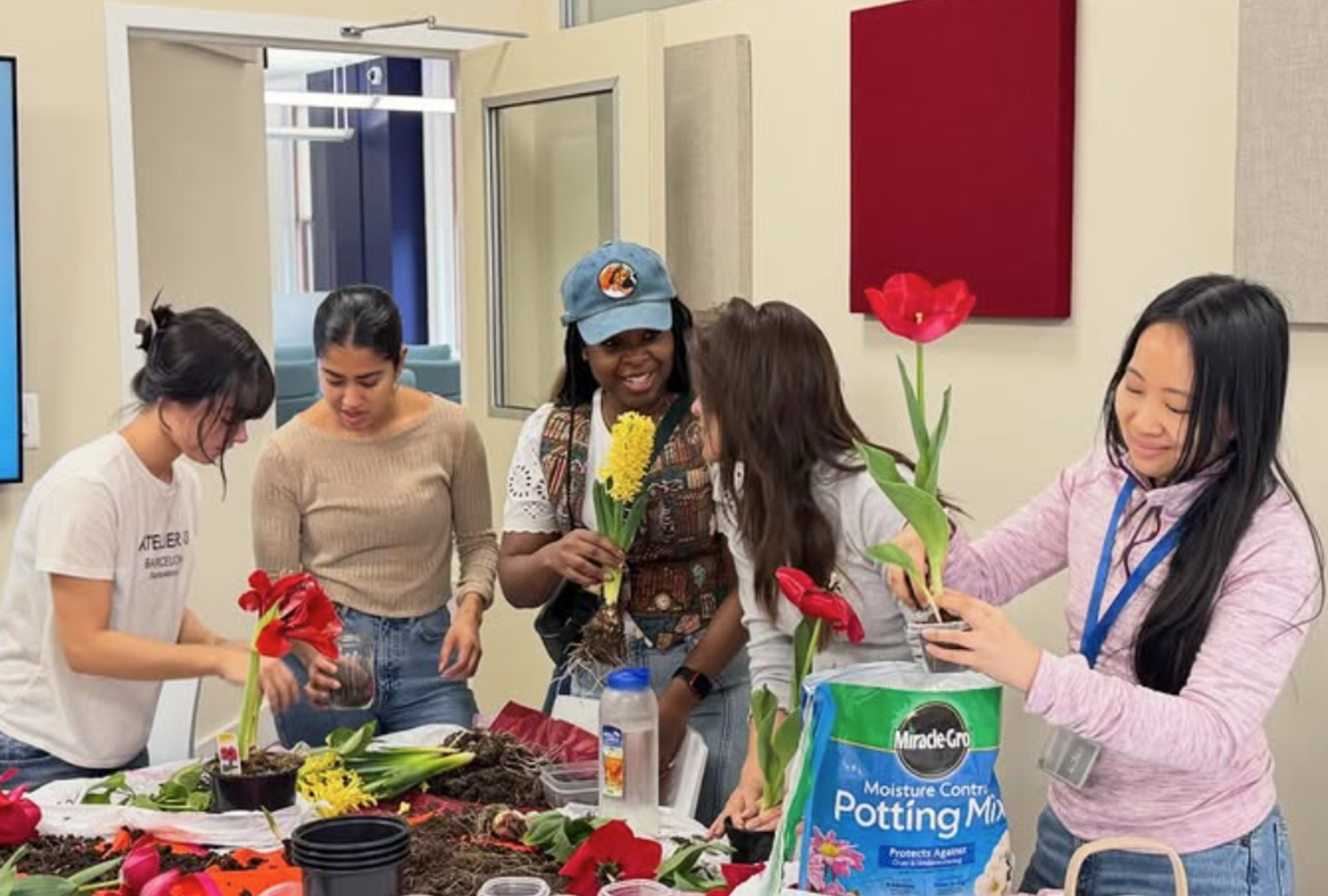
At Teachers College, sustainability has increasingly become part of how the institution thinks about both its campus and its academic programs. Behind that shift is a sustained history of student organizing: the Sustainability Task Force (STF). STF, established in 2020 by Amber Kim and Darren Rabinowitz, Ph.D., is a student organization dedicated to building a culture of sustainability at TC and advocating for institutional change in partnership with the Center for Sustainable Futures. Over several years, STF has created a space where students can organize across departments, develop proposals, and bring them directly to faculty and college leadership. In doing so, the organization has helped move sustainability from a shared concern among students toward a more visible institutional priority. That organizing has coincided with substantial changes across TC. Sustainability was incorporated as a distinct line in the college’s five-year plan, while completed campus projects have included replacing lighting with LED bulbs, converting more than 50 spaces from window air-conditioning units to central air, and developing a dining hall composting program. STF also presented directly to college leadership and faculty with a call for further action. For the students who led STF through this period, however, the organization’s importance was not limited to the changes visible across campus. It also created a community through which students learned how sustainability could be pursued collectively within the college campus.
Christina Torres, Ph.D. (Science Education, Teachers College, Columbia University; Visiting Assistant Professor of Teaching at Teachers College) joined STF during her first semester at TC in Fall 2020, when the COVID-19 pandemic had left much of student life online. She initially came to the organization looking for community and found a group of students whose interests in environmental issues overlapped with her own work. Over her six years at TC, she took on larger responsibilities and eventually served as co-president, while building relationships with students outside her department as well as faculty and staff. By Fall 2021, those relationships had become the basis for a broader effort to advocate for a more sustainable TC. Torres recalls three years of work involving students, faculty, staff, alumni, and administrators, during which she saw sustainable infrastructure expand across campus, sustainability become one of the College’s four core priorities, and a new M.A. program in Sustainability and Education What stands out to her most, though, is what students accomplished together: “Students have SO much power when we work together to make a big difference.”
That experience of crossing disciplinary boundaries also shaped Niklas Nyblom’s (Ph.D. Student, Clinical Psychology, Teachers College) involvement. Coming from clinical psychology, Nyblom was drawn to STF because sustainability did not appear to him as an issue belonging to any one field. As he put it, he joined because he felt a responsibility to “demonstrate how sustainability intersects with every discipline,” and because STF combined education, advocacy, and community around shared goals. The interdisciplinary community he found through STF ultimately became part of his own professional development. Nyblom describes his “greatest takeaway” as “the power of a supportive, interdisciplinary community,” emphasizing that working alongside faculty and fellow students showed him the importance of collective effort in producing lasting change. He also credits that experience with helping shape his current research interests in clinical psychology. Those interests now extend to the relationship between climate change and psychological well-being, pro-environmental behavior, planetary health, and community wellness.
Maja Dahms (Ph.D. Student, Comparative and International Education, Humboldt University of Berlin) was drawn to STF during her time as a Master’s student at TC for a similar reason: it offered a way to connect academic work with action. She saw the organization as a place where TC’s sustainability research could be put into practice across disciplines, while also giving students and faculty opportunities to collaborate on advocacy and new initiatives. At the same time, STF offered something less formal but equally important: a family of those who shared an interest in environmental issues and the natural world. For Dahms, that community was built gradually. “Regular meetings build a sense of community over time,” she reflects, and participation in STF made her more aware of the resources available across the college while reinforcing “the practice of care for one another and for the environment around us.” She now plans to carry those lessons about community building and shared vision into her research and teaching at Humboldt University in Berlin, while making civic action a more central part of her scholarship.
Taken together, these experiences show why STF’s significance extends beyond any single sustainability initiative. The organization has given students a channel through which to advocate for change while connecting them across departments and bringing them into sustained collaboration with faculty, staff, alumni, and administrators. Just as importantly, participation in STF has shaped the students themselves, influencing their research, professional trajectories, and understanding of how change takes place. For Torres, that is what made the organization such a consequential part of her time at Teachers College. “Being part of STF was a defining part of my doctoral journey,” she reflects. The relationships she built are ones she expects to carry for the rest of her life. “I can’t say enough how much I hope to see STF continue to flourish in the future.”
If you are interested in joining and being a part of the STF community please contact stf@tc.columbia.edu.