At a Glance
Location:
Our program is located on the Teachers College, Columbia University campus in Morningside Heights.
Campers:
Every Year we welcome 200 campers from the U.S and abroad. Our campers are rising 1st graders to 5th graders.
Camp Groups:
Camp is made up of 8 camp groups. Each group studies a unique science topic for the duration of camp.
Camp-Wide Theme
Every summer we select a camp-wide theme to explore as an all-camp community. Each camp group examines the camp-wide theme through the lens of their specific group topic.
Date & Time:
Camp runs on weekdays from 8:30am to 3:15pm during the month of July.
Camp does not run on July 4th.
Accessibility:
Our classrooms are nut-free and fully accessible.
OUR APPROACH TO SCIENCE
Our curriculum is designed to put campers into the role of scientists.
With hands-on activities and guided experiments, we challenge and support our campers as they learn through their own experiences. We cultivate meaningful discussions by listening to our campers and building on their knowledge. We present questions and thrive on discoveries made in the classroom. We embrace failure as an opportunity to grow and we always encourage campers to try and try again. Every lesson at Hollingworth is carefully designed to ensure it is both engaging and developmentally appropriate for our young learners.
Our curriculum is informed by three educational approaches:
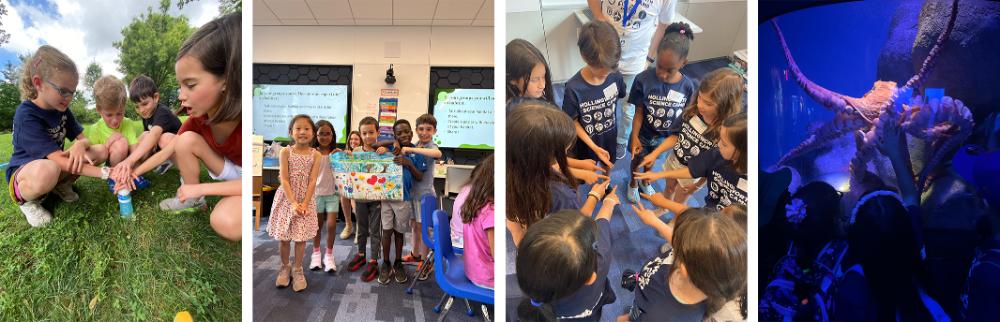
Inquiry-based Science
Our approach to science provides campers with opportunities to investigate the world around them, grow their curiosity and feel empowered by the fact that they can design investigations to answer scientific questions.
What does this look like? Campers develop scientific skills when they:
- Ask questions and seek answers
- Use hands-on materials for investigation
- Test out ideas
- Think creatively
- Collaborate with others
- Make observations
- Collect data and draw conclusions
- Link new concepts to their preexisting ideas
- Communicate findings through scientific talk and creative expression
- Learn how to disagree and provide constructive feedback
These inquiry-based science explorations lead to higher student engagement and help campers see themselves as scientists with curiosity, agency, and a love of learning.
Engineering and Making
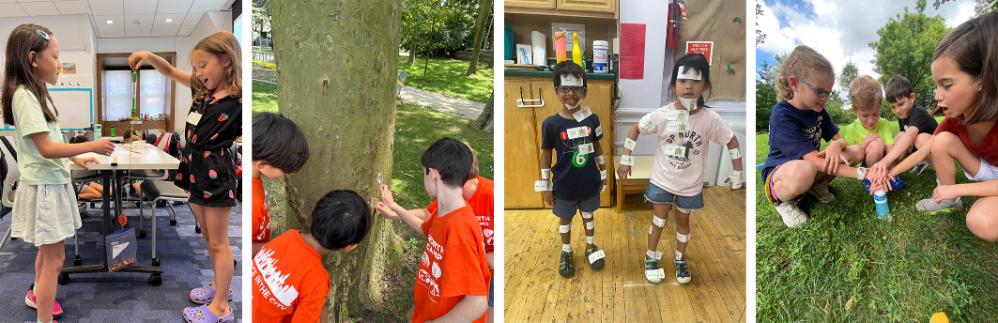
We use the engineering design process to guide our problem-solving and creation. Campers identify real-world issues, brainstorm ideas, build prototypes, test, and then improve their design before testing again. When engaged in this process, campers come away with increased confidence and perseverance that helps them approach problems by generating and evaluating potential solutions, a skill that will help them in countless settings.
The engineering design process is used by engineers to address and solve problems, and ultimately create new innovations. Unlike inquiry, which typically answers a question, engineering is used to identify an issue and methodically approach its solution. Cooperation and embracing failure are at the very heart of this approach, and we practice these skills every day.
Each camp classroom also includes a Maker space. Maker spaces bring campers together to “tinker” and stretch their creative muscles as they imagine, design, and build. We find that this approach weaves right into science and engineering, supporting the development of similar skills. For example, the Maker culture emphasizes taking risks, learning from failed attempts, being comfortable with the unknown, and contributing to communities of sharing. Our campers come away with a “tinkering” mindset that supports their joyful discoveries.
Equity and Belonging
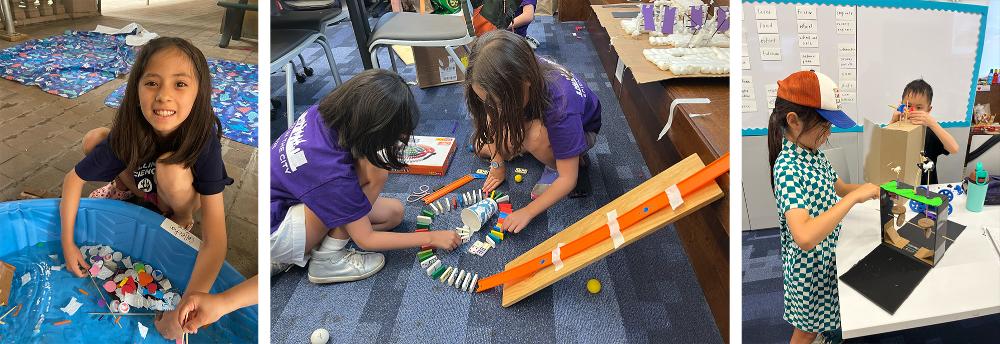
Our goal is to nurture confident, curious learners who see themselves as scientists and change-makers. Our campers have the opportunity to hold multiple perspectives, engage in respectful disagreement, and feel empowered to challenge injustice and imagine more equitable futures.
We work toward this by:
Building culturally responsive learning spaces:
We work to build a community that finds connections and celebrates diverse experiences and perspectives. We are intentional in our curriculum design, classroom language, books, videos, and classroom culture.
Combating stereotypes in science:
We see windows and mirrors in our exploration of scientists past and present. This includes asking critical questions: who is being marginalized/left out? Who is being included/highlighted? How are different perspectives being honored or ignored?
Support the development of social and emotional skills at camp:
A day at camp offers opportunities to interact with peers, teachers, and other community members. Campers have informed, caring educators to support them as they work through social challenges and triumphs, conflicts, and moments of connection.
Social skills that are honed at camp include: self-awareness, identifying emotions, communicating those emotions/expressing them in constructive ways, self-management (handling stress, controlling impulses), social awareness (empathy, understanding perspectives), relationship skills (communication, cooperation, conflict resolution), and responsible decision making (ethical choices, problem-solving).
Camp groups often discuss ways to engage in community with respect, care, and open-mindedness. Learning how to respectfully disagree with peers, what makes criticism constructive or destructive, how to hold space for multiple ideas or ways of knowing at the same time, how to embrace our similarities and differences, how to understand and empathize with others, and with the natural world.
Implementing reflexive practice:
We assess and improve our curriculum yearly, asking critical questions like: what beliefs, practices, and ways of knowing are present in our community and our learning, and how are we positioning those experiences in our time together at school or camp?
Dr. Ghouldy Muhammad defines criticality as a skill that helps “cultivate young people who, across the course of their lifetimes, will disrupt, disquiet, or unhinge oppression.” We work to infuse our lessons and camp experiences with opportunities to hone this skill. Science does not exist within a vacuum. By including appropriate context for our scientific studies, we aim to connect science learning to its effects in broader society, particularly how it relates to power, equity, and access.
By highlighting collective action, joyful learning, and the value of effort and curiosity, we strive to cultivate a community where all campers feel seen, valued, and connected.