This project applies what we’ve learned about the failures of ambitious reform efforts in the 20th Century to explore how we can transform education in the 21st Century. This work builds on several key principles of school improvement described in The Education We Need for a Future We Can’t Predict:
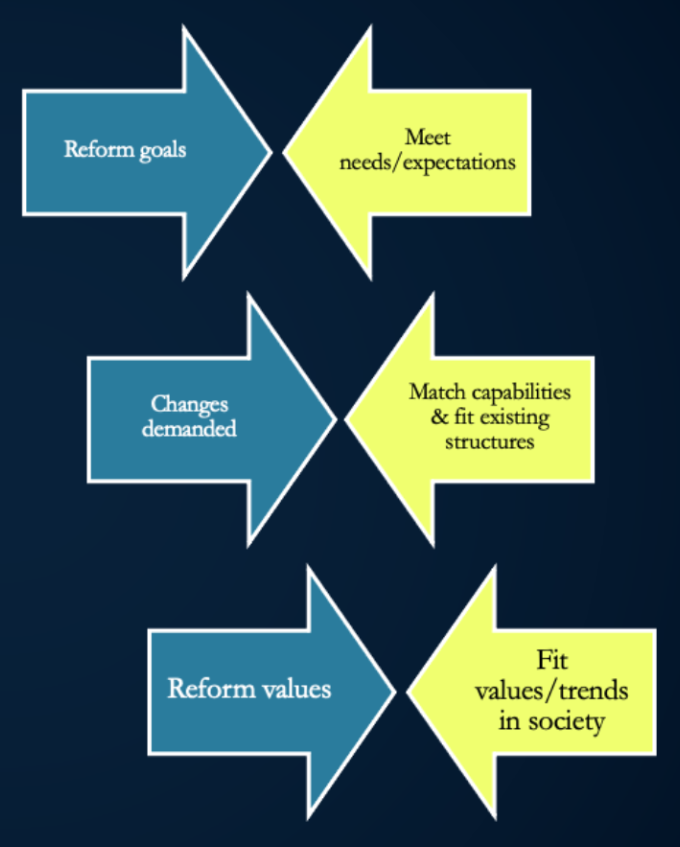
- New possibilities for schooling are most likely to take off when their goals, capacity demands, and values fit the common needs, existing capabilities, and prevailing conditions in the schools and communities where they are supposed to work;
- But the more radical visions for educational reform are, the less likely they are to fit the affordances of conventional schooling and to take hold on a large scale
- Nonetheless, the demands and pressures of conventional schooling make it easier to bring radical visions to life in particular circumstances and contexts – ecological “niches” of possibility” – rather than across entire school systems.
This “niche” approach suggests a shift away from a focus on creating new educational practices – such as more holistic, personalized or student-centred approaches to learning – that are supposed to work in general, for all subjects and topics, all the time. Instead, a “niche” approach focuses on developing specific “micro-innovations” and adaptations – resources, structures, practices services and activities that are new to the contexts in which they are introduced.
This project is reviewing educational news and research from around the world to identify micro-innovations that educators are developing in key areas like tutoring, foundational learning, supporting students’ mental health and wellbeing; increasing access to college and careers; sustainability of school facilities and operations; and assessment of competencies. To complement these reviews, school visits and interviews with educators are also being carried out in “higher-performing” education systems including Finland, Estonia, Singapore, China, and Vietnam.
For more information, contact Thomas Hatch, hatch@tc.edu
Publications:
Ongoing reflections and reports on the project can be found at internationalednews.com
Hatch, T. (2025). The power of condensing the curriculum. Educational Leadership. 83 (4), 22-27.
Hatch, T. (2021). We will now resume our regular programming
Journal of Educational Change, 22 (3), 447–456.
Hatch, T., with Corson, J. & Van den Berg, S. (2021). The education we need for a future we can’t predict. Thousand Oaks, CA: Corwin. 6), 37-41.