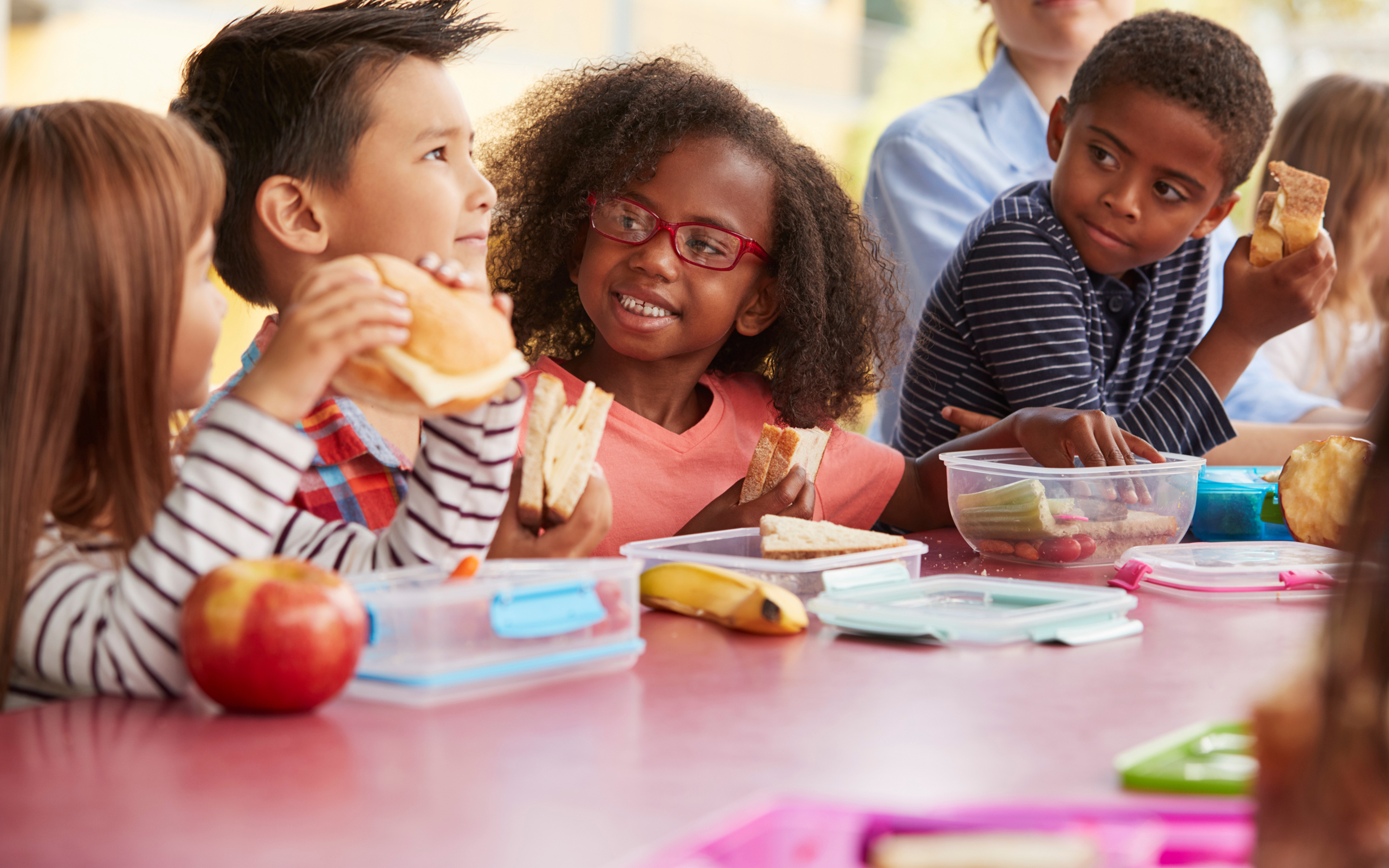
What if a three-minute classroom activity could change the way students think about their lunch?
This spring, during the final months of the 2025-2026 school year, members of the CRUNCH Lunch Team piloted a series of classroom Micro-Activities at a charter school in Brooklyn. These activities ranged from a quick discussion prompt to a five-minute slide-based lesson, making them easy to incorporate into the school day.
The pilot gave us the opportunity to see how these activities worked in a real school setting, observe what happened in the cafeteria, and hear directly from teachers and students. One thing became clear: even brief moments of reflection can spark meaningful conversations about food.
What is CRUNCH Lunch?
Creating Resources Uplifting Nutrition, Culture and Health at Lunch (CRUNCH Lunch) is supported by the National Institutes of Health Science Education Partnership Award. CRUNCH Lunch has an online resource hub that provides teachers with easy access to a wide variety of classroom resources related to science, technology, engineering, and mathematics (STEM) as well as other academic subjects. Through these resources, students learn where food comes from, what happens to plants from cultivation to consumption, and how food choices impact both their health and the environment. By connecting these topics to the foods students encounter every day, CRUNCH Lunch helps them see how science is connected to their lives.
The National School Lunch Program provides all students with a nourishing meal. This is especially important for students who experience food and nutrition insecurity. The resources available on the CRUNCH Lunch website help teachers use school lunch as a meaningful context for learning, while also building students’ understanding of the nutritional, environmental, and educational benefits of school meals. This will, in turn, encourage them to eat school lunch regularly which can lead to improved academic performance and health.
The Dietary Guidelines for Americans (DGAs) are a set of recommendations that advise Americans on their intake of various food groups, vitamins, and minerals. They are also used by healthcare providers and policymakers to help inform nutrition programs, education, and policy. The DGAs help shape preventative nutrition measures that can offset chronic diseases, and also provide intake recommendations for individuals with varying dietary preferences and across different life stages. A comprehensive report is published every 5 years and builds upon the ideas of previous DGAs. These ideas are all brought together into a visual infographic that can be easily understood by the general public.
Micro-Activities
One set of resources available on the CRUNCH Lunch website are the Micro-Activities. These short, classroom activities were developed in response to research showing that teachers value nutrition education that is directly connected to school meals. Based on the daily school lunch menu, they use brief investigations, discussions, and visual exploration before and after lunch, to help students connect STEM concepts to the meals they eat at school.
It is well established that nutrition education enables students to create connections between what they learn in the classroom and the food choices they make in their everyday lives. Decades of research by Pamela Koch, Isobel Contento, and colleagues have shown that effective nutrition education goes beyond providing facts. Students learn more when they actively investigate food-related questions, discuss ideas with others, and apply what they learn to everyday decisions about food and the food system.
One of the most meaningful opportunities to connect nutrition education to students' daily lives is the school lunch period. Every day, students make decisions about what to eat, talk with friends about food, and experience the school food environment. Yet lunch is often viewed as a break from learning rather than as an extension of it. As a result, there can be a disconnect between what students discuss in nutrition lessons and what happens when they sit down to eat. If students are making food choices every day, why not use those moments as opportunities for learning?
The CRUNCH Lunch Micro-Activities were developed to help bridge that gap. Instead of adding lengthy lessons to an already busy school day, they provide short, engaging activities before and after lunch that encourage students to think about their food choices, reflect on their experiences, and connect classroom discussions with what is happening in the cafeteria.
Bringing Micro-Activities into the classroom
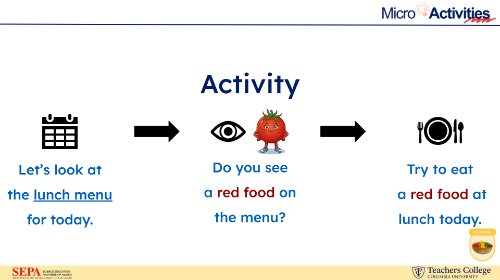
The pilot was conducted over two weeks and included one classroom each in first, third, and fifth grade. Teachers could choose from quick prompts, mid-length slide-based lessons, or longer ten minute lessons. Activities were designed to be completed before and after lunch, allowing students to make connections between the activity and their actual lunchtime experience.
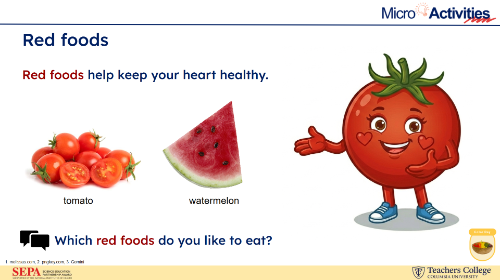
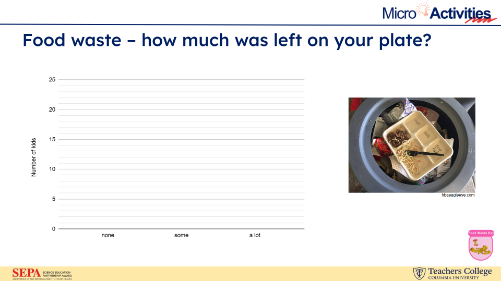
Students were asked simple discussion questions and were encouraged to connect the question with what they encountered during school lunch, while other activities introduced students to a food or STEM concept. For example, if the lesson that day was about “red foods,” the students were asked to look for any tomatoes, berries, or other red ingredients in their lunch. All students participated, whether they ate the school lunch or brought lunch from home. After lunch, the teacher might tally how many students ate a red food item at lunch and make a graph with the students.
Throughout the pilot, members of the CRUNCH Lunch Team observed both the classroom activities and lunch periods to better understand how the program was implemented and how students engaged with the activities.
What we observed
Although the pilot was designed primarily to test and refine the activities, several encouraging patterns emerged.
Students across all three grade levels were eager to participate in conversations about food. Many shared personal experiences, compared favorite foods, and made spontaneous connections between the activities and their lunches. In several cases, these conversations continued into the lunch period, suggesting that the activities helped extend reflection beyond the classroom.
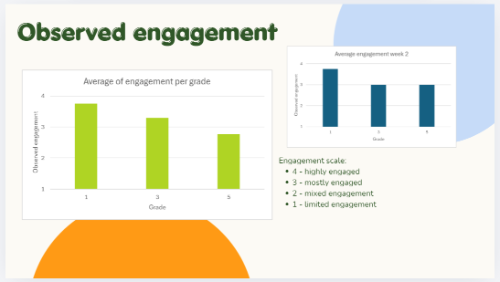
Engagement varied somewhat by grade. First-grade students were consistently enthusiastic and responsive from the beginning. Participation was initially more reserved in the third and fifth grade classrooms, but fifth grade engagement increased noticeably during the second week.
That increase may be important. It suggests that students’ familiarity with the activity format—and teachers’ growing comfort leading it—can influence participation. A routine that takes only a few minutes may become more effective as students learn what to expect and begin to see lunch reflection as a regular part of the day.
Overall, while engagement differed by grade, most students remained actively involved, particularly once the routines became familiar.
Teacher perspectives
For teachers, the micro-activities needed to do more than engage students; they also had to fit into an already busy school day. Teachers consistently described the activities as quick, simple, and easy to implement.
“I could do this for the whole year”
-participating teacher
Teachers also valued the connection between classroom and cafeteria experiences, noting that the activities offered a rare window into what students experience during lunch and created opportunities to revisit those moments afterward. Briefly revisiting those experiences afterward created opportunities to turn an ordinary meal into a moment of scientific observation, conversation, and reflection.
"[The lessons] add a bit of fun to the day"
-participating teacher
Looking forward
This pilot activity revealed that CRUNCH Lunch has the potential to create meaningful change in the way students interact with school lunch. The use of STEM-based education provides students with an interactive and intriguing foundation to create connections between the food they eat and the world around them. For educators, CRUNCH Lunch can provide resources that are small enough to fit into the school day, but meaningful enough to change how students see the food and the science that are already a part of their daily lives.
For more information on the CRUNCH Lunch program and additional resources, please visit the CRUNCH Lunch Micro-Activities or email crunchlunch@tc.columbia.edu