By Alice Wilder (Ed.D. ’98, Educational Psychology)
Growing up, I didn’t see myself as a learner.
As a student, I lacked passion for school, mostly earning Cs. I quietly decided that “real learners” were the kids who aced tests and raised their hands without hesitation. I was curious but shy, and school felt abstract and unrelatable.
That all changed during my freshman year at Skidmore College, when my psychology professor, Mary Ann Foley, told me, “I like the questions you ask.”
With a few words, she transformed my life, recognizing and naming how my mind worked as a strength.
She invited me to work in her memory and cognition lab. Sitting with elementary-age kids, asking questions and listening to their answers, I felt something: deep engagement.
From that moment, I became a lifelong learner.
When I say learner, I don’t simply mean a student in a classroom. Learners are thinkers, explorers and risk-takers who see themselves as curious, capable and continually growing. They believe their ideas matter.
A learner’s mindset begins with feeling seen and heard and confidence in who they are and what makes them distinctly themselves.
A learner’s mindset begins with feeling seen and heard and confidence in who they are and what makes them distinctly themselves.
As I’ve helped design curricula for children’s television, one belief has guided my work: To make anything for children, we must truly see them. How do we get there? By asking for their opinions and listening — not by assuming what they know, believe or feel. Most adults simply don’t remember what it’s like to be a child.
The same is true for parents and teachers. When we jump in to fix things, explain everything or assume we know what a child means, we can accidentally talk over the very thinking we want to nurture. When we slow down, ask questions and listen, we learn — and become better guides in their learning.
My undergraduate experiences — and the movie Big — helped me see myself differently. Watching Tom Hanks’s character Josh explain kids to adults, I realized I wanted to be that adult in the room — one who thought like a kid, helping writers, creators and producers remember what it was like to be our audience’s age.
That mission led me to Teachers College, where the Educational Psychology* program provided the tools to create educational products for kids using children’s voices, child development, instructional design and research methods.
(Photo: Chelsea Loren)
In Joanna Williams’s reading and language lab, I learned by studying children, speaking with 12–14-year-old nonreaders, asking questions and discovering their interests.
I studied the science of learning, including the effectiveness of storytelling, emotion, scaffolding, repetition, metacognitive “wrap-ups,” hands-on exploration and concrete examples. I learned how strong instructional design can transform abstract ideas into meaningful understanding.
As adults, we can design experiences for positive impact by using the science of learning. It starts with a mission and setting specific goals. Then, ask questions and listen to understand your audience – reflecting their input into relatable, developmentally appropriate, emotional stories.
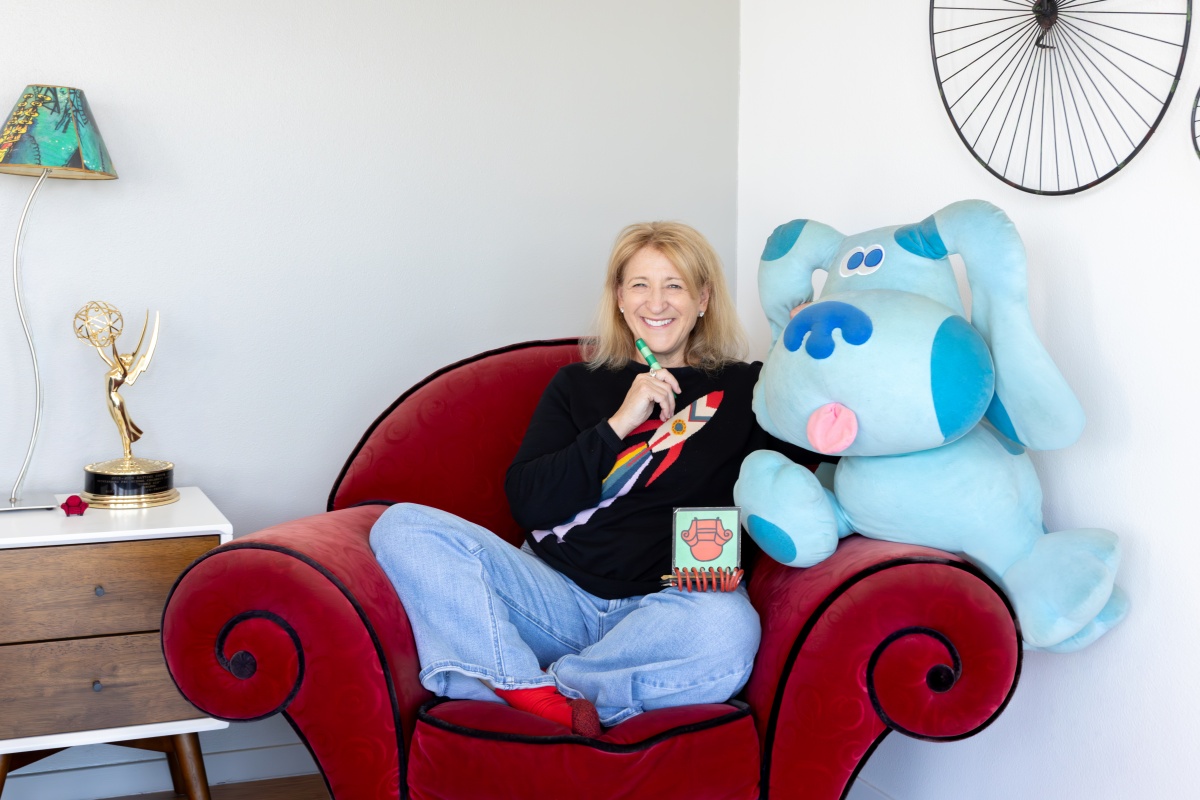
On shows like Blue’s Clues and Super Why!, we didn’t just rely on academic research; we brought scripts, animatics, and finished episodes to children before they aired, assessing what they liked, where they got stuck, and their learning.
But the ultimate test happens after the screen goes off: How do children transfer what they’ve learned to real life? In one session, a preschooler watched an episode with a shape game. Later, they pointed to a light switch plate on the wall, identifying it as a rectangle. That transfer — from screen to real life — is the ultimate form of learning.
If a child thinks, “They get me. I understand this. I can figure things out,” we’ve succeeded.
When we invite children into the process, something powerful happens: They feel like they matter. They become empowered and open to seeing themselves as learners. That’s the real magic.
Tumble Leaf, where quirky characters explore and experiment in nature, promoted curiosity and modeled learning science through play. We repeated the phrase “Let me figure this out!” as a way to encourage preschoolers to use the phrase when they encountered an obstacle in real life.
For Cha-Ching: Money Smart Kids, we asked children about money and learned that many financial concepts, like earning and spending, are abstract, so we created episodes to make those ideas concrete. One showed every object in a house labeled with a price tag, making the cost of living tangible and relatable.
When we invite children into the process, something powerful happens: They feel like they matter. They become empowered and open to seeing themselves as learners. That’s the real magic.
Learning, at its best, is energizing — it’s dopamine. Whether kids are watching high-quality educational TV, playing outside or sitting in a classroom, adults can help recognize and ignite the learners children already are.
I know what it feels like to move through school without that identity — and how powerful it is when an adult listens and recognizes your thinking as valuable.
My experiences sparked a lasting conviction: No child should grow up thinking they are not a learner.
Alice Wilder (Ed.D. ’98, Educational Psychology*) has more than three decades of experience in children’s educational programming as a producer and head of research.
*Editor’s Note: Teachers College has since renamed this program Psychology in Education.