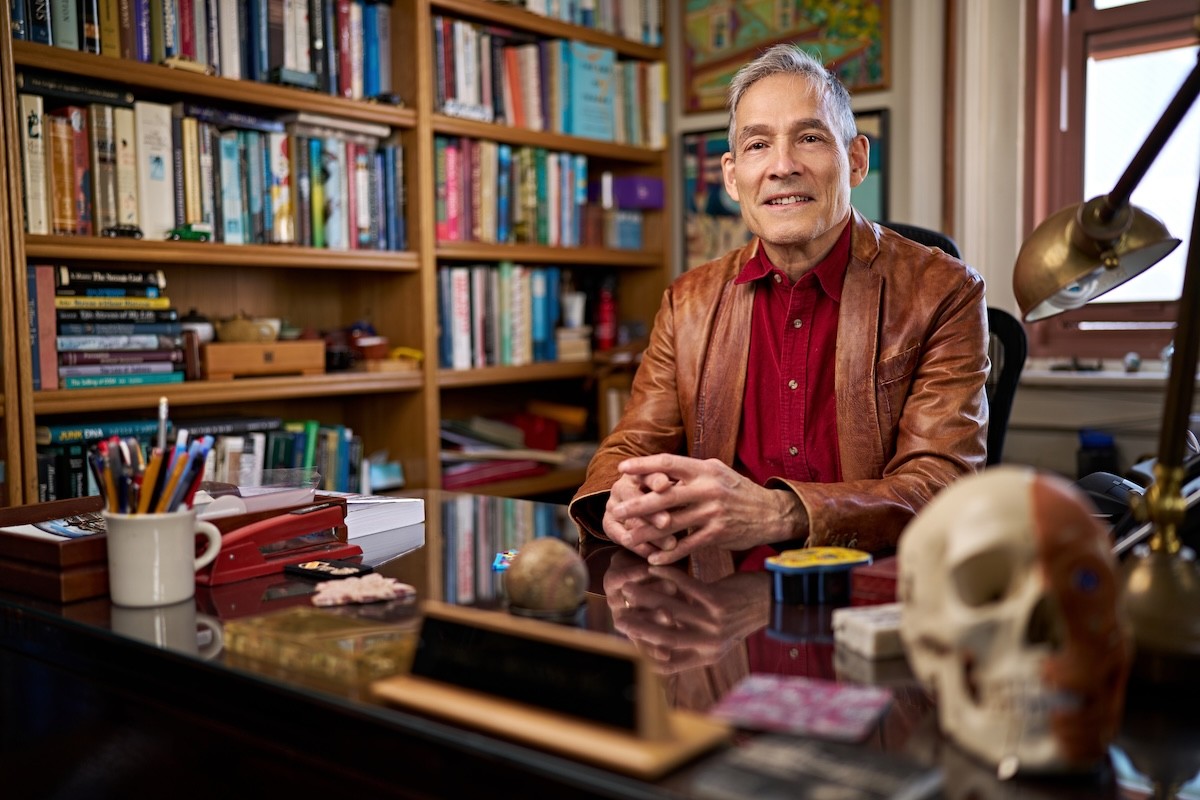
What allows someone to overcome the visceral pain that too often accompanies life itself? For more than three decades, George Bonanno — Professor of Clinical Psychology — has reframed the narrative about individual responses to trauma, loss and grief. This spring, the American Association for the Advancement of Science named him a fellow, one of the most distinct honors in the scientific community. But before the expert broke new ground in his TC research labs, Bonanno ventured on a nonlinear path to his academic career that may have subliminally influenced his later research pursuits. In his youth, the future psychologist spent a decade hitchhiking from his native Illinois to the West, working as a farmhand, factory cleaner and itinerant fruit picker.
“I left home at 17 to see the world and be something different,” says Bonanno. “At the time, my life was fairly bleak. I had barely graduated [from] high school.”
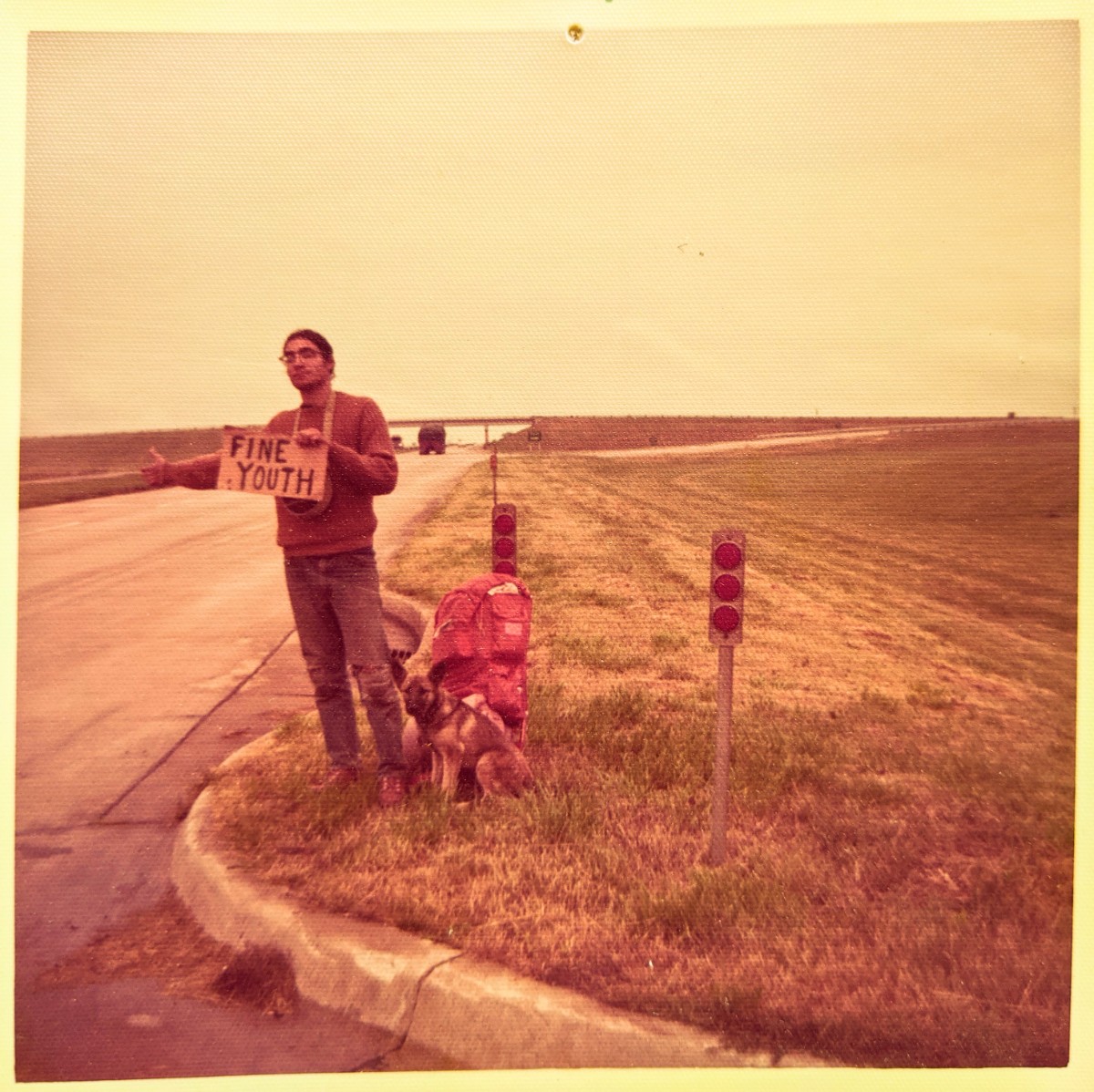
Bonanno hitchhiking in 1974. (Photo courtesy of Bonanno)
Raised in a Chicago suburb in what he describes as a troubled and sometimes violent home, he has only recently realized how his interest in resilience may have had roots in those early adventures. Paradoxically, the hardships he experienced on the road yielded a surprising insight that Bonanno acknowledges lay dormant for a while. While on the road with his dog, one morning, “I woke up and felt ‘everything’s just fine. The universe is okay, and you’re fine.’”
There was more to come.
“A few years later, I was in a small town in Washington State,” recalls Bonanno, who is currently working on a book that is part autobiography and part science. “I went to a park to sleep in the bushes. I had no money, and I was hungry. There was a restaurant nearby, and I offered to help and clean up in exchange for food. They gave me a meal, and the next day I found work picking fruit. I realized I’ll always be okay; I’ll always be able to find a solution and do it. That was my very own epiphany.”
Insight on Bereavement and Trauma
Bonanno, whose honors also include lifetime achievement awards from the Association for Psychological Science and the International Society for Traumatic Stress Studies, has gone on to study 9/11 survivors and veterans, to assess the impact of their traumas. He advances this research at TC’s Loss, Trauma and Emotion Lab as well as at the College’s Resilience Center for Veterans and Families, which supports veterans and their families in their transition to civilian life. Both ventures allow Bonnano to also support the next generation of clinical psychologists — TC doctoral and master’s students — in building hands-on experience in research and patient care to support resilience amid trauma.
Resilience — including its defining attributes and the conditions that allow it to flourish — has come to captivate Bonanno and those who see his research as a pathway to understanding human survival itself. This work began when Bonanno was a postdoctoral research fellow at the University of California in San Francisco, where Bonanno interrogated the then-popular concept of ‘delayed grief.’
“I came from a different perspective — that people were assuming grief where there isn’t any,” says Bonanno, who used big data sets to counter the concept of delayed grief.
Challenging the norms around grief and trauma were not initially embraced, he recalls.
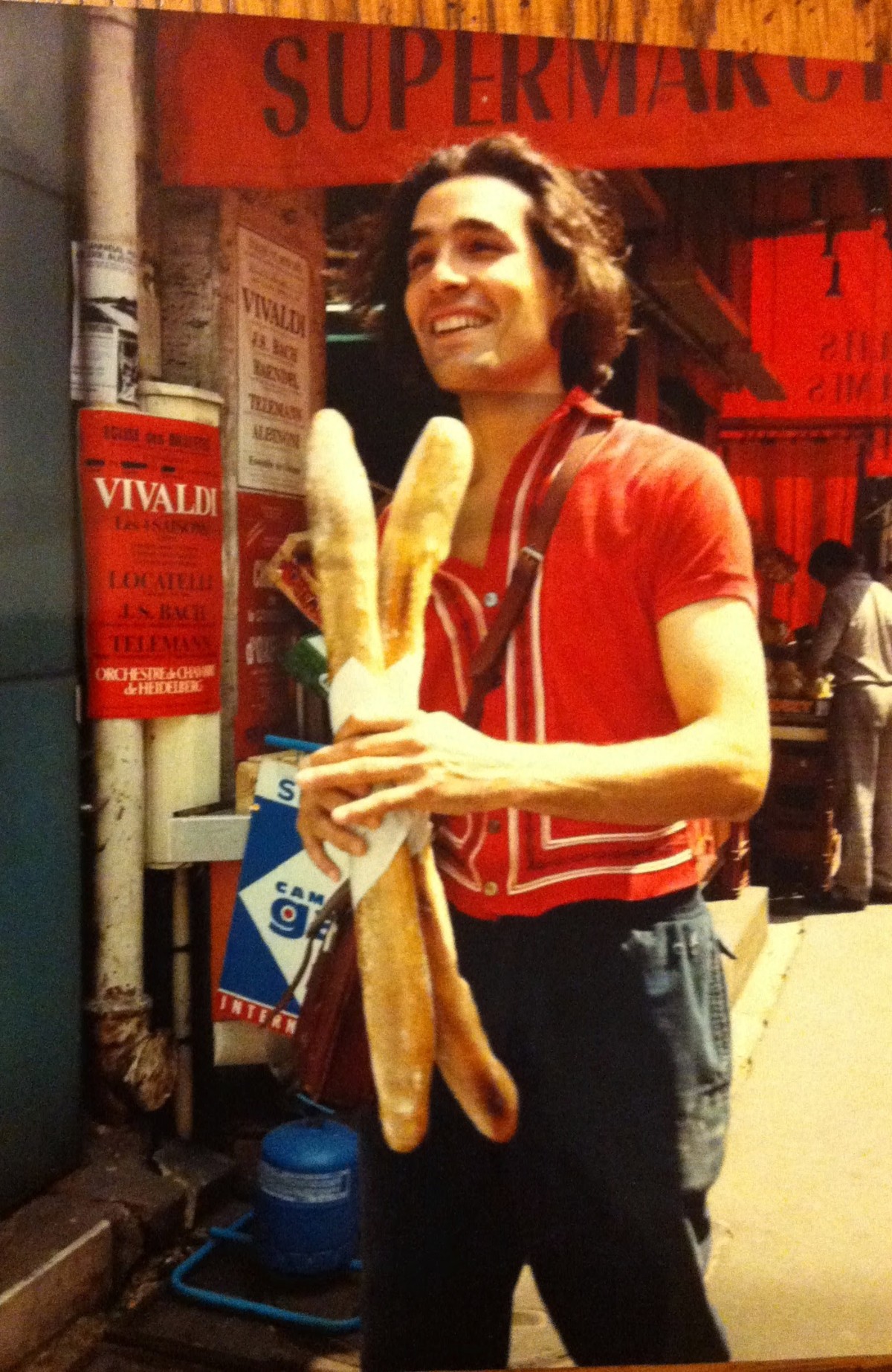
Bonanno in Paris in 1980. (Photo courtesy of Bonanno)
“Those who were resilient, in grief, were ignored” by a prevailing narrative among professionals who studied grief that there was an expected response, explains Bonanno. “People didn’t want [our findings on resilience] to be true . . . we got pushback. The trauma world was openly disdainful.”
Uncovering why some people responded to loss and trauma in more resilient ways than was predicted became a question that intrigued Bonanno and led him to further investigation.
“When you try to figure out what resilient people do, you’re looking at how they do problem-solving, regulating their emotions — lots and lots of things,” says Bonanno. “The resilience paradox is that you can’t predict it. What works in one situation won’t necessarily work in another. Every time there’s a challenge, an individual has to identify what’s happening, what can I try, and correct as needed. Not everything always works, and not everything doesn’t work all the time. You need to understand what it is — break the challenge into different pieces, and see ‘this piece works for this,’ and put together a model. It’s a way of thinking.”
Reflecting on Flexibility
What Bonanno and his team at the TC Loss, Trauma and Emotion Lab discovered was that resilience wasn’t static. Individuals who in one traumatic situation responded in a particular way didn’t necessarily respond the same way to a different challenge. In one study, working with veterans and people who had a diagnosed psychopathology, Bonanno and Mark Shuquan Chen (Ph.D. ’24), now at Harvard, texted participants four times a day for three weeks to give rapid responses to how they handled difficult challenges.
“There are three major components: Tell us what you did, did it work, and what did you do if it didn’t work,” says Bonanno. “Instead of thinking about the large picture — about PTSD, anxiety — it’s thinking: ‘What’s the problem? What’s the solution? What’s the actual problem to solve?’ It’s like a decision tree. Do self-talk to get yourself focusing on what’s happening right now, what can I do about it, and what tools I can use.”
We’re going to get through this. We’ll live through this by being true to who we are.
Received wisdom around resilience was that those who demonstrated this quality were always able to access this ability.
Not exactly. Nor is resilience pre-wired into some humans’ genetic code.
“The big difference [in my research] is the correction part,” says Bonanno. “We’ve done the only research on the correction part, of trying something else. Even healthy people use trial and error. The myth about a resilient person is that they don’t correct.”
Takeaway
During these unstable and unpredictable times, it can seem tempting to descend into despair and resignation. Bonanno urges a different response.
“We’re going to get through this,” Bonanno asserts. “We’ll live through this by being true to who we are.”