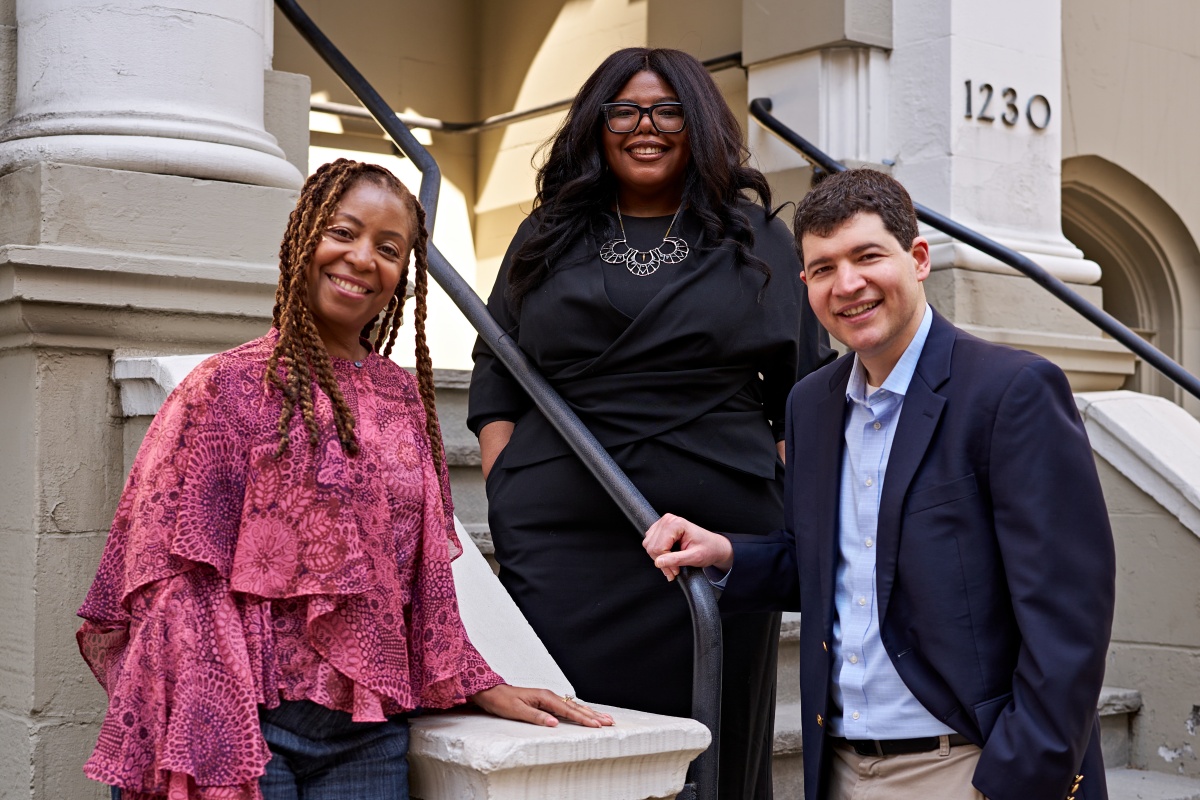
TC faculty’s research in psychology helps to improve mental health outcomes and transform pathways for all people across schools, communities and organizations. Among those leading that critical work are Ayorkor Gaba, Assistant Professor of Clinical Psychology; Patricia Hewlin, Professor of Social-Organizational Psychology; and Ben Lovett, Professor of Psychology and Education, who offered us a closer look at their scholarship.
Improving Mental Health Systems
While more than 61 million Americans are struggling with their mental health, barriers to access mean that just 52 percent of that population receive any care. For many individuals, untreated symptoms and limited access to care end in incarceration. To help address these challenges, Ayorkor Gaba, Assistant Professor of Clinical Psychology, is reimagining how we think about co-occurring disorders as well as behavioral and mental health interventions for people in the criminal legal system.
Community input is central to Gaba’s research, which seeks to create more effective interventions. “The people who are being served are maybe consulted for a focus group, but they are [often] left out of the experience of developing interventions, policies or practices,” says Gaba, founding director of the Behavioral Health Equity Advancement Lab (B-HEAL). “[So] it’s important to me to make sure that community members are part of the life of a project.”
Why It Matters: For Gaba, addressing structural challenges is key to combating the mental health crisis and reducing recidivism. “Individual clinical work is amazing. It has a great impact. But if you’re not looking at the larger structural issues that are causing people to be ‘sick,’” says Gaba, “it’s almost like you’re putting a Band-Aid on a larger wound.”
What’s Next: Gaba is currently part of a project funded by the Substance Abuse and Mental Health Services Administration (SAMHSA) that will create a triage system for at-risk youth designed to provide behavioral health support through partnerships with several New York City community organizations. She is also designing a statewide training for Massachusetts specialty courts to identify where and how inequity and bias are impacting the legal system.
If you’re not looking at the larger structural issues that are causing people to be ‘sick,’ it’s almost like you’re putting a Band-Aid on a larger wound.
In addition to teaching and mentoring the next generation of mental health professionals, Gaba is also supporting development of sustainable interventions for marginalized youth. She is one of several faculty leading a new, community-rooted collaborative project to help young people access preventative mental health support in NYC schools as part of TC’s Public Good Initiative. In the future, Gaba plans to examine the rising use of AI for mental health support as well as the relationship between substance use, mental health and physical health disorders.

Teachers College students regularly work alongside faculty — including Gaba, Hewlin and Lovett. In supporting their research on campus and beyond, students help advance key findings — and build their own expertise. (Photo: TC Archives)
Creating More Authentic Workplaces
In a time of greater and more pervasive political polarization, how can someone effectively navigate the pressures to both conform to an office culture and be authentic to their own worldview? This question is the core of Staying True to You, a forthcoming book from Professor of Social-Organizational Psychology Patricia Hewlin, which expands upon her decades-long research on authenticity and self-expression in the workplace and introduces the concept of a “middle self,” or finding a balance between authenticity and conformity. “Authenticity is not always good, and conformity is not always bad,” says Hewlin, who has studied this relationship across industries in the U.S., Canada and several countries in Asia. “Understanding how we can thrive in the middle allows us to not only enhance our well-being, but it can enhance the well-being of others.”
Why It Matters: Hewlin’s research has shown that suppressing one’s values and perspectives in order to “survive and succeed” in the workplace, what she calls “creating facades of conformity,” is emotionally exhausting, reduces engagement at work and increases attrition. While authentic self-expression is found to boost general life satisfaction, Hewlin has also observed that, for marginalized groups, being fully authentic can cause harm if their expression is considered unprofessional.
Understanding how we can thrive in the middle allows us to not only enhance our well-being, but it can enhance the well-being of others
“Certain authentic expressions of people who are considered racial or cultural minorities — such as cultural or religious attire, hairstyles and speech patterns — can receive a backlash,” says Hewlin. “[While] it is critical for organizations to foster environments for authentic self-expression, being true to oneself also requires discernment and selecting contexts and relationships that safeguard our psychological and emotional reserves.”
What’s Next: As she continues to explore “the middle self” through her research and organizational consulting roles, Hewlin plans to expand her scholarship to include K–12 students’ perspectives in order to help young people avoid the challenges adults face as they navigate the balance between conformity and authenticity.

(Photo: iStock)
Finding Better Solutions for Test Anxiety
Feeling nervous before taking a test is common, but for some students, the fear of failure is overwhelming. In an attempt to help, many schools have implemented avoidance-focused accommodations where students can opt out of the stressor. However, these accommodations may end up worsening anxiety rather than improving it, according to Ben Lovett, Professor of Psychology and Education, who is developing more effective support measures for anxious students. His 2025 book Overcoming Test Anxiety, co-authored with Harvard’s Alex Jordan, offered evidence-based interventions for mental health providers and educators to help students build motivation in school while finding ways to manage their anxiety.
Often people come to treatment with beliefs about anxiety that might not be accurate or rational.
Lovett, associate director for the Education for Persistence and Innovation Center (EPIC), is now expanding that scholarship to understand how students believe anxiety affects their performance. While research suggests that feelings of anxiety don’t have direct negative effects on performance, there is little scholarship examining how students think about that relationship, a gap that Lovett and his doctoral student, Hayley Landman, are seeking to fill.
Why It Matters: Gaining a stronger understanding of students’ perceptions is a key element of creating more effective psychological interventions so that practitioners can better support students who are struggling. “Often people come to treatment with beliefs about anxiety that might not be accurate or rational,” says Lovett. “Systematically examining the perceptions of high school students, college students and even parents will give us ideas about what we can target in therapy.”
What’s Next: While Lovett is continuing to develop interventions for test anxiety, he is also part of an Institute of Education Sciences research grant project examining testing accommodations for National Assessment of Educational Progress exams to better tailor them to students’ needs and reduce interruptions in instruction. He is also currently working on projects related to the Woodcock-Johnson Battery, a collection of tests commonly used to diagnose learning disabilities.