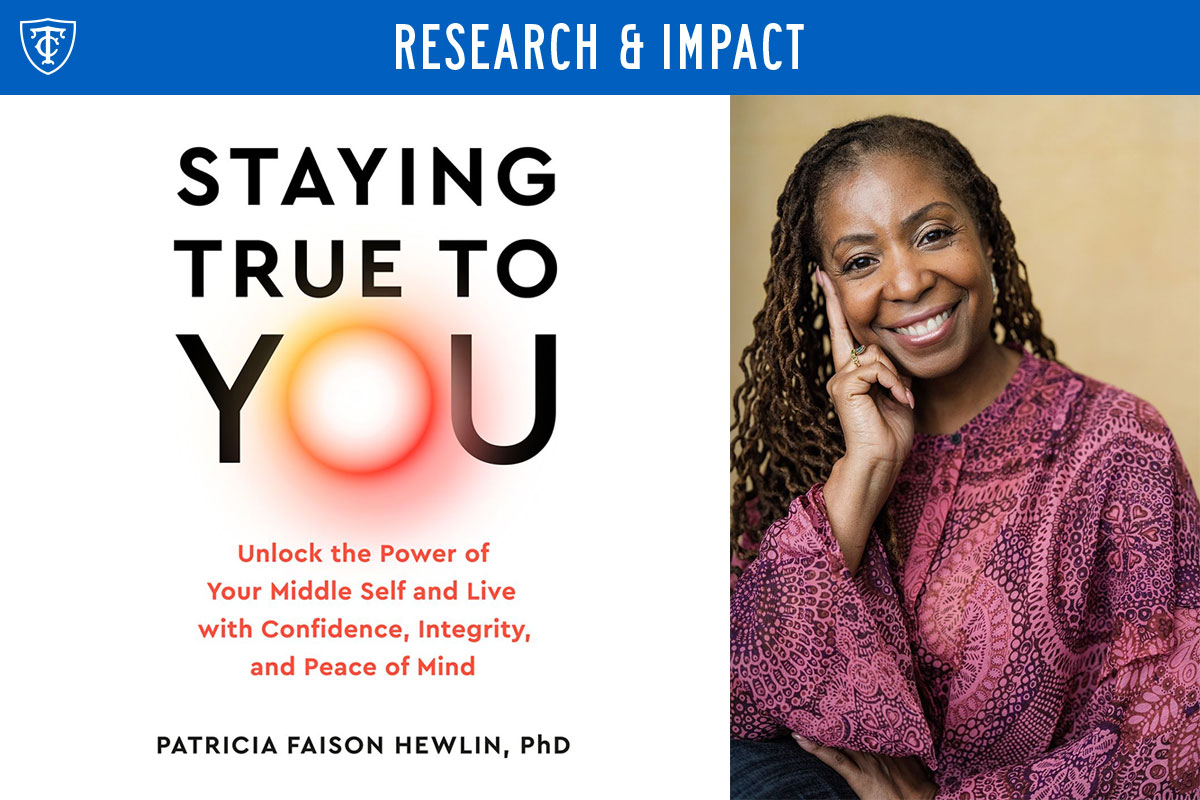
Starting a new job should be a time of excitement and anticipation, but some employees are instead questioning if they will need to change their hair, hide their beliefs or speak differently to feel accepted. While many struggle to balance workplace expectations with personal identity, a new book from TC’s award-winning organizational psychologist Patricia Hewlin, Staying True to You, offers a path to inner tranquility: the middle self, which she describes as a continuum between positive compromise and social liberty.
Staying True to You builds upon Hewlin’s more than 20 years of research on workplace authenticity to help employees and leaders find a fulfilling balance that allows you to thrive at work while maintaining authenticity. “The middle self relies on the daily habit of recognizing your non-negotiables and negotiables,” says Hewlin, Professor of Social-Organizational Psychology. “It ensures that when you adapt in a professional setting, you are flexing your style without selling out your core beliefs.”
Why does finding balance matter?
According to Hewlin’s research, 30 percent of employees feel pressure to create “facades of conformity,” which results in emotional exhaustion, decreased engagement and ultimately leaves people feeling disempowered. At the same time, being too authentic can make people feel less accepted and more isolated, especially if their vulnerability is met with negativity.
By finding a way to the middle self, Hewlin argues that we can live in harmony and ultimately find inner peace, which is especially relevant considering the rising polarization dividing our society. “The disempowered self diminishes us, weakens relationships and lessens our potential to help others,” writes Hewlin in the book. “The middle self fortifies and boosts us and the people around us.”
How do we find the middle-self?
There is no one-size-fits-all method to entering the middle self, however, Hewlin identifies several essential elements: understanding the three bedrocks, knowing your values and, perhaps most critically, having a circle of champions (COC).
Introspection, temperance and discernment are the three crucial skills that Hewlin describes as “bedrocks” to the middle self. They work in concert to develop the “middle self muscle” and mastering these skills makes it easier to move smoothly between conformity and authenticity. By knowing ourselves, through introspection, we are able to discern the impact a relationship or situation has on us in real time and then use temperance to determine how to act.
Knowing one’s values is another critical component because values act as a “yardstick” for determining if our actions align with our beliefs. Staying True to You guides readers through 10 commonly-held values, helps them determine which beliefs are fixed and which are more malleable and uses real-world examples to demonstrate how we can use our values to better navigate professional and personal relationships.
The final component to finding balance is having a supportive community; what Hewlin calls the Circle of Champions (COC). A COC provides space to be ourselves, while also getting loving feedback and perspective about our actions. “Without a trusted community, it becomes much easier to internalize toxic workplace messages, fall into perfectionism or rely on performative masks because you have no safe space to drop the act,” explains Hewlin. “Building a support system takes time, but grounding yourself in integrity first makes it easier to attract and recognize real champions.”
Dive deeper into the middle self with Staying True to You, available at all major booksellers.