
By Ruth Vinz, the Enid & Lester Morse Professor in Teacher Education
Twenty-five years later, what I remember first about September 11, 2001, is not a single event but the ache of not-knowing.
In those first hours and days, none of us knew the dimensions of what had happened, what might happen next, or even how those closest to us were faring. TC’s president at the time, Arthur Levine, and I spent time in the hallways of the College, in the lounges of the dorms where people gathered because they did not know where else to go. We watched the towers fall over and over again. We stood on fire escapes and upper landings and watched the smoke drift across the sky — for days, it seems now. The bridges and tunnels were closed. Members of our community were stranded — away from TC or in the neighborhood. We made lists: Who could not get home? Who needed somewhere to stay? Who had a room, a sofa, a way to make space for someone else? What food was available in the cafeteria to share with everyone?
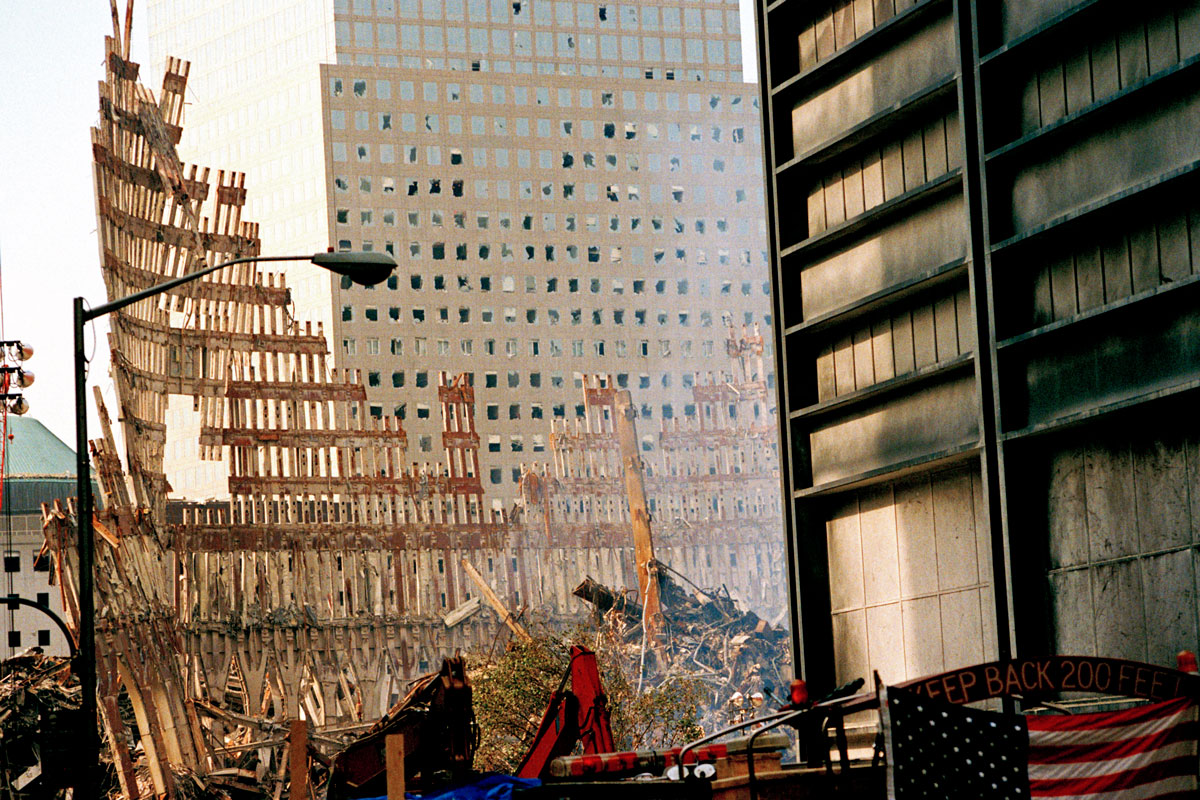
(Photo: The steel remains of the South Tower of the World Trade Center; iStock)
And then there were the schools. Almost immediately, my mind began traveling downtown — to the schools near the towers, to classrooms where our students were teaching, to teachers, and children in schools where members of our faculty and students worked every day. Where were they? Had they gotten out? Were children with their teachers? Could families reach them? How were teachers carrying responsibility for frightened children while frightened themselves? Teachers College sat on 120th Street, but our lives and work were threaded through schools and communities across the city. On that morning those threads felt terribly fragile — and terribly real.
The lists. The sofas. The cafeteria. The phones. The smoke. The waiting. And the schools.
Always the schools.
Those acts were practical and immediate, but they were also something more. In a moment when the scale of the violence was almost impossible to comprehend, people responded through the human scale of care. Someone offered a place to sleep. Someone remained with a person who should not be alone. Someone searched for news of a colleague, a student, a family member or a stranger. Teachers accounted for children, comforted them, improvised ways to keep them safe, and stayed when families could not arrive. Fear and uncertainty were everywhere, but so, too, were the “small acts of generosity” through which people made themselves known to one another.
There is something particular about New York in such moments. We are a city often represented through toughness, speed, impatience, self-sufficiency. And yet beneath — or perhaps within — that toughness is an attentiveness to other people that we do not always name. New Yorkers move through the city appearing private, absorbed, intent on getting somewhere. But we are reading one another all the time: who needs directions, who needs help carrying something up subway stairs, who seems frightened, who should not be left alone. In moments of crisis, that mostly unspoken awareness becomes visible. For a little while, the anonymity of New York becomes intimacy.
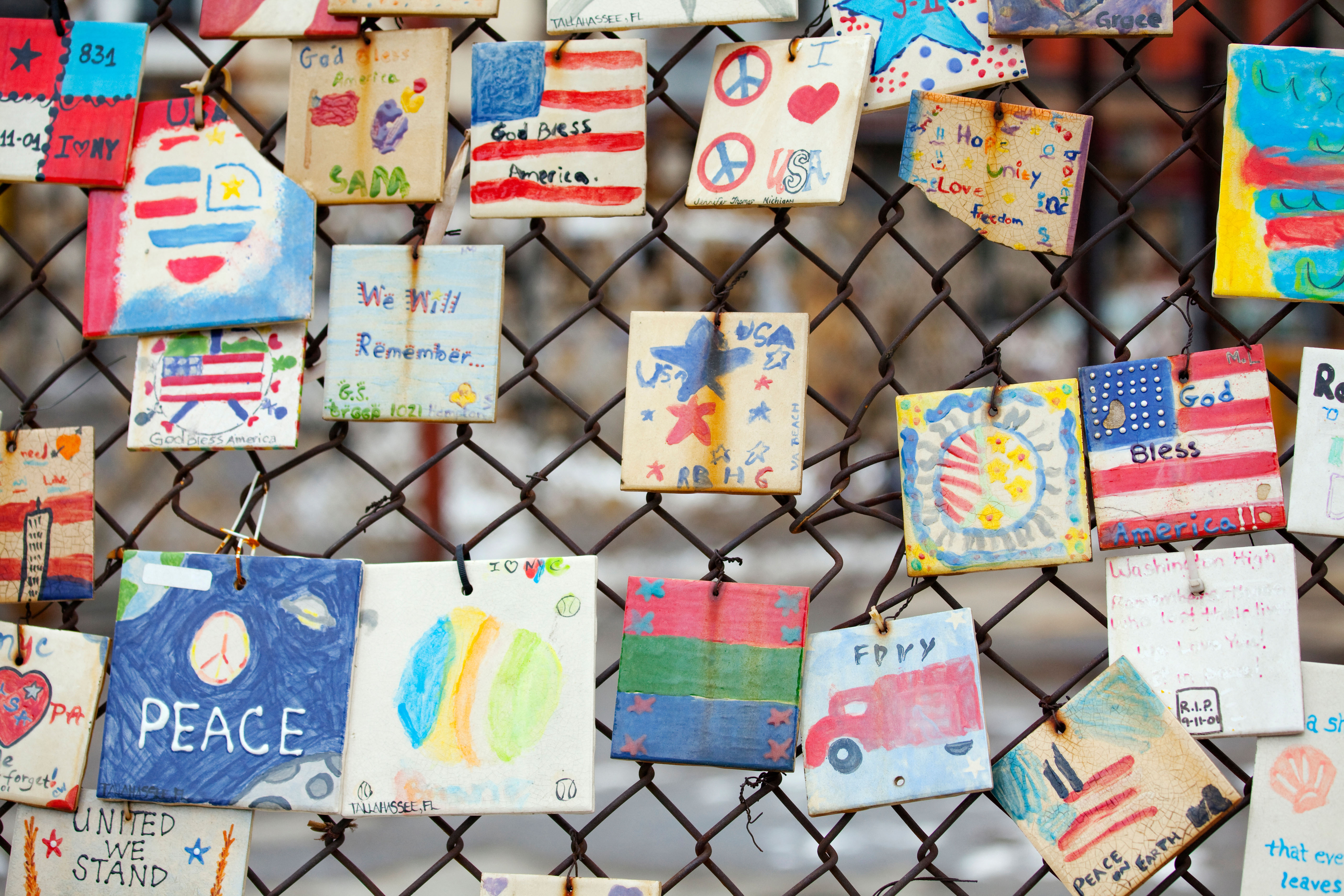
Students commemorated the tenth anniversary of September 11th with ceramic titles hung in Greenwich Village. (Photo: Philippe Renault/Alamy)
September 11 brought the city together, but I hesitate even now to make the experience too consoling. Coming together did not erase the deaths, the fear, the anger, or the injustices that followed. Community was not a permanent achievement secured by tragedy. It was something people enacted, repeatedly and imperfectly, through choices about how to respond to one another. We saw that capacity again during the pandemic, when New Yorkers found ways to care across distance and isolation. We see it more joyously when a victory spills out of an arena and strangers celebrate together in the streets. In such moments the boundaries around our individual lives become, briefly, more porous. We remember that a city is not only a place we inhabit alongside one another; it is a life we are continually making with one another.
Community was not a permanent achievement secured by tragedy. It was something people enacted, repeatedly and imperfectly, through choices about how to respond to one another.
Those who were in New York on September 11 do share a particular bond, although it is difficult to name without overstating or simplifying it. It is not that everyone experienced the day in the same way. Proximity, loss, age, work, family, neighborhood, race, religion and countless other circumstances shaped what each person lived. Some people lost those they loved. Some witnessed events directly. Some waited for hours or days for news. Some carried responsibility for the safety of others while afraid themselves.
Perhaps the bond lies not in sameness but in recognition. Those who lived through those days recognize something in one another that does not need to be fully narrated: the altered cityscape, the acrid air, the missing-person notices, the silence where ordinary city noise had been, the sudden awareness that a familiar world could become unfamiliar in a morning. A memorial can teach and commemorate. A documentary can preserve images and testimony. But lived experience resides elsewhere too — in the body, in sounds and smells and gestures, in routes through the city, in moments of waiting that may return unexpectedly even decades later.
Perhaps what is shared is less a story than an embodied knowing: I know something of the world you are remembering, even if neither of us can entirely say it.
On September 13, two days after the attacks, we arranged a breakfast gathering so that the full Teachers College community could come together. I began with words I had written that morning: “Death is a small noun and carries much weight.” I remember the candid sunlight. It was one of those startlingly beautiful September mornings in New York, and the beauty felt almost unbearable. I wanted, impossibly, to begin Tuesday morning again — to return each person to the ordinary beginning of that day, before the phone calls, before the smoke, before the missing, before the dead.
And so I asked: “Is there a more gentle way to go on?”
I am not sure I knew, on September 13, exactly what I meant by gentle. Perhaps it was less an answer than a plea. I knew only that I did not want grief to teach us hatred. I did not want fear to decide whom we would become. I wanted to know whether it was possible to carry the dead with us without making more death.
I did not mean gentleness as softness, passivity, or withdrawal from what justice requires. I meant — and perhaps understand more clearly now — something closer to an ethical discipline: protecting one another without deciding that some lives were less grievable than others; resisting the desire for certainty, retaliation and division; remaining capable of seeing the human being before us when fear urged us toward categories of “us” and “them.”
Twenty-five years later, I cannot say that we have found that more gentle way. There have been acts of extraordinary courage, generosity, solidarity and repair. There have also been wars, displacements, renewed hatreds, political divisions and forms of violence that demonstrate how readily fear can be mobilized against others. We have come closer in particular moments and moved terribly far away in others. Perhaps gentleness is not a destination at which a society arrives. Perhaps it is a way of proceeding, a difficult practice chosen again and again — and protected by the institutions, relationships, classrooms and forms of public life that allow us to keep recognizing one another.
Three weeks after September 11, in the State of the College address on October 4, I found myself looking backward in order to think forward. At the end of World War I, Teachers College philosopher William Heard Kilpatrick addressed students gathered on the College steps. He told them that what had begun as a conflict among nations had ended as “a war against war” — and that building a new and just democracy would depend upon teachers.
That October I said, “The winds whisper war again.” Twenty-five years later, I find myself wondering whether Kilpatrick is still standing there. Or perhaps the question is whether we are.
His words carry both hope and warning now. Education has not prevented war, intolerance, dehumanization, or atrocity. We should be wary of claiming for education a redemptive power that history does not support. Knowledge alone does not make people just. Schools can reproduce prejudice, exclusion, fear and inherited certainties as readily as they can interrupt them.
Education can help us understand that democracy is not merely a form of government. It is a difficult practice of living with others.
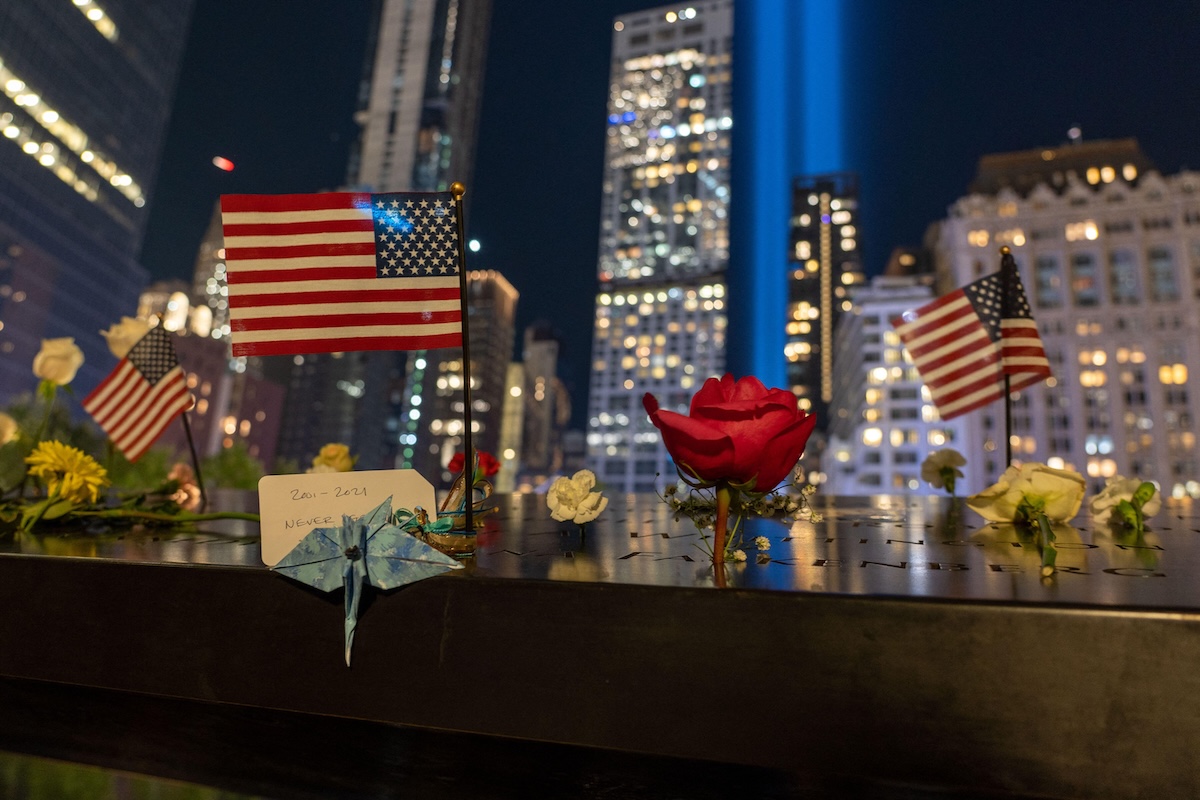
Tributes to victims captured at the 9/11 Memorial in lower Manhattan. (Photo: Ron Adar/Alamy)
Yet education remains one of the places where another future can be rehearsed and made imaginable. It can help us attend closely rather than react reflexively; encounter histories that trouble what we thought we knew; and remain in the presence of difference without needing to erase it. Education can help us understand that democracy is not merely a form of government. It is a difficult practice of living with others.
The question I asked on September 13, 2001, remains the question I would ask now: “How will we as a community committed to education help write the future?”
Twenty-five years have made me less certain that education can provide an answer. They have made me more certain that what and how we teach matters profoundly. Education is, after all, one of the places where we practice ways of being in the world with others. We can cultivate habits of certainty or habits of questioning; habits of indifference or habits of attention; ways of encountering difference as threat or as an invitation to listen, wonder, and learn. We can help make imaginable a world in which care is not simply our response to catastrophe, but one of the ways we learn to live.
And perhaps I understand the teachers in those downtown schools differently now, too. On that Tuesday morning they could not know what the future would ask of them. They could only attend to the child in front of them, find the next safe place, make the next phone call, tell the next frightened student: I am here. Stay with me. We will find a way. There is something profoundly educational in that—not a lesson delivered, but a way of being answerable to another person when there is no lesson plan for what has happened. This, too, was teaching: Attend to the person before you. Stay near. Make room. Listen. Do not abandon one another.
No memorial, no anniversary, no act of remembrance can return anyone to the ordinary beginning of September 11, 2001. But there is always another morning — and another classroom — in which we practice what we will carry forward: whose histories we will know, whose suffering we will recognize, what we will refuse to turn into hatred, what forms of attention and care we will offer one another.
We cannot begin that Tuesday morning again. No memorial, no anniversary, no act of remembrance can return anyone to the ordinary beginning of September 11, 2001. But there is always another morning — and another classroom — in which we practice what we will carry forward: whose histories we will know, whose suffering we will recognize, what we will refuse to turn into hatred, what forms of attention and care we will offer one another.
Twenty-five years later, I am still asking whether there is a more gentle way to go on. Perhaps education cannot give us the answer. But it can help us cultivate the habits of mind and heart with which we keep reaching toward (an)other future.