Treatment
What is AAC?
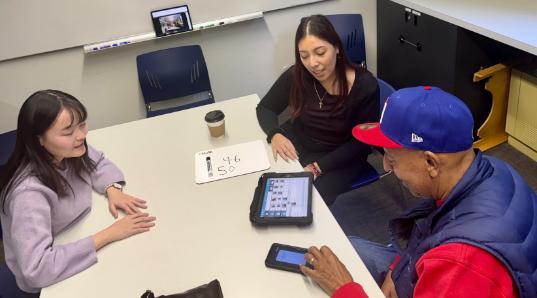
AAC stands for Augmentative and Alternative Communication. It includes all the ways people communicate besides verbal speech. This can be as simple as gestures, facial expressions, or pointing to pictures, and as advanced as using a speech-generating devices (SGDs). AAC helps people of all ages share their thoughts, needs, and ideas by augmenting and supplementing verbal communication skills.
What We Do:
- AAC/Speech-Generating Device Evaluations
- Individualized AAC Therapy
- AAC Device Programming
- Family & Caregiver Training
Who We Serve:
- Children, adolescents, and adults who cannot use verbal speech alone to communication needs
- Families seeking AAC/SGD support
What We Offer:
- AAC Clinic Initiatives during the Fall & Spring Semesters: AAC/SGD Device Evaluations, AAC Progress Monitoring, Pediatric AAC Therapy, Aphasia AAC Therapy
- AAC Clinic Initiatives during the Summer A & Summer B: CommuniKitchen AAC Camp for Children, AAC ALS Clinic
What Is Aphasia?
Aphasia is a language disorder that happens when the parts of the brain responsible for language are damaged, most often from a stroke or head injury. It can change how a person understands, speaks, reads, or writes, even though their thinking and intelligence are still intact.
What Aphasia Can Look Like
- Trouble finding words, so speech may sound halting or “on the tip of the tongue.”
- Using the wrong words or made‑up words without realizing it.
- Difficulty understanding what others say, especially when speech is fast, noisy, or complex.
- Challenges reading or writing, from single words to longer sentences and texts.
What Aphasia Is NOT
- It is not a problem with intelligence.
- It is not the same as dementia, though a person could have both.
- It is not just “slurred speech” (that is more often due to dysarthria or other motor‑speech problems).
Common Causes
- Stroke (the most common cause).
- Traumatic brain injury.
- Brain tumors or infections affecting language areas.
- Some progressive neurological diseases (in a condition called primary progressive aphasia).
Why Early Help Matters
Speech‑language pathologists (SLPs) work with people who have aphasia to improve communication and to teach helpful strategies, such as using gestures, writing, drawing, pictures, or communication apps. They also educate family and friends so communication partners know how to support conversation, reduce frustration, and help the person stay involved in daily life.
What We Offer
At the Mysak Clinic, we offer a range of services for people living with aphasia and their care partners. We provide group therapy sessions in person and via teletherapy, a monthly Saturday Aphasia Program that meets on the first Saturday of each month (except August, September, and January), Care Partner Support Groups, and individual therapy sessions tailored to each person’s goals. Each year in July and August, we also offer a 4‑week Intensive Comprehensive Aphasia Program (ICAP) to provide more frequent, focused support in a short period of time.
The Applied Autism clinic offers speech-language therapy sessions in the Mysak Clinic to any individuals who identify as Neurodivergent and are seeking support from our team of SLPs and Graduate students. Our services are designed to be affirming, supportive, and responsive to individual communication needs. My team works with the client to determine goals in various areas including but not limited to executive functioning, reading/writing, expressive/receptive language, motor speech, transitions and pragmatic language.
Sessions will be provided by Panagiota Tampakis, SLPD, CCC-SLP and student clinicians in the Communication Sciences and Disorders (CSD) MS program at Teachers College in the Edward D. Mysak Clinic at Teachers College. Please contact Dr. Panagiota Tampakis (pdt2108@tc.columbia.edu) for more information and availability.
What services are provided?
Sessions will be tailored to the students’ identified areas of need in any of the following areas*:
- Communication (with a focus on academic language including but not limited to written language, understanding assignments, figurative language/non-literal language, email etiquette, etc.)
- Tools for Social Communication (this approach provides learners with the skills that they need to be able to communicate and navigate social interactions with confidence in their preferred way, as well as understand and advocate for their own needs and preferences. This way of teaching social skills supports individuals to develop positive relationships with others in a way which they enjoy without adding pressure, and which supports their needs and mental health. Topics may include but are not limited to interpreting body language, perspective taking, group participation, etc.)
- Self-advocacy (Topics include but are not limited to problem solving, setting boundaries, etc.)
- Executive functioning (Topics include but are not limited to time management, planning, prioritizing, self-monitoring, self-regulation etc.)
- Transitions (Topics include but are not limited to preparing for new experiences, flexibility, etc.)
*All sessions will be offered from a Neurodivergent-affirming approach; the speech-language pathologist (SLP) and student clinicians are aware that each client is an expert on their own experience. Sessions will be determined with feedback from the client on what they would like to work on rather than the SLP or student clinicians telling them what they should work on based on neurotypical expectations. It is our goal to hold space for everyone’s lived experiences and not make anyone feel that they need to be changed or different but rather we hope to provide supports to ensure everyone feels confident and successful in their own environments.
When will the sessions be provided?
Sessions will be offered during various times on Fridays.
What do the sessions cost?
All sessions are $25 for the semester.
How long will the sessions be?
The sessions will be 45 minutes each.
Will the sessions be in person or online?
There will be options for in person sessions as well as online session options. The in-person sessions will take place in the Edward D. Mysak Clinic at Teachers College.
How long do I have to commit to these services?
These sessions are for you, and we want to ensure that you’re getting the most out of them. We ask that you attend for 3-4 weeks before stopping, but you can of course stop at any time.
How will session plans be decided?
Dr. Tampakis and the CSD students assigned to each group will meet with the interested individuals before sessions begin to determine identified goal areas of interest. Based on the information obtained from that initial meeting, sessions will be planned and check-ins will occur every other week to ensure the sessions meet the expectations of the individual.
What are cognitive-communication disorders?
Cognitive-communication disorders involve difficulties with thinking skills that support communication, including attention, memory, problem-solving, organization, and word-finding. These changes can affect everyday tasks like following conversations, managing schedules, or expressing ideas clearly. They may occur after conditions such as stroke, traumatic brain injury, neurodegenerative disease, or chronic medical conditions (e.g., HIV).
What does treatment look like?
Treatment focuses on improving functional, real-world communication and cognitive skills, including:
- Memory and attention training
- Word-finding and discourse strategies
- Executive function (planning, organization, problem-solving)
- Use of compensatory strategies (e.g., calendars, apps, routines)
- Group-based therapy to support communication and social participation
What is dysphagia?
Dysphagia refers to difficulty swallowing, which can affect the ability to safely eat or drink. It may involve problems in the oral, pharyngeal, or esophageal phases of swallowing and can lead to complications such as aspiration, pneumonia, dehydration, or malnutrition. Dysphagia may occur in both adults and children due to neurological, structural, or developmental conditions.
What is a Pediatric Feeding Disorder?
Pediatric Feeding services at the Mysak Clinic support infants, toddlers, and children who are having difficulty eating, drinking, or moving toward age‑appropriate textures. Our clinicians provide comprehensive assessment and individualized treatment for children with medical, sensory, and motor‑based feeding disorders, including challenges with chewing, oral‑motor coordination, and safe swallowing. Families receive clear education, practical home programming, and coordinated care with medical and allied health providers to promote consistent progress across settings.
What does treatment look like?
Adult Dysphagia
- Swallowing exercises to improve strength and coordination
- Diet modifications (texture, liquid consistency)
- Compensatory strategies (postures, pacing)
- Instrumental assessments (e.g., FEES, VFSS)
- Education on safe swallowing and oral care
Pediatric Feeding & Swallowing
- Feeding therapy focused on oral-motor skills and sensory needs
- Caregiver coaching for mealtime routines
- Support for picky eating and feeding aversion
Summer Feeding Clinic: In June, our clinic offers a 4 week feeding clinic, specifically for children with motor‑based feeding disorders. This clinic targets oral‑motor skill development, texture advancement, and safer, more efficient intake. Caregivers participate in daily training sessions designed to build confidence, support generalization at home, and sustain gains beyond the intensive week.
The Hearing Loss Clinic, led by Jonathan Jolivette, MS CCC-SLP, TSSLD, LSLS Cert. AVT, provides Aural Rehabilitation and Auditory-Verbal Therapy to adult and pediatric clients diagnosed with hearing loss.
What is Aural Rehabilitation (AR)?
Aural Rehabilitation is a service provided to adult clients and older pediatric clients who use cochlear implants or hearing aids. AR services improve clients’ listening skills by helping clients develop an ability to hear differences between speech sounds; simulate real world conversations; and develop strategies for effective communication with conversation partners.
What is Auditory-Verbal Therapy (AVT)?
Auditory-Verbal Therapy is a family centered, play based approach to spoken language development. AVT sessions teach families of children diagnosed with hearing loss how to help their child develop spoken language skills at home through the development of age-appropriate listening, speech, cognition and communication skills.
What other hearing loss-related services do you offer at The Mysak Clinic?
Community Hearing Screenings; Collaboration with Teachers College professionals to provide unique services to clients (e.g., Music class)
- Hearing Screenings - Although The New York City Department of Education requires hearing screening completion prior to a child’s enrollment in school (i.e., newborn hearing screening), hearing screenings are no longer required after enrollment. The Mysak Clinic offers hearing screenings to local schoolchildren, led by Jonathan Jolivette, MS CCC-SLP, TSSLD, LSLS Cert. AVT. School staff, parents and caregivers are provided information related to the importance of hearing screening, as well as referral support, based on the results of a child’s hearing screening.
What Are Pediatric Speech & Language Services?
Pediatric speech and language services support children in developing the communication skills they need to learn, connect, and participate in their daily lives. These services address how children understand language, express themselves, produce speech sounds, and engage with others across home, school, and community settings.
We use evidence-based, family-centered, and culturally-linguistically responsive approaches to support children from diverse linguistic and cultural backgrounds.
What We Do
We provide comprehensive evaluation and individualized treatment in the following areas:
- Speech Sound Disorders (Articulation & Phonology): Supporting clear speech production and intelligibility
- Language Development (Receptive & Expressive Language): Building vocabulary, sentence structure, and comprehension skills
- Early Intervention (Birth–3 years): Coaching caregivers to support early communication through play and daily routines
- Literacy & Academic Language: Supporting narrative skills, vocabulary, phonological awareness, and reading/writing
- Multilingual Language Development & Assessments: Culturally and linguistically responsive evaluations and therapy.
- Hearing Loss & Auditory Development: Supporting spoken language and communication development for children with hearing differences
- Social Communication: Supporting interaction, play, and pragmatic language skills in young children.
What are Early Language Skills?
Early language skills are the foundation for how children understand and use communication. These skills begin developing from birth and grow through everyday interactions with caregivers and others. Early language includes a child’s ability to understand words (receptive language), use gestures, use words and sentences (expressive language), play with a variety of toys, and engage in back-and-forth interactions.
What are Emergent Literacy Skills?
Emergent literacy skills are the building blocks for learning to read and write. These skills develop long before a child begins formal reading instruction and are shaped through experiences such as listening to stories, singing songs, and exploring books and print in their environment.
Together, early language and emergent literacy skills support a child’s ability to:
- Learn new words and concepts
- Tell and understand stories
- Recognize sounds in words (e.g., rhyming)
- Develop early reading and writing skills
- Participate successfully in school and everyday activities
These skills grow best through meaningful interactions—such as play, conversations, and shared book reading—especially when caregivers are actively involved.
What We Do
We provide comprehensive, family-centered services that support children’s communication development across clinical and community settings. Our work integrates direct intervention, caregiver collaboration, and partnerships with local programs to extend impact beyond the clinic.
- Individual & Small Group Therapy (Mysak Clinic)
We offer individualized and small group sessions designed to support speech, language, and early literacy development. Sessions are tailored to each child’s strengths and needs, with opportunities to build skills and generalize them through peer interaction. - Caregiver Coaching
We partner with caregivers to embed communication strategies into everyday routines such as play, mealtime, and shared book reading. This approach supports carryover of skills beyond therapy sessions and empowers families as active participants in their child’s development. - Community Partnerships & Collaborations
In collaboration with preschools, early childhood centers, and community programs, we provide: - Developmental screenings
- Early language programs for young children
- Emergent literacy groups focused on foundational reading skills
- Caregiver webinars and workshops
- Professional development for teachers and staff
These partnerships are designed to increase access to services, support educators and families, and create sustainable, community-based models of care.
What are voice disorders?
Voice disorders occur when there are changes in pitch, loudness, quality, or effort of the voice that affect communication. Individuals may experience a voice that sounds hoarse, strained, breathy, or weak, or may feel discomfort when speaking. Voice disorders can result from vocal misuse/overuse, neurological conditions (e.g., Parkinson’s disease), or structural changes to the vocal folds.
What does treatment look like?
Voice therapy focuses on improving voice quality, efficiency, and comfort, including:
- Exercises to improve breath support and vocal fold function
- Techniques to reduce strain and improve vocal efficiency
- Behavioral voice therapy (e.g., resonant voice therapy)
- Speech/voice programs for neurological conditions (e.g., Parkinson’s disease)
- Education on vocal hygiene and prevention
Speech for Parkinson's Disease (PD)
The Speech for Parkinson’s Disease (PD) program is a university and community based initiative designed to support individuals living with Parkinson’s disease and their care partners. The program focuses on improving voice, speech clarity, communication effectiveness, and social participation for people experiencing communication changes related to Parkinson’s disease.
Speech for PD is connected to the Communication, Technology, and Language Diversity Lab at Teachers College, Columbia University and is directed by Dr. Gemma Moya Galé, PhD, CCC SLP. The program integrates clinical care, research, and community outreach to advance innovative approaches to speech rehabilitation in Parkinson’s disease.
Through this initiative, individuals with Parkinson’s disease can participate in programs that support communication skills, social engagement, and quality of life. The program also contributes to ongoing research exploring new technology based approaches to improve speech intelligibility and access to treatment for people with Parkinson’s disease.