The Food Ed Coalition Spotlight Series highlights people and organizations doing amazing work in food education and access in NYC. Find more from the series on the Food Ed Hub.
Interview with Ora Kemp, Director of Nutrition, NY Common Pantry
The interview has been edited for length and clarity.
1. What impact does NY Common Pantry have on food access and nutrition education in New York City?
Our organization, New York Common Pantry, is made up of six different programs.
The most front-facing ones are the ones that work with our pantry services where we promote the idea of dignity. A big part of that is offering choice. When you come into our pantries, you don't just get whatever we give you. It's an opportunity for you to actually see everything that we have available, and you can select what you'd like to take home. Before COVID, we were establishing more relationships with farmers in the Green Market organization and working directly with Hunts Point to rescue more food. People in our neighborhood already have an overabundance of processed and packaged foods, so what we really need to be giving them is the stuff that they can't afford already. Through programs like Food Saving or being able to partner with farmers, we can distribute healthier food like produce. In the first nine months of implementing our Food Rescue program, with just one farmer, we are able to rescue over 1.6 million pounds of produce.
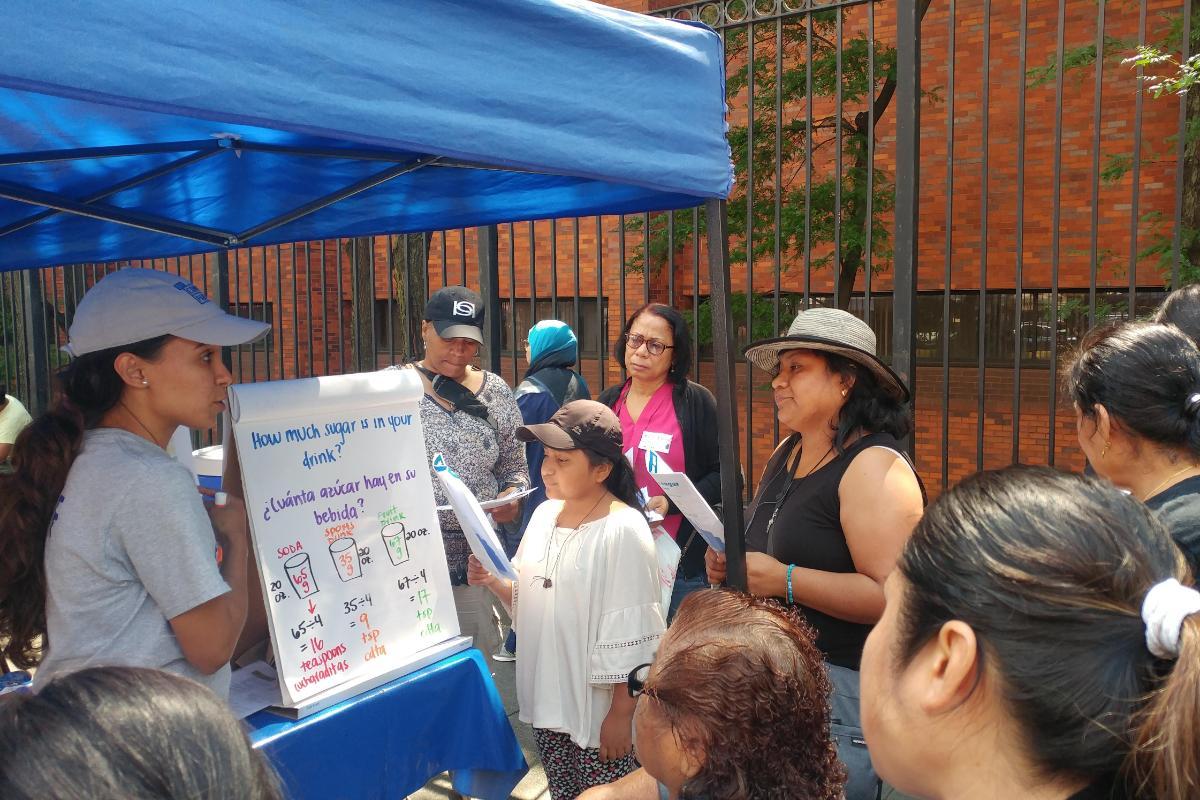
Through Project Dignity, we work with homeless New Yorkers. We provide services like showers, haircuts, laundry services, and mail services which allow individuals to file for important documents like a replacement birth certificate or ID. Through our Nourish Program, we work with seniors. And for the Live Healthy! Program, we do nutrition education, as well as policy, systems, and environmental work. We're not just looking at the tools that we can give to the individual on how to eat healthier or make their food dollar stretch longer; we're also looking at the built environment.
2. Describe a “day in the life” at New York Common Pantry.
On a typical Tuesday, I’m usually at our office around 6:45am to receive our farm share delivery. We're all on staggered schedules right now because of COVID, so there can't be too many of us in the office at the same time. My team usually gets there around 9:00 am to start doing prep for our Farm Share Program. They'll send reminders to participants and prepare the produce cards, which are informational cards for any items in the bag they might be unfamiliar with. These cards help people know how to store the item, how to prepare it, and what nutrients it is high in.
Our nutrition education team gets ready for our recipe club each week. The club utilizes items that clients get either in the pantry bag or from the farm share, and we make a healthy recipe in real-time. Clients will see part of our Policy, Systems, and Environmental change (PSE) team, and join our nutrition team for virtual education. We usually have some kind of meeting with community partners to follow up on a project or drop things off to satellite sites. It's a mix of different activities throughout the day.
3. How have your services changed since COVID?
Everything has gone virtual. My whole team now is getting more comfortable with the virtual format. We can record a workshop and send it to parents who might not have the time when the workshop actually happens. It definitely opened up more opportunities to connect with more people.
The biggest changes came with our Farm Share Program. Over time, we were able to start coordinating alternative delivery methods. We did the delivery for a while, and then we got the partnership with Invisible Hands. They can go directly to the person, as well as doing group drop-offs to senior or community sites. Also, we really tried to focus on how we were communicating with people because a lot of seniors might not be as familiar with technology like Zoom. Our communication structure has definitely shifted. We have multiple routes not just to share information, but also receive feedback. And we have been receiving feedback that never would have crossed our minds. We're like, "Wow, that is a barrier in accessibility. Let's find a way to integrate a better model."
4. What advice or best practice do you have for Food Ed Coalition members operating during COVID?
See evaluation and feedback as more of a continuous piece of your programming. It's not enough to just ask people when you're first in contact about where they are and ask again at the end of your programming. The conversation and the relationship-building that happens between those two points is, in some cases, more valuable because it adds texture to what your data will show later. Sometimes it is not the program that's not successful. It could be the delivery method that is not successful. And you only know that the delivery method is the issue because you talked to people throughout.
5. What is your favorite local fruit or vegetable?
I have a lot of favorites, but locally, I'm going to say mulberries. They're actually everywhere in the Bronx. I have a mulberry tree in my backyard. I collect the berries and bake them into a giant fruit tart to share!