A Dose of Realpolitik
Published: 2/23/2006
D.C. up close, via TC's Federal Policy Institute
How to argue for increased education funding at a time when society
seems more focused on Medicare, terrorism, the environment and other
issues?
That was the question posed to a group of 30-odd
students from the Teachers College Federal Policy Institute (FPI) one
afternoon this past January by Ed Kealy, Executive Director of the
Committee for Education.
"A lot of people see investing
in education as deficit spending, so it's very important to reframe the
issue," Kealy told his listeners, who had come to Washington for the
week-long visit that is one of the highpoints of the FPI experience.
"Our position is that spending on education is an investment in the
workforce, because having a better-educated citizenry is the way to
remain competitive with rising economic powers such as China and India."
With 104 member organizations reflecting political views of every
stripe, it might seem amazing that the Committee- '"the nation's
largest coalition of education-focused groups'"- has a position on
anything. But that's Lesson One of FPI: policy-making is a
collaborative effort that works best when it reflects the views of all
the constituents at the table.
More broadly, FPI is a hands-on exploration of the issues shaping
federal policy on education, from school funding and high-stakes
testing to determining who is qualified to teach. It's also a crash
course in how the shifts in America's two-party system and the politics
of constructing legislation affect everything from Head Start to
graduate education.
"I have always felt that the role of an
academic institution is to provide an array of issues and give students
all the tools necessary to analyze them," says Professor Sharon Lynn
Kagan, who teaches FPI. "The Federal Policy Institute lets our students
test what they've learned in their readings against the reality of what
they see in Washington."
Kagan, who is also TC's Associate
Dean for Policy and head of the College's Office of Policy and
Research, knows a thing or two about political realities. As a staff
intern for both Democratic and Republican lawmakers on Capitol Hill
earlier in her career, she absorbed a full range of views and
philosophies touching on education policy. She has since gone on to
advise presidential administrations, governors, and the governments of
other countries on early childhood education, which is her own
particular specialty.
"Education is about understanding
multiple perspectives, and educators have a responsibility to present
that kind of breadth," she says. "I've tried to embed that outlook in
my teaching and in the FPI experience."
Through FPI, students
attend several class sessions at TC on the historical and current
involvement of the federal government in education. In Washington, they
observe and talk to leaders on Capitol Hill and their staff members,
officials in the U.S. Department of Education, and heads of education
policy think tanks, research centers and advocacy organizations. During
one session in January, this year's TC delegation heard senior
Republican and Democratic legislative aides from the House and Senate
education committees talk about how they came to their jobs. Some were
former educators and researchers; some had worked in state governments.
One said she'd started out opening mail and answering phones in
congressional offices on Capitol Hill. Beyond their personal stories of
how they came to work on the Hill, these staffers offered a candid
portrayal of partisanship in policymaking and an insider's view of the
key relationships and roles of legislative staff.
The FPI
students themselves were similarly diverse, with majors that ranged
from international education to nursing education. The group also
included active classroom teachers and several non-degree students.
"I teach high school students about how government works, so it's great
to see it first-hand," said Mary Kate Blaine, a TC alumna who teaches
at the Notre Dame School in Manhattan.
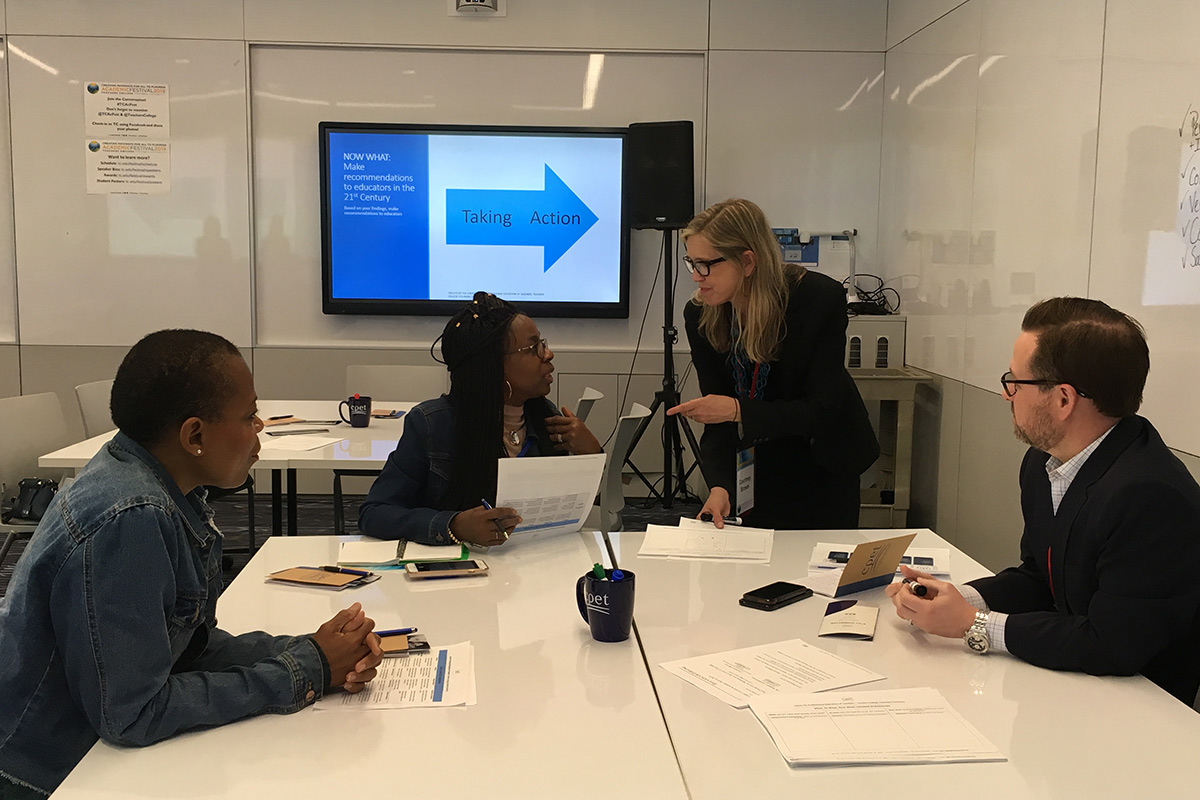
Upon their return to
TC, the FPI students are asked to prepare a policy analysis and give
mock testimony on an education policy topic of their choosing. As with
congressional testimony, they are given just three minutes to make the
case for why their particular issue is important and then recommend a
course of action. It's daunting work, but if the meeting with Ed
Kealy was any indication, it was clear that, by week's end in
Washington, the group was mastering some political basics.
"So," said Kagan after a subsequent session at which two leaders of
organizations representing corporate America also talked about
education as an investment, "we seem to be acknowledging that business
is increasingly shaping the construction of education policy."
A student raised her hand and turned to the class. "Maybe we need to suspend our judgment of their motives?"

Related Articles
Related Articles
By topic:
By program:
By faculty: