
The stunning results of the midterm elections have set the stage for a possible sea change in American K-12 and higher education. Beyond taking control of both houses of Congress, Democrats won the majority of governorships for the first time since 2006, gained hundreds of seats in state legislatures, and will control all branches of government in 23 states. In Texas, long an incubator for Republican policies, the new governor, Gina Hinojosa, and newly elected Senator James Talarico, both former middle school teachers, have vowed to end the state’s private school voucher program, redirect funds to public schools, and fight book bans and restrictions on classroom instruction. In Illinois, former school principal Jessica Biggs became the first-ever president of the Chicago Board of Education, ending 30 years of mayoral control of schools, a practice that has been a fixture in most major cities.
But success at the polls may have been the easy part for Democrats focused on education, suggested Jonathan Collins, Assistant Professor of Politics and Education, and Basil Smikle (Ph.D. ’19), Professor of Practice at Columbia University’s School of Professional Studies, during Teachers College’s “True Change: The Post-Election Classroom” forum on November 4. Sharing their expertise with the TC community the evening after the elections, Collins and Smikle discussed the challenges and opportunities ahead for education policy in the United States in a virtual conversation moderated by Liz Willen, Editor-in-Chief of The Hechinger Report, an independent nonprofit newsroom based at TC.
“As the nation’s leading graduate school of education, we at Teachers College have a responsibility to engage around policy and civic education and raise awareness of what the implications of elections are on our educators, our schools, and our future,” said President Thomas Bailey in welcome remarks.
Read on to explore some of the major issues lawmakers will contend with throughout this next chapter in American politics, according to Collins and Smikle.
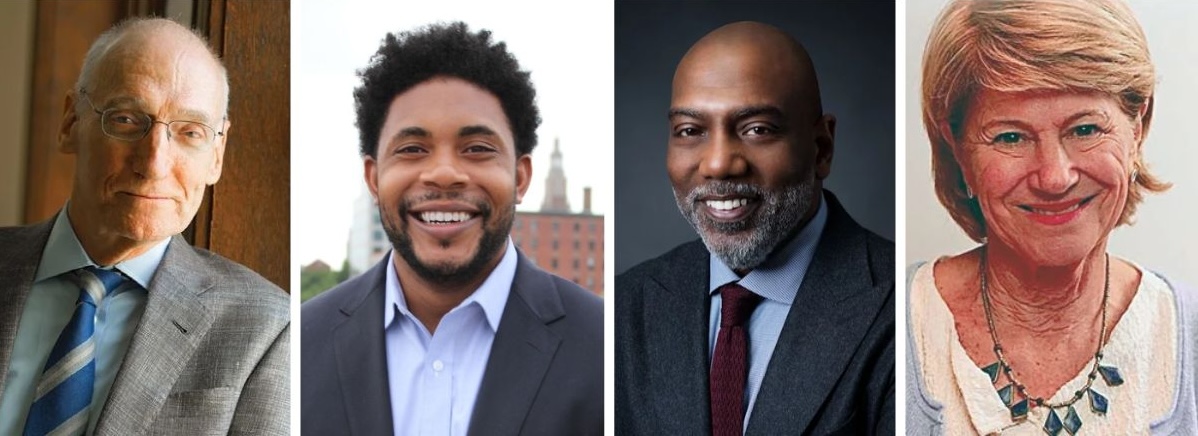
Pictured from left to right: President Thomas Bailey; Jonathan Collins, Assistant Professor of Politics and Education; Basil Smikle (Ph.D. ’19), Professor of Practice at Columbia University’s School of Professional Studies; and Liz Willen, Editor-in-Chief of The Hechinger Report. (Photos: TC Archives)
Making education reform speak to affordability. Affordability – including gas prices, housing, healthcare and education itself – was one of the major issues on which Democrats campaigned.
“How can this quest for improving affordability and quality of life be connected to education?” asked Collins, who leads both the College’s Center for Educational Equity, and the School Board and Youth Engagement (S-BYE) Lab. “The pathway to more economic opportunity starts with K-12 schools, colleges, universities — so what can we see from this new Democratic majority that is going to invest in widening that pathway to the middle class through the education system?”
Smikle, a graduate of TC’s Politics and Education program, called for immediate action that alleviates financial pressure on families. “What are the Democrats going to focus on right out of the gate? What are some things that can be restored that actually have an impact on a family’s income or pocket book today, whether it’s some Head Start funding or funding for students who are disabled?”
(Photo: iStock)
Finding common ground and prioritizing. To negotiate with the president, Democrats must first work out their own differences, said the panelists. Such is seemingly the case in Texas, where lawmakers campaigned on addressing a variety of issues that will not only require collaboration across multiple levels of government to succeed, but also significant time and resources.
“There is going to be this inherent tension between this low-hanging fruit — what can a lot of these leaders do right away to address the concerns of the constituencies that got them elected,” explains Smikle, “but also focus on these big items that a lot of progressives are going to look for some policy-making towards.”
Texas governor-elect Gina Hinojosa is set to strengthen local control of schools, a policy decision that will shift the current status-quo of districts and may pose interesting choices down the line, explains Collins. “The question is, what happens if said reform doesn't generate the kind of results, especially immediately, that some of these top-down reform processes have produced? That's always been the challenge when looking to restrict some of these market-based reforms.”
At the federal level, voters should expect to see these inner-party debates continue to play out, explains Collins; however, these ideological battles will carry significant weight as Democrats decide what issues to prioritize and how to spend their political capital.
“I'm really interested to see the internal conversations between the moderate Dem establishment and then the Democratic Socialists who seem not very interested in this idea of compromise,” said Collins. Thus, policy makers will need to decide how to tactically work within their own party and across the aisle.
(Photo: iStock)
Navigating the future of higher education. The future of colleges and universities may emerge as the most significant flashpoint within the Democratic party and beyond. Here again, affordability and funding cuts exacerbate what Smikle describes as a false choice between college versus no college.
“The truth is that over the course of time, both pathways have been necessary,” said Smikle, noting the resemblance to the 19th century debate between W.E.B. DuBois and Booker T. Washington on how Black Americans could best improve their circumstances. “The problem is not whether we need one or the other, the problem has always been access, and it's always been how does that access translate to generational wealth?”
Framing higher education as the most successful approach to reducing inequity, Collins emphasized that without collective, concerted effort to make higher education more accessible, affordability “problems are going to continue regardless of who the president is and what the constellation of power looks like.”
The beauty of higher education is the ability to go and be exposed to different ideas, different perspectives, to learn how to think critically, to engage with different kinds of texts, timeless texts, to develop a wide range of skill sets that are not necessarily vocational. That's kind of the point. Like we can't lose sight of the importance of the ability to develop our minds, and especially again as AI continues to loom as a threat.
The evening’s discussion raised more questions than answers, and Willen offered viewers a closing observation about the ties between education and politics.
“In my years of covering education, I’ve often felt that education and politics are one and the same,” she said. “There are so many ways in which they are interlocked and so many ways in which each impacts the other.”