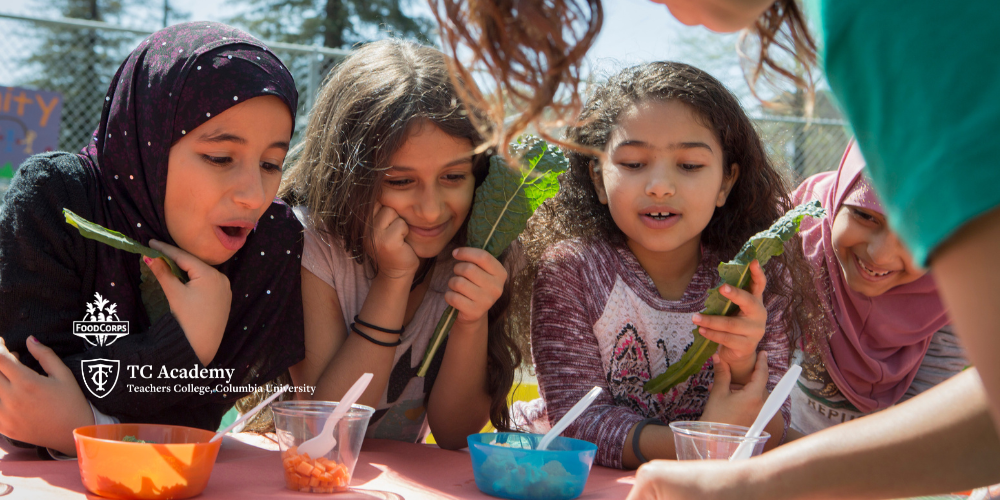
NEW YORK, NY — Teachers College, Columbia University today announced the launch of Food Education in the Classroom (Food-E), the nation's first microcredential designed specifically to train K–5 teachers in food education. Developed in partnership with FoodCorps, the national school-food nonprofit, Food-E marks a milestone in Teachers College's commitment to translating education research into practical tools for the nation's classrooms.
The launch comes eight months after Congress eliminated SNAP-Ed—the country's largest federally funded nutrition education program, which had reached roughly 90 million low-income Americans, including an estimated 35 million children—leaving a critical gap in school-based nutrition programming across the country.
Food-E is the first program of its kind to pair a top-ranked school of education with a national school-food nonprofit in a single credential for elementary teachers. The six-week online course draws on Teachers College's deep research expertise in nutrition and pedagogy alongside FoodCorps' nearly 15 years of school-based programming, which has reached 1.5 million students across 1,844 schools.
"Food education is not about telling kids what to eat. It's about teaching them how to think about food, where it comes from, how it shapes their bodies and their communities, and why it matters," said Pamela Koch, Mary Swartz Rose Associate Professor of Nutrition and Education at Teachers College, Columbia University, who leads the program. "When we teach food well in elementary school, we are teaching science, culture, and citizenship at the same time."
The six-week, asynchronous course (with live sessions) is built around two pillars: nutrition science and experiential learning. The curriculum spans biology, ecology, environmental science, sociology, and history, and is designed so educators can connect food lessons to existing standards across subjects, rather than treating food as an add-on. Guest contributors include John B. King Jr., former U.S. Secretary of Education under President Obama; Alice Waters, founder of Chez Panisse and the Edible Schoolyard Project; and Maya Feller, MS, RD, CDN, founder of Maya Feller Nutrition and nutrition expert for Good Morning America.
The need is urgent. While the National School Lunch Program continues to feed nearly 30 million students every school day, access alone is not sufficient: 60 percent of U.S. children do not eat enough fruit, and 93 percent do not consume enough vegetables to meet daily recommendations. Research demonstrates that hands-on food education—such as cooking and gardening activities at school—can change those outcomes. Among students who experience food education through FoodCorps programming, an average of 60% increase their preference for fruits and vegetables, and with more hands-on activities, students eat up to three times as many fruits and vegetables (Koch et al., 2017).
"Kids deserve opportunities to build positive relationships with food from an early age, and teachers are uniquely positioned to make that possible without sacrificing instructional time," said Rachel Willis, President of FoodCorps. "Food-E offers an evidence-based, scalable approach that helps teachers integrate meaningful food education into everyday learning."
Teachers who complete the program earn CEU/CTLE credits toward professional licensure and leave with an implementation roadmap tailored to their own classrooms. Food-E is open to K–5 teachers in every state, regardless of prior experience with food or nutrition education.
Enrollment is open now at foodcorps.org/food-e. The first cohort begins July 13.
About Food-E Food Education in the Classroom (Food-E) is an online microcredential from Teachers College, Columbia University, developed in partnership with FoodCorps. The six-week program trains K–5 teachers in evidence-based food education grounded in nutrition science and experiential learning. The curriculum spans biology, ecology, environmental science, sociology, and history, and is designed to map to existing curriculum standards. Learn more at foodcorps.org/food-e.
About Teachers College, Columbia University Founded in 1887, Teachers College, Columbia University is the first and largest graduate school of education in the United States and is perennially ranked among the nation's best. Teachers College engages in research and prepares professionals across its three areas of expertise — education, health, and psychology — to work with public and private entities in local, national, and global communities and to inform public policy. Students choose from among 150 separate programs to earn graduate degrees conferred by Columbia University. Learn more at tc.columbia.edu.
About FoodCorps FoodCorps is a national nonprofit advancing child well-being through food in school. Building on nearly 15 years of in-school programming reaching 1.5 million students, FoodCorps partners with students, families, and communities to champion nourishing food at local, state, and national levels. Learn more at foodcorps.org.