BERC Summer Conference: From Equity to Emancipation
Black Studies as the Practice of Freedom in NYC Schools
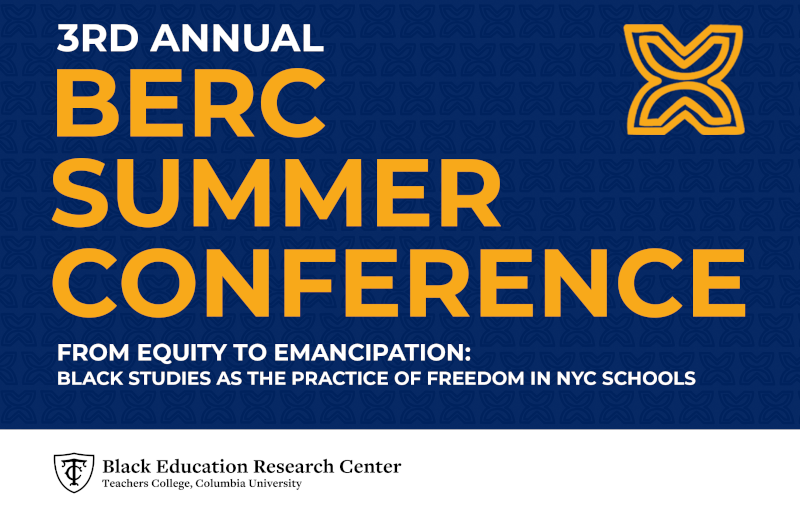
Program Description:
The BERC 2026 Summer Conference, entitled From Equity to Emancipation: Black Studies as the Practice of Freedom in NYC Schools, provides teachers, school leaders, policy makers, and community educators an opportunity to reclaim the emancipatory power of education. Despite the long shadow of “mis-education” and separate and unequal education that continues to cast itself upon U.S. public schools, the fight for educational equality and opportunity continues. The current political landscape requires those concerned with the future of K-12 education to shift our collective focus from equity as a means of “ensuring that everyone gets what they need,” to emancipation as the process of “ensuring that everyone is free” or “getting free.” This is not to abandon the goals of equity, but acknowledging that until all of us are free, none of us truly are (Hamer, 1971). One promising project is the implementation of Black Studies as the Study of the World: A PK-12 Black Studies Curriculum for New York City Public Schools, —a timely and relevant example of how PK-12 educators, policymakers, and researchers can work together to harness the power of knowledge, resources, and leadership to plant the seeds of educational transformation and systemic change. The provision of Black studies in PK-12 education represents a unique opportunity to correct, enrich, and supplant where necessary, existing curricula, and advance a more comprehensive and inclusive learning experience for all students.
By attending, participants of this year’s conference will be able to utilize lessons from Black Studies as the Study of the World to enact the three essential functions of Black studies (Gordon & Brown, 2024):
- Memorialize and explain the African experience in the Americas,
- Document the evolution and achievements of Black people in the Americas, and
- Provide analytical frameworks for understanding Black experience and beyond.
The urgency of the present political moment demands a fundamentally emancipatory approach to education—one that reimagines research and policy not as neutral or technocratic endeavors, but as instruments of collective freedom and human flourishing. Education remains the most powerful path toward consciousness and freedom from mental bondage. Through Black studies, we find not only a framework for understanding the world, but a liberatory way of being in it—fulfilling the enduring call to move from equity to emancipation.
In community,
Black Education Research Center
References
Gordon, E. W., & Brown, M. C. (2025). The three essential functions of Black studies: A clear and unwavering argument. Black Education Research Center, Teachers College, Columbia University.
Hamer, F. L. (2011). "Nobody's free until everybody's free,": Speech delivered at the founding of the National Women's Political Caucus in Washington, D. C., July 10, 1974 in M. P. Brooks & D. W. Houck (Eds.), The speeches of Fannie Lou Hamer: To tell it like it is (pp. 134-139). University Press of Mississippi.