Financial Literacy Microcredential

Program Description:
The Financial Literacy Microcredential offers a fresh, engaging approach to teaching personal finance in classrooms. Designed for educators, the microcredential equips participants with classroom‑ready resources and practical strategies to teach essential financial concepts, including budgeting, credit, investing, risk, and insurance.
Central to the design of this microcredential is a case‑study approach that engages participants in analyzing authentic financial challenges. These narrative‑driven cases encourage deep thinking, persistence, and problem‑solving by presenting multiple perspectives and avoiding simple, one‑size‑fits‑all answers. Participants explore complex financial topics, analyze real‑world scenarios, and build confidence in guiding students through challenging decisions.
Throughout the microcredential, educators collaborate with peers, exchange effective practices, and engage with leading experts in the field. Along the way, they may even gain insights that strengthen their own financial understanding. This microcredential empowers teachers to deliver meaningful, relevant financial literacy instruction that prepares students for the real financial choices they will face.
Although the cases and examples used in the course are based on the US, the materials and concepts apply across contexts and can be used or adapted for other countries. Please contact tcacademy@tc.columbia.edu if you are interested in exploring how to adapt these materials and the course for use with students outside the US.
Dates & Registration
Format: Asynchronous Online Modules
Price: $295
For more information, questions, or to register: Email tcacademy@tc.columbia.edu
Instructors
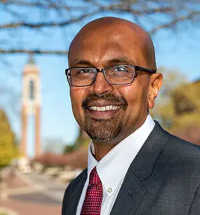
Anand R. Marri
Anand R. Marri is the Provost and Executive Vice President for Academic Affairs at Ball State University, where he leads the University’s academic vision and oversees its colleges, schools, libraries, online learning, and major academic initiatives. Before becoming Provost, he served as Dean of Ball State’s Teachers College, guiding its nationally recognized partnership with Muncie Community Schools. His career includes leadership at the University of Rochester, 15 years on the faculty at Columbia University’s Teachers College, and a senior role at the Federal Reserve Bank of New York overseeing outreach and economic education. A respected scholar in civic and economic education, Dr. Marri has secured over $12.5 million in grants and has been featured in major national media outlets.

Robert D. Shand
Robert D. Shand is Associate Professor in the School of Education at American University. He received his Ph.D. in Economics and Education from Teachers College, Columbia University. A former high school economics and government teacher, his interests lie at the intersection of research, policy and practice. His current research focuses on teacher improvement through collaboration and professional development and how schools and teachers use data from economic evaluation and accountability systems to make decisions and improve over time. Recent work with colleagues at the Center for Benefit-Cost Studies of Education at Teachers College has emphasized the unique opportunities and methodological challenges of evaluating complex partnership programs, including the university-school-community partnership Raising Educational Achievement Coalition of Harlem, and the comprehensive student support program, City Connects. He is a co-author of the third edition of Economic Evaluation in Education: Cost-Effectiveness and Benefit-Cost Analysis, and he has contributed to publications in the American Journal of Evaluation, Educational Evaluation and Policy Analysis, and the Journal of Research on Educational Effectiveness.
Learning Objectives
Participants will:
- Learn how to use the case-study method and the real-world dilemmas of managing money to teach financial literacy in their classroom.
- Deepen their understanding of financial literacy topics, including budgeting, saving, banking, credit, investment, risk, and insurance. They will draw on the case studies and their associated resources, discussions with fellow participants and instructors, and Q&A sessions with financial literacy experts in this field.
- Connect the course’s case studies to the larger economic, political, and social issues students face as citizens, voters, and taxpayers.
- Analyze financial choices from a behavioral perspective to better understand limits to their decision-making abilities and advocate for policies and choice architecture to help individuals make better financial decisions.
Who Should Attend
This microcredential is designed for educators who want to strengthen their ability to teach financial literacy through engaging, real‑world learning. It’s an excellent fit for teachers seeking classroom‑ready resources, practical strategies, and a deeper understanding of topics such as budgeting, credit, investing, risk, and insurance. Educators who value discussion‑based learning and want to use case studies to help students navigate complex financial dilemmas will find this course especially valuable. Participants who enjoy collaborating with colleagues, exploring multiple perspectives, and learning from experts in the field will benefit from this experience — and may even gain insights that support their own financial decision‑making.
Upon Completion
Participants who successfully complete this microcredential course will earn a verified Certificate of Participation and an official Digital Badge—valuable credentials that showcase your commitment to professional growth and can be shared on LinkedIn or digital portfolios.
View our sample program badge and certificate below:


Important Notice: This is a non-credit program. Completion does not provide academic credit toward any degree program at Teachers College or other institutions. No transcript credit will be awarded.