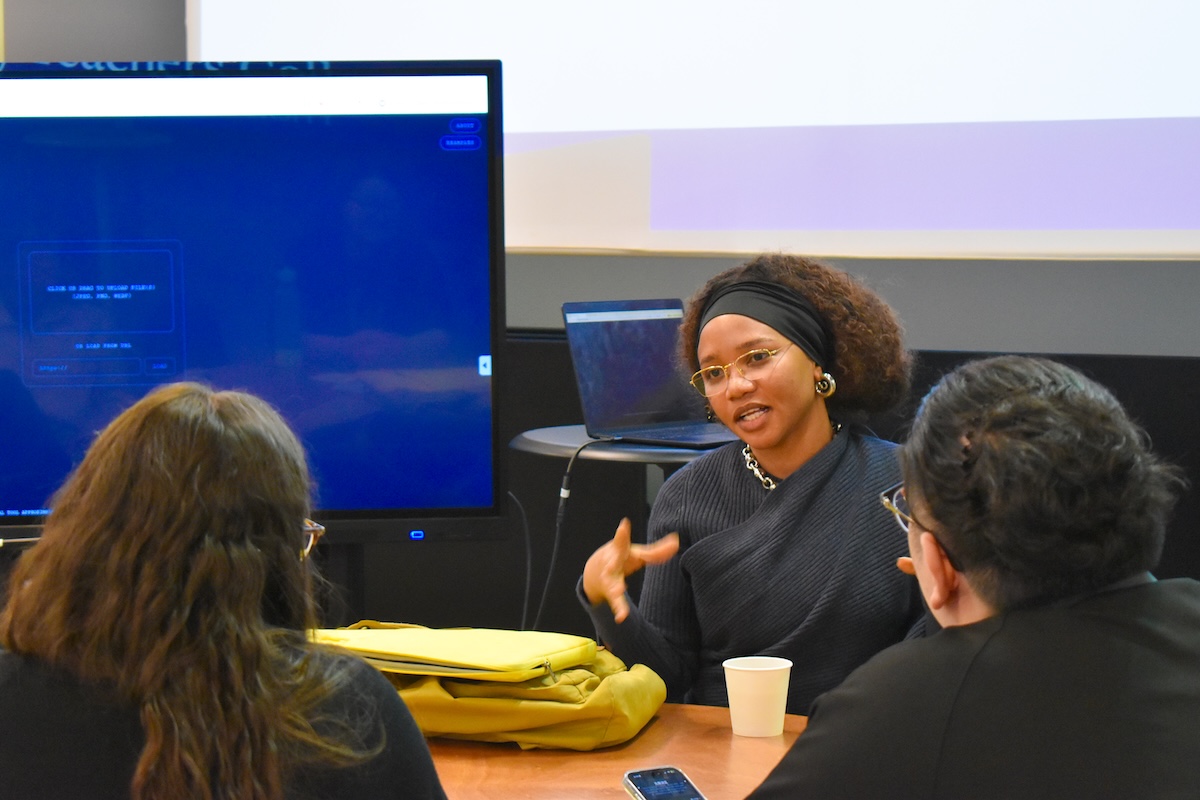
As part of TC’s strategic focus on sustainability, Teachers College students, faculty and staff gathered in the Smith Learning Theater in early February to share research and projects for the second annual TC Sustainability Showcase. The event is a joint effort between the Center for Sustainable Futures (CSF), Sustainability and Education program, Visual Research Center for Education, Art & Social Change and the student-run Sustainability Task Force (STF) in order to spark conversation on sustainability and how it looks in practice.
Despite the fact that nearly two-thirds of Americans are concerned about climate change, only one third of Americans have even an occasional discussion about it. “It’s not enough to be worried about climate or sustainability. We have to talk about it without peers, coworkers [and] family in order to mobilize more people to take action,” said Oren Pizmony-Levy, Associate Professor of International and Comparative Education and Director of Center for Sustainable Futures, in his welcoming remarks. “We are seeking today to [address this] question: how can our work at TC foster conversations about sustainability for social change and reach different audiences in the public sphere, beyond academic boundaries?”
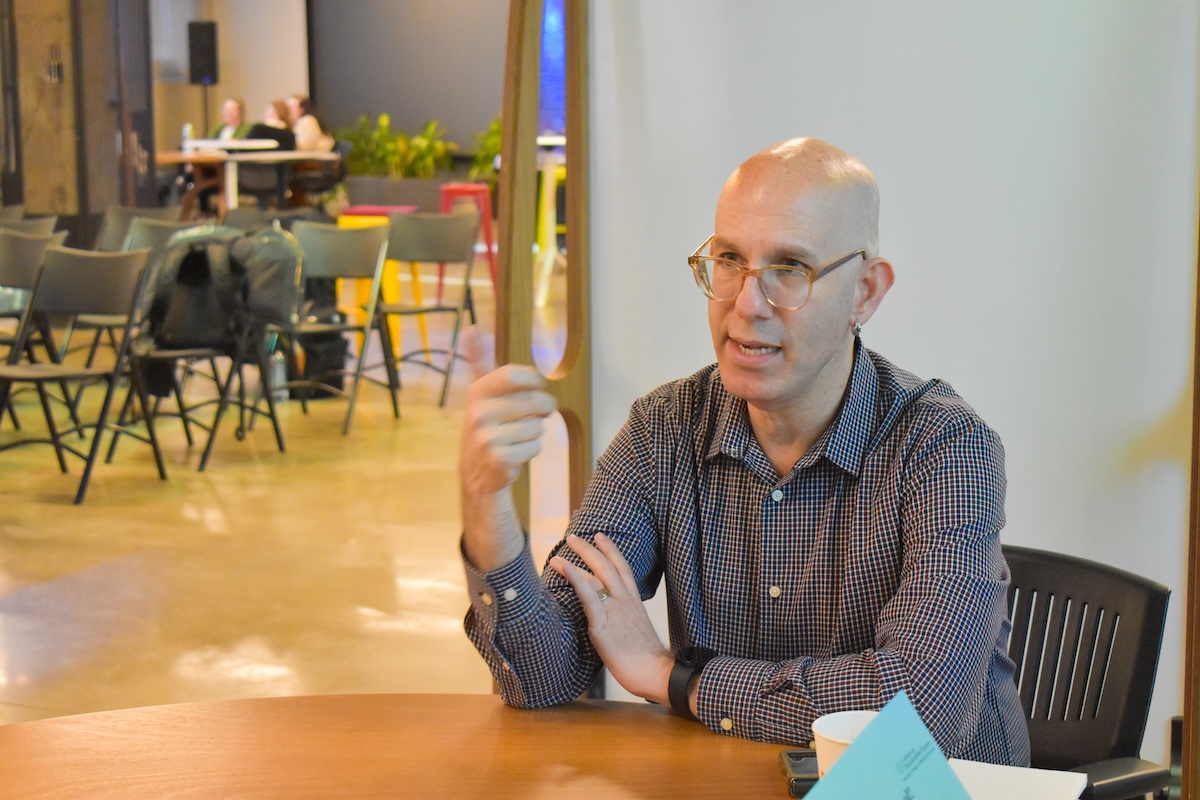
Oren Pizmony-Levy during a roundtable discussion (Photo: The Center for Sustainable Futures)
The Sustainability Showcase was established in 2025 to help spark those critical conversations by offering members of the TC community a forum to share how they employ sustainable practices in their work while also learning from their peers. From video projects and community art workshops to climate-change educational initiatives and international policy comparisons, presentations demonstrated the diverse applications of sustainability research through a series of lighting presentations followed by roundtable discussions.
New for this year was the inclusion of staff members, who offered insights into the ways that TC enacts more sustainable practices on the institutional level. Representatives from the Office of the Vice President for Administration (VPA), Office of Residential Services and Office of Environmental Health and Safety presented on the ways that sustainability informs their decision making. The staff presentations also demonstrated how environmental and social issues can be addressed through education, a central aspect of TC’s new online masters program in Sustainability and Education.
Read on for some brief snapshots from the presentations.
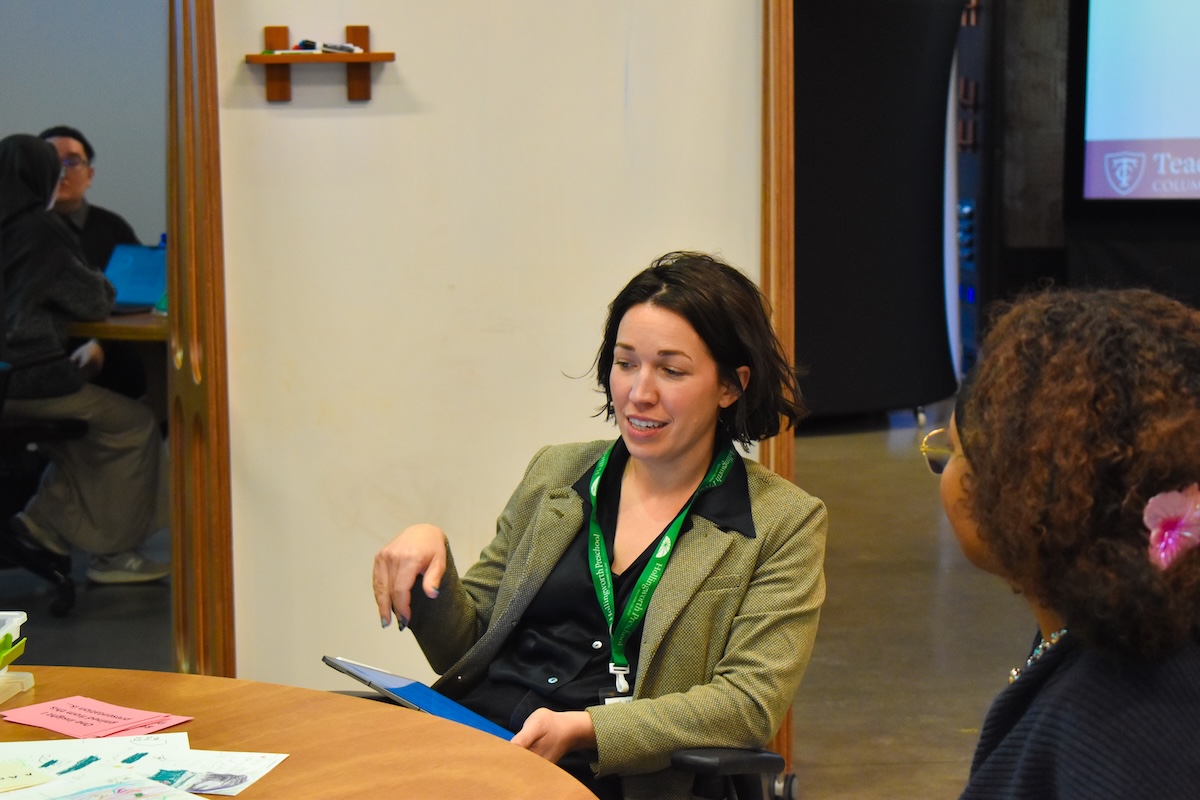
Sarah Duer, Director of Hollingworth Preschool (Photo: The Center for Sustainable Futures)
“Climate Change Through Oceanography for K-5” - Jacquelyn Durán (Ph.D. ’18), Director of Science Initiatives at the Hollingworth Center
Finding engaging and age-appropriate ways to teach young children about climate change was one of the core challenges for the staff organizing last summer’s Hollingworth Science Camp, which focused on oceanography. The presentation — given alongside Durán’s colleagues Sarah Duer, Director of Hollingworth Preschool; Allison Matthews (M.A. '06), Curriculum Specialist and Researcher for the Hollingworth Science Camp; and Nina Borland, Creative and Instructional Designer for Hollingworth — gave insights into the planning and execution of the 2025 camp, as well as takeaways from the summer.
Camp organizers walked through several barriers to instruction that come with teaching climate change and how robust professional development for camp teachers helped mitigate those challenges. “The lessons and experiences that we created for our campers [focused] on finding solutions and that includes socio emotional check-ins for the children as this is a heavy topic,” said Duer, a TC doctoral student who is leveraging insights from campers for her dissertation research. The inquiry based curriculum included a wide range of experiments, field trips and special visits from an oceanographer and author of Abuelo, the Sea, and Me, Ismée Williams.
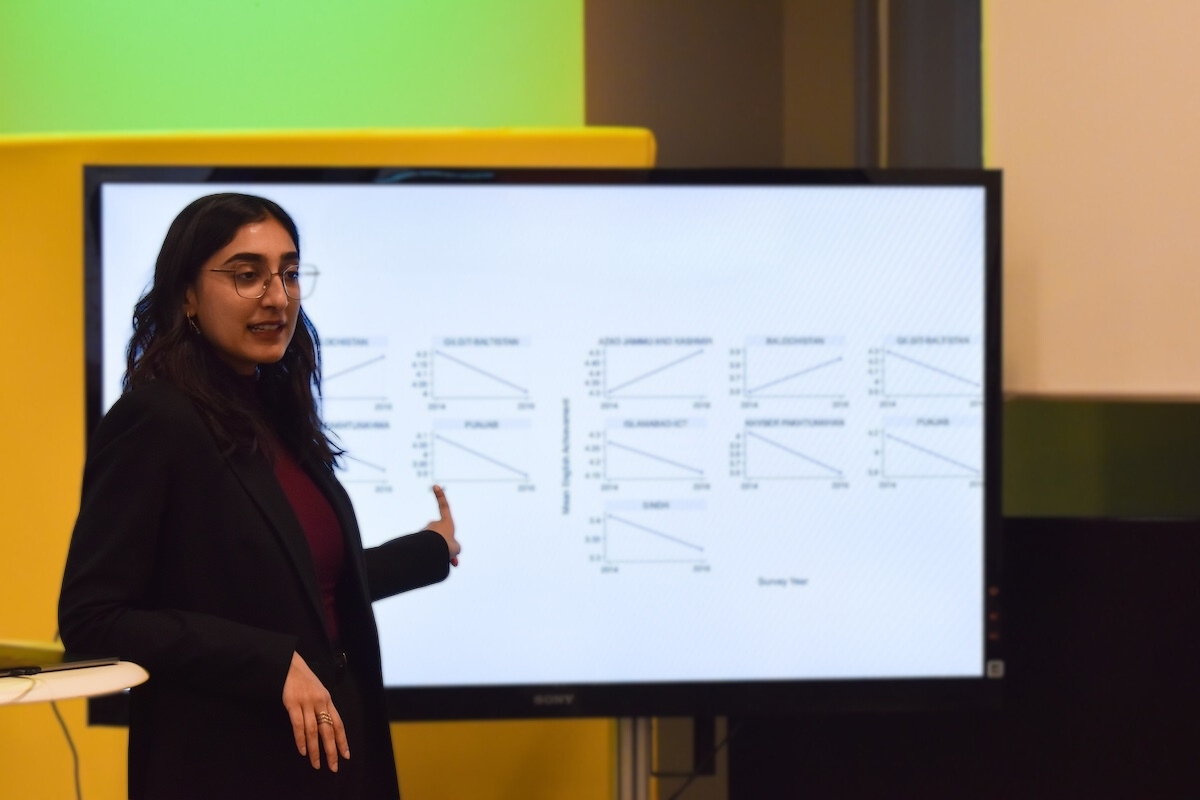
Ushna Fawad giving her presentation (Photo: The Center for Sustainable Futures)
“Lighting the Way: School Solarization and Learning Outcomes in Rural Pakistan” - Ushna Fawad, Masters student in the International Educational Development program
Exploring the relationship between increased access to solar power and educational outcomes in rural Pakistan was the crux of Fawad’s presentation, which featured preliminary findings from her research project. The Fulbright scholar was inspired by her own experiences teaching a class of more than 50 students in a school that often had no electricity on hot days. “Children and teachers are working in classrooms that can go as high as 100 degrees Fahrenheit… without even a single working fan,” said the Fulbright scholar.
High temperatures are proven to worsen outcomes for students and due to an ongoing energy crisis and a lack of infrastructure, only 60 percent of schools in Pakistan have electricity. However, in 2015 the Pakistan government began a school solarization campaign, improving access to power for rural students. To identify the impact that the campaign has on learning, Fawad utilized national data and her preliminary findings suggest that solarization improves learning outcomes and school enrollment.
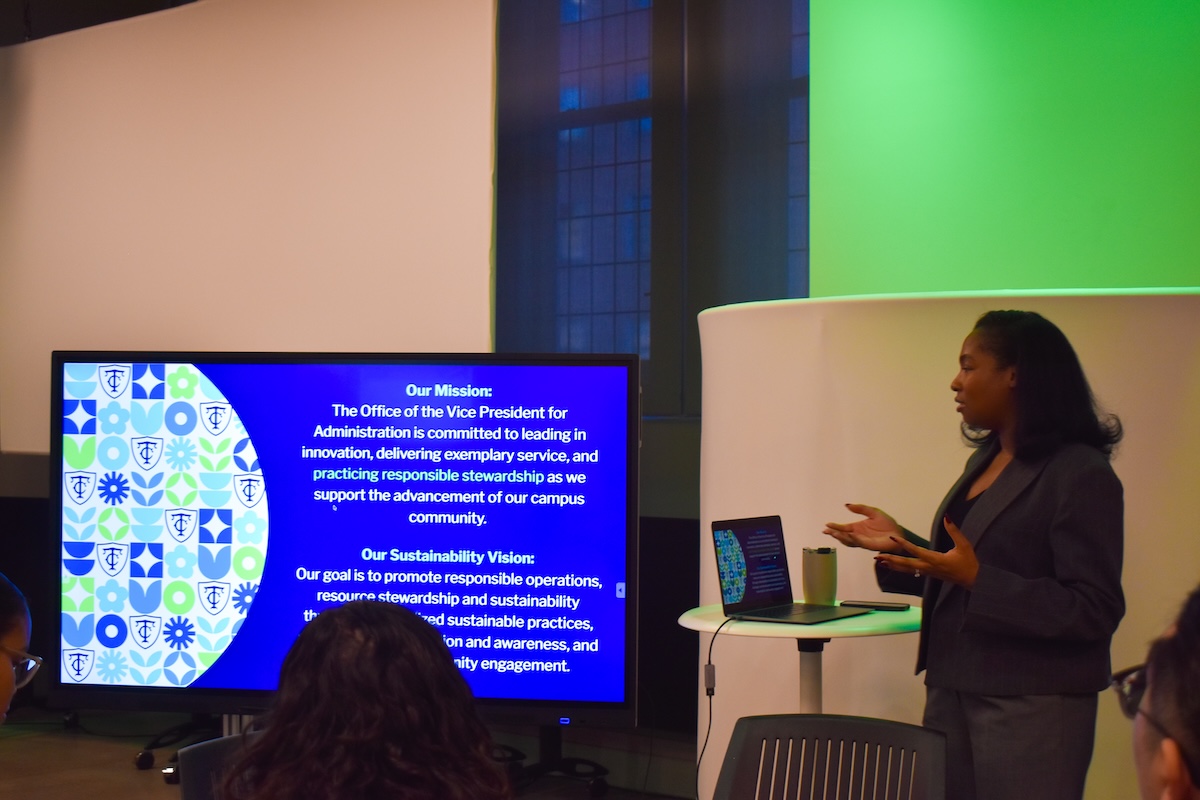
Akesia Philip-Bryan, Senior Manager for Planning and Operations for the VPA Division (Photo: The Center for Sustainable Futures)
“From Commitment to Practice: Advancing Sustainability in the VPA Division at Teachers College” - Akesia Philip-Bryan, Senior Manager for Planning and Operations
As part of its mission of responsible stewardship of the College’s resources, TC’s VPA office emphasizes sustainability through practices like a digital-first approach to onboarding, reducing electronic waste and server demand and community engagement initiatives. In her presentation Philip-Bryan, a senior staff member of VPA, detailed the impact of this approach in the HR, IT and operations departments and in the rest of the College. “We know that by integrating sustainability into our division’s daily operations and practices, we model [it] for the other administrative offices,” said Philip-Bryan, who spearheaded the College’s Earth Day Annual Plant Giveaway. “It's something that we take really seriously. We want to contribute to the colleges’ overall mission.”
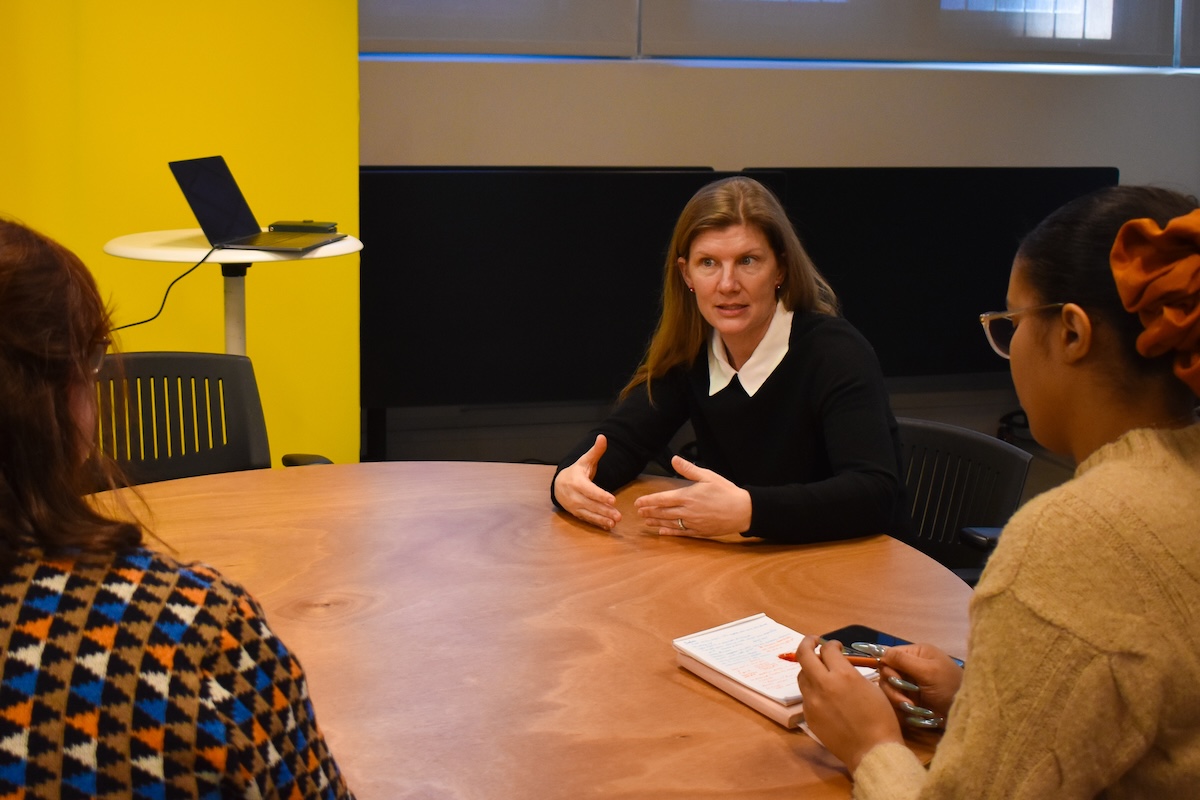
Colby Tofel-Grehl, Associate Professor of Science Education (Photo: The Center for Sustainable Futures)
“Building Ecological Presence: Towards a Dynamic Framework of Environmental Justice” - Colby Tofel-Grehl, Associate Professor of Science Education
When it comes to addressing structural societal issues like climate change, encouraging agency among young people is key according to scholars like Tofel-Grehl, Vice Dean for Teacher Education and School & Community Partnerships. Her presentation for the showcase centered on ecological presence, a theoretical framework Tofel-Grehl developed alongside Tyler Hansen, Assistant Professor at Washington State University, which aims to develop a strong sense of agency for youth.
As a way of demonstrating ecological presence in action, Tofel-Grehl also gave insights into a recent study she conducted through a long-term research practice partnership with summer school students on the Big Island of Hawaii about their relationship to nature. “Part of what makes ecological presence really powerful is that it makes the invisible visible in a lot of cultures and communities,” explained Tofel-Grehl. “A lot of kids don't think that they have a relationship with nature, but in fact, we all do have an ecological relationship with the environment around us. Making that visible is essential.”
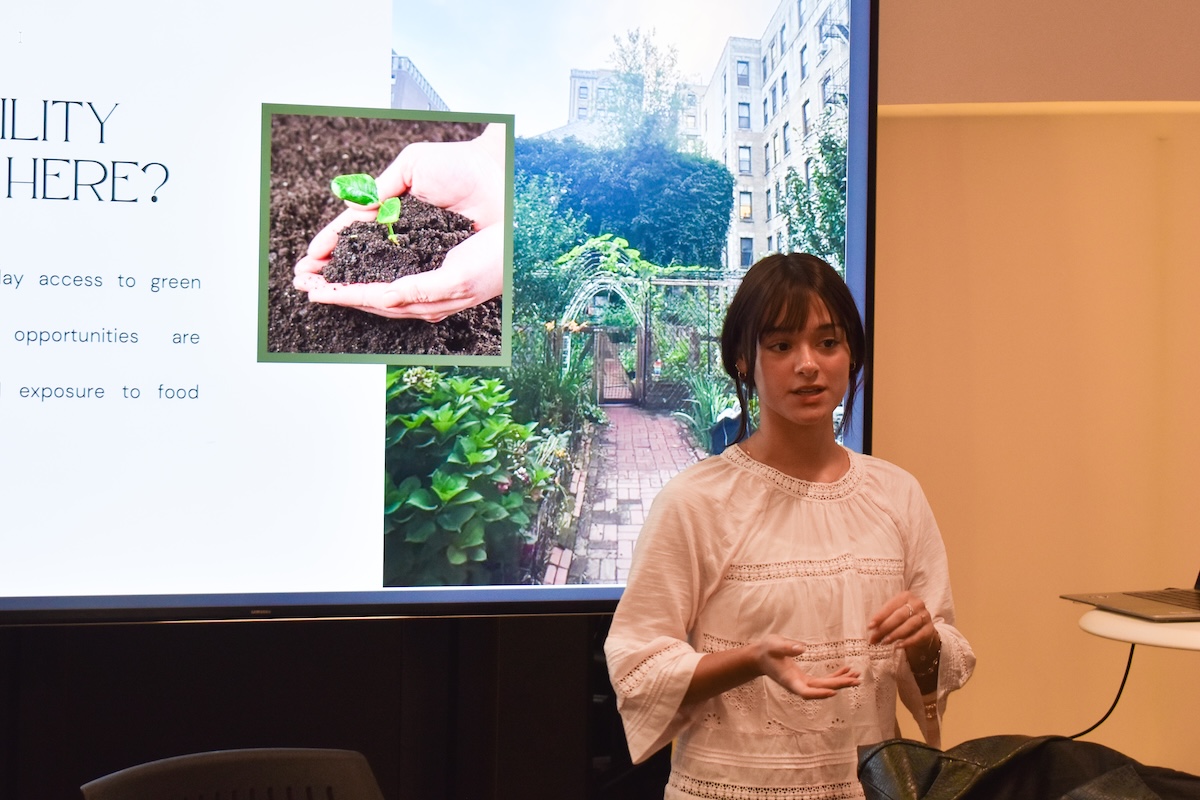
Isabella Trezza presenting on Gatehouse Garden (Photo: The Center for Sustainable Futures)
“Education as Liberation: Community Sustainability Learning at the Gatehouse Garden” - Isabella Trezza, Masters student in the Intellectual Disabilities/Autism Program
Community gardens, like Gatehouse Garden just a few blocks from TC, are important sites of hand-on sustainability education for students and adults in the neighborhood. In her presentation Trezza, Head of Education & Outreach at Gatehouse Garden, walked through the garden’s offerings, examined the impacts of embodied learning on student comprehension and connected these insights to the broader field of sustainability and education. “By bridging community and schooling, the garden becomes a living, intergenerational classroom and shows how sustainability education can function as a tool for empowerment, connection, and social transformation,” said Trezza, who is always looking for new volunteers at Gatehouse Garden.