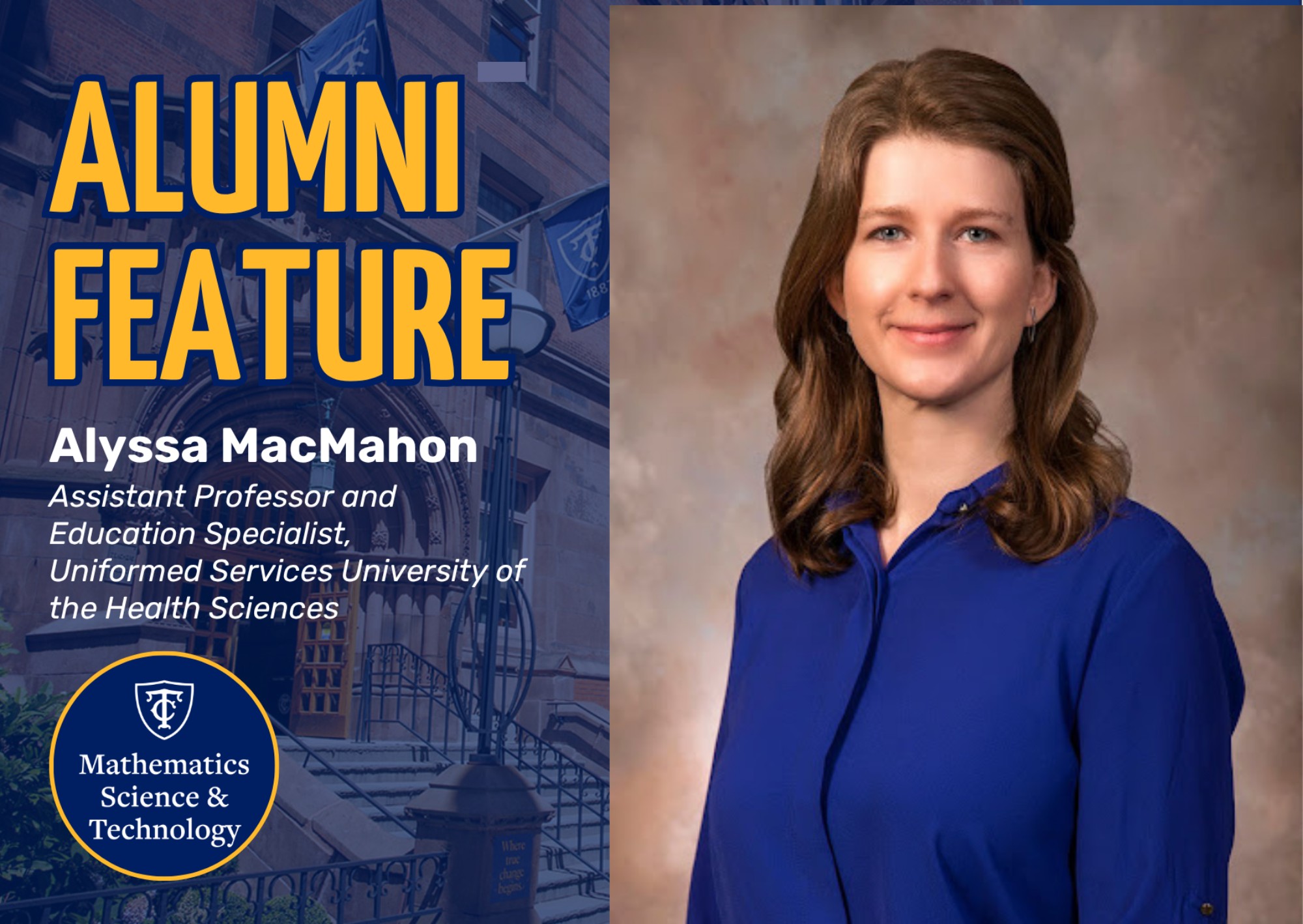
For Dr. Alyssa MacMahon, the path to becoming an educator was never in doubt. A natural affinity for mathematics in middle and high school, combined with watching her mother shape young minds in the classroom, made the choice clear. Her experiences range from secondary school teaching and private tutoring, to ultimately becoming an assistant professor at the Uniformed Services University of the Health Sciences, where she now works at the intersection of pediatric medicine and educational innovation.
Dr. MacMahon chose to apply to TC among several mathematics education programs across the country. She was drawn to the school by a mathematics education faculty known for its diversity of thought and a curriculum that she describes as approaching teaching and learning “with a holistic lens, integrating compassion and empathy.” MacMahon’s doctoral advisor was Dr. Irina Lyublinskaya, who shared her passion for educational technology. Dr. Lyublinskaya was a valuable mentor whose guidance helped to shape MacMahon’s scholarship and pedagogy. Equally formative were her fellow students, whose breadth of backgrounds sparked the kind of honest, challenging dialogue that MacMahon credits with reshaping her own practice.
"I particularly valued the broad range of backgrounds and perspectives my fellow classmates brought to our classrooms that contributed to rich conversations that made me reflect and make changes to my practice.”
Dr. MacMahon’s dissertation tackled a question at the heart of modern STEM pedagogy: how do teachers effectively fuse technology, formative assessment, and mathematics instruction? MacMahon developed an original framework which built on the widely used TPACK model, which she called Technology-Enhanced Formative Assessment (TEFA) Literacy. This model identifies the specialized competencies educators need to bring all three domains together. Her research assessed both pre-service and practicing secondary mathematics teachers, mapping which competencies developed organically, and which required deliberate training.
As an Assistant Professor and Education Specialist in the Department of Pediatrics at Uniformed Services University of the Health Sciences, MacMahon brings the same rigor she applied to secondary classrooms to the training of future physicians. Her work examines how feedback, assessment design, and technology shape learning outcomes in clinical training. Recent projects have explored the impact of screen-based simulations on clerkship performance and the use of AI to evaluate medical student writing. The MST department is proud to have Dr. MacMahon as an alum, and we look forward to seeing her work continue to grow!