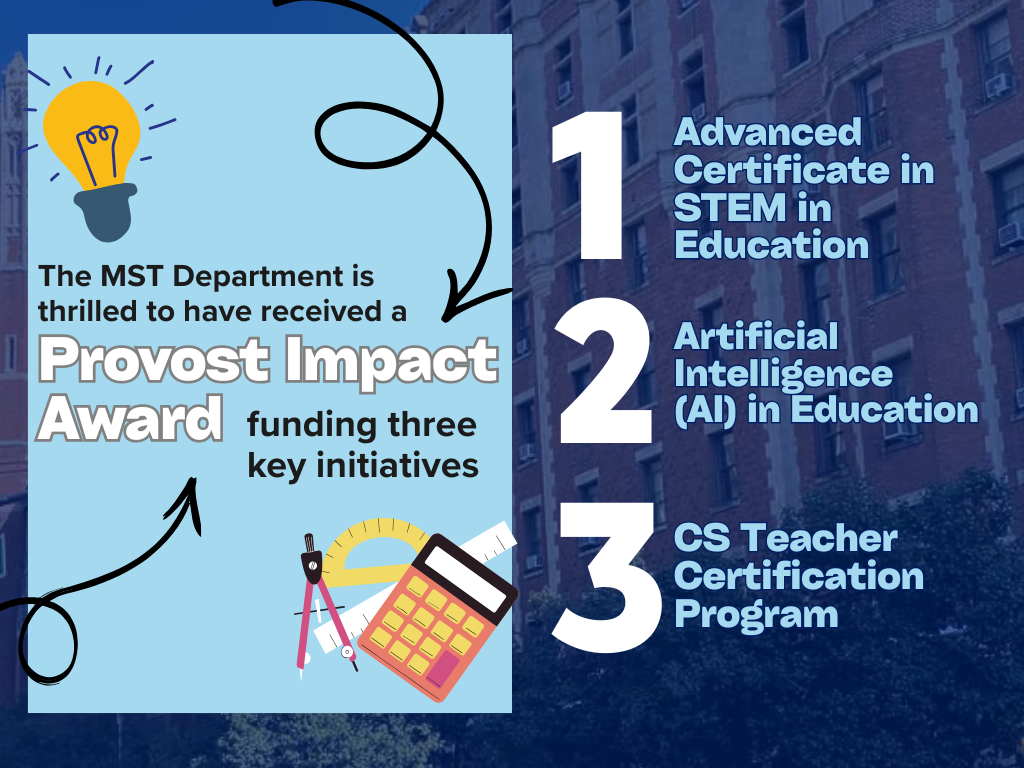
The Mathematics, Science & Technology (MST) Department is thrilled to have received a Provost Impact Award. The Provost Impact Award seeks to help departments at TC grow in new and exciting ways! Specifically, it supports projects that 1) enact TC’s values; 2) invite new students to the college; 3) create better bridges and engagement with our alum and NYC partners; 4) foster intentional partnerships; and/or 5) strengthen pathways programs into TC. In this vein, the MST Department has received this award to fund three projects: an Advanced Certificate in STEM in Education, Artificial Intelligence (AI) in Education Initiatives, and a Computer Science (CS) Teacher Certification Program.
At a moment when classrooms are being reshaped by rapid technological change, widening educational inequities, and growing demands on teachers, the MST Department is launching a coordinated set of new initiatives focused on the future of STEM education. These efforts build on years of innovative teaching, research, and community engagement within the department. Together, they respond directly to urgent needs in K–12 schools while advancing Teachers College’s mission of equity-driven educational leadership.
MST has long integrated mathematics, science, and technology with cultural, creative, and justice-centered approaches. Faculty work has explored connections between STEM and hip-hop pedagogy, popular culture, embodied learning, and youth media practices. Community-facing events like STEAMnasium have brought these ideas to life by inviting the broader NYC community to engage STEM learning in hands-on and accessible ways. The three projectss funded by the Provost Impact Award extend this tradition by translating scholarship into sustainable programs for educator preparation.
Advanced Certificate in STEM in Education
The first of these three projects is the development of an Advanced Certificate in STEM in Education. Designed for both pre-service and in-service teachers, the certificate will offer flexible pathways for educators to deepen their STEM expertise without committing to a full graduate degree. The certificate will emphasize interdisciplinary thinking across math, science, and technology, reflecting how STEM knowledge operates in real classrooms. For teachers, it provides expanded credentials and professional mobility; for schools, it helps to address the persistent shortage of qualified STEM educators.
Artificial Intelligence (AI) in Education Initiatives
The second area of focus is implementing Artificial Intelligence (AI) in Education initiatives across each program in the department. While students increasingly encounter AI-powered tools, many teachers lack the preparation to guide their use critically and ethically. MST faculty are coordinating AI-related coursework across the department, centering learning, equity, and critical understanding rather than profit-driven technologies. This work positions Teachers College as a leader in shaping thoughtful, responsible approaches to AI in K–12 education.
Computer Science (CS) Teacher Certification Program
Finally, the department is developing a K–12 Computer Science (CS) teacher certification program to address ongoing inequities in access to CS education. Despite growing demand for computing skills, many students, particularly those in underserved communities, still do not receive consistent exposure to high-quality CS instruction. This teacher certification program will align directly with the NY State Education Department’s CS certification requirements, and will adhere to NY State CS Learning Standards, Computer Science Teachers Association (CSTA) Standards, and emerging AI4K12 guidelines. In its totality, this program will prepare educators to integrate computational thinking across grade levels and subject areas.
Together, these projects reflect MST’s belief that teachers are not just implementers of curriculum, but innovators and knowledge-makers. By strengthening preparation in STEM, AI, and computer science, the department is expanding access to critical literacies that shape students’ futures. The impact of this work will extend from Teachers College classrooms into schools across New York City and beyond. Ultimately, these efforts position MST at the forefront of reimagining STEM education for a more just and rapidly changing world.