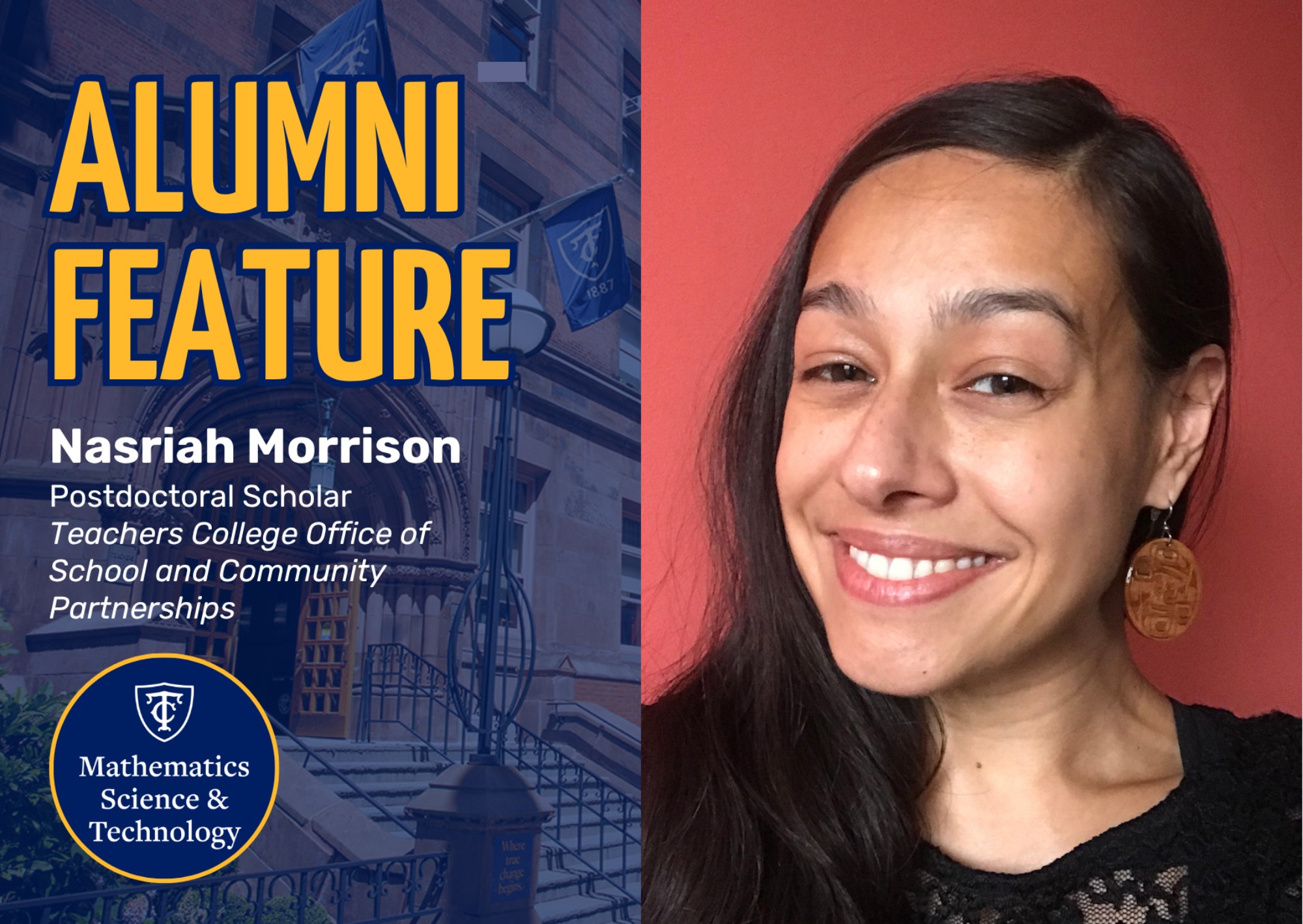
Dr. Nasriah Morrison's journey into mathematics education began in a middle school summer program. A self-described lover of math and logic, Morrison had not always found that love reflected back to her in formal classroom settings. It was when she was asked to teach math herself that something shifted. Watching her students grow more confident as they learned to build and navigate algebraic models for real-world problems, she found her passion.
Dr. Morrison completed both her master's degree and teaching credential at TC before returning as a doctoral student to join Dr. Erica Walker's Storytelling for Mathematics research team. Through this project, Dr. Morrison and her colleagues interviewed mathematicians about their learning experiences, gathering material originally intended for classroom use. But over time, she noticed how many of the mathematicians' stories resonated with her own. There were moments of doubt, negotiations of belonging, and a clear interplay between how one feels about math and how one engages with it over time.
Morrison’s doctoral research grew directly out of this project. Her dissertation became a narrative study of a subset of those mathematicians, investigating how their cognitive and affective beliefs about mathematics developed alongside sociocultural and sociopolitical forces throughout their schooling. The goal was to center their voices while identifying strategies that could better support learners from historically excluded groups.
Now in her second postdoctoral role, Dr. Morrison continues to build on the foundation her dissertation created. Her first postdoctoral fellowship with the Edmund W. Gordon Institute for Advanced Study allowed her to extend the Storytelling project's reach beyond traditional classrooms into informal learning environments, exploring how stories by and about diverse mathematicians can reshape how learners, educators, and society at large understand who mathematicians are and what mathematics is for. Her current postdoctoral fellowship in the Office of School and Community Partnerships has offered her the opportunity to more deeply explore this topic, seeking to understand how students' conceptions of mathematics and science shape their STEM identity development more broadly.
For Dr. Morrison, the personal and the scholarly remain inseparable. Her dissertation's central finding, that exposure to diverse mathematical mentors and role models plays a meaningful role in building positive mathematics identities, reflects something she has lived as well as researched. It is the same insight that animated her very first experience in a math classroom as a teacher, watching students slowly begin to see themselves in the subject.
Her advice to new doctoral graduates is as much about sustaining community as it is about career: take time to celebrate, she urges, then hold on to the mentors, mentees, and collaborators who helped carry you through. "There are many people eager to support you," she says, "as well as to learn through your guidance and example." The MST Department is proud to count Dr. Morrison among its alumni and looks forward to watching her work continue to grow.