Dr. Jooeun Shim brings a bold and community-centered vision to STEM education. Her work focuses on designing learning environments that give students genuine intellectual authority. She seeks to instill the confidence and tools to not just absorb knowledge, but to have students ask questions, analyze data, and connect their learning to the world around them as well. Since joining TC in January 2025, she has brought this philosophy to her courses, her research, and her lab: the Technologies for Action, Making, and Grasp of practice among YOUth (TAMGU) Lab.
Dr. Shim's path to TC began in South Korea, where she developed an early interest in science and learning. She came to the United States in 2015 to pursue a master's degree at the University of Pennsylvania, and it was during that time that a pivotal experience helped to clarify the direction for her career. While teaching an elective course called “App Inventor for Science Class” at a public middle school in West Philadelphia, she asked students to design smartphone apps that addressed real problems in their communities. One student who was working on a recycling app told her: “I want people to be able to make small contributions using our app. It is not big, but it is big enough that even small contributions are made to the environment.” That moment changed how Dr. Shim understood STEM education. She began to see it not just as a pathway to high-powered tech and engineering careers, but as a way to empower young people to investigate problems and take action. She went on to complete her doctorate in 2023, with a dissertation focused on critical data literacy in science classes. After a postdoctoral fellowship in the Learning, Teaching, and Literacy Division of Penn’s Graduate School of Education, which gave her more hands-on design experience, she joined the MST faculty in January 2025.
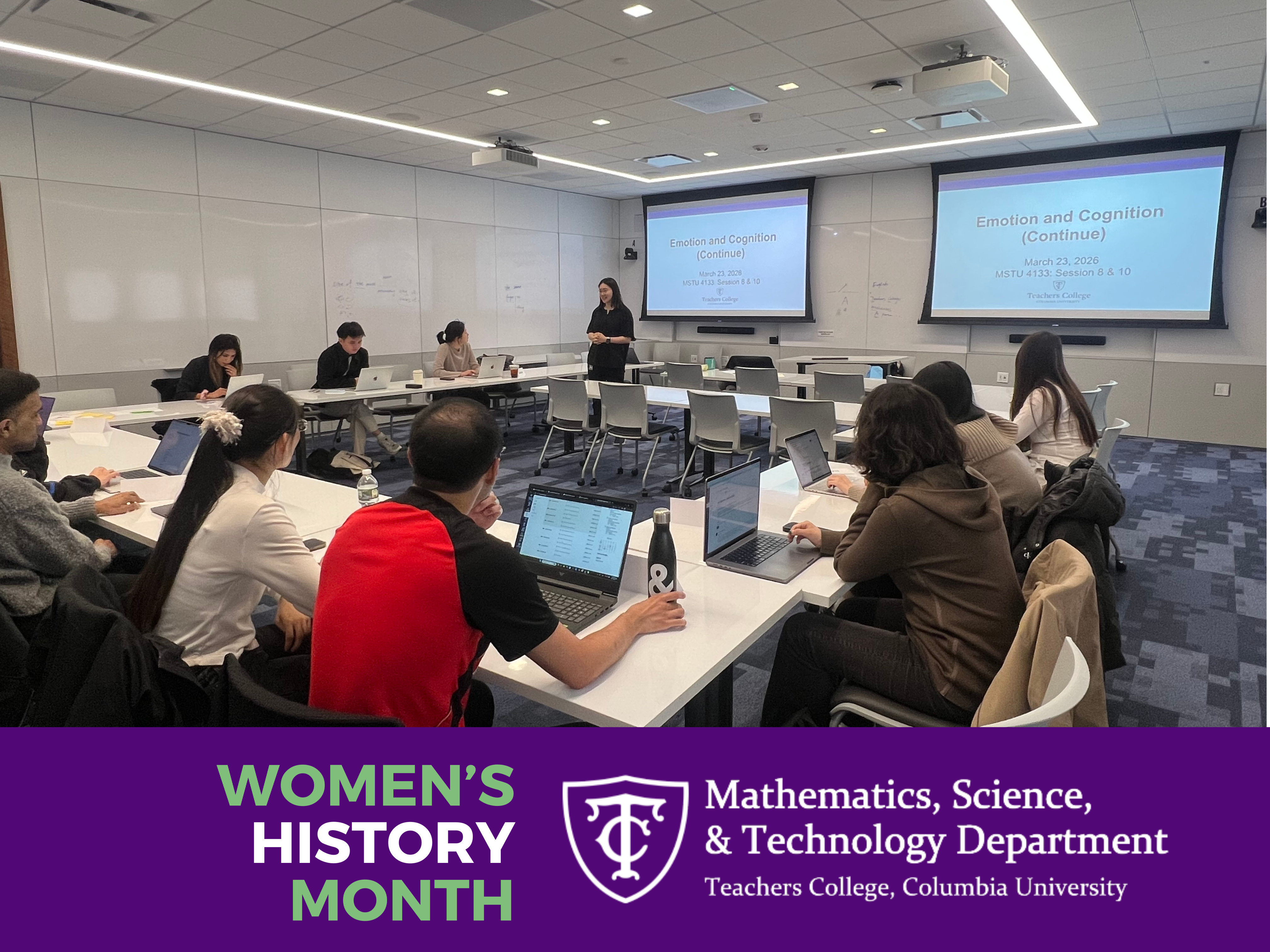
In her courses at TC, Dr. Shim is intentional about sharing intellectual authority with her students. Drawing on her own experience as an Asian woman navigating STEM spaces where certain voices are more easily heard than others, she designs her classrooms to make every student's thinking visible and valued. In her Cognition and Computers course, she uses a collaborative annotation tool that maps students' discussion posts, showing how each person's ideas connect to and shape the larger class conversation. “When students see that their ideas are there, recognized, and connected to other people's thinking, something shifts,” she says. “They start to see themselves as legitimate contributors, not just recipients of knowledge.”
Dr. Shim currently works closely with public school teachers to understand what resources and constraints they face when integrating STEM into existing classrooms, and she designs educational technology to support authentic, community-rooted learning. Her scholarship draws on an evolving framework in the field that positions STEM not merely as workforce preparation, but as a form of critical literacy. She sees STEM learning as a way for students to understand their communities, engage with complex social issues, and understand themselves as participants in civic life.
When asked which story has most inspired her as a woman in STEM, Dr. Shim points to Hidden Figures, a film she returns to regularly. “What struck me most was not only their intellectual brilliance, but how their contributions remained largely invisible for so long,” she reflects. The story of the Black mathematicians whose work was essential to NASA’s early space program resonates deeply with her own commitment to visibility in the classroom and beyond. For Dr. Shim, expanding participation in STEM isn't only about opening doors, it's about making sure that once students walk through them, their presence and their ideas are truly seen.