
Big tech is already in classrooms, with the majority of U.S. college and high school students already using artificial intelligence for their schoolwork. But by 2034, AI’s role in education will be a $112 billion industry, according to the World Economic Forum, which earlier this year urged tech leaders to work more closely with teachers on how AI can effectively prepare students for an evolving global economy.
Educators and tech industry leaders did just that during the AI for Educators Summit as part of EdTech Week, co-hosted by Teachers College and StartEd, a network of senior operators that focuses on the education technology and workforce learning sectors. More than 430 educators deepened their understanding of the opportunities, challenges and future of AI in the classroom, while gaining Continuing Teacher and Leader Education (CTLE) credits through an asynchronous course designed by TC’s Digital Futures Institute (DFI).
“Teachers College was founded over 100 years ago on the principles of education access and pedagogical excellence. These two principles are especially relevant at a time of significant digital transformation,” said Lalitha Vasudevan, Vice Dean for Digital Innovation, Managing Director of DFI, and Professor of Technology and Education during her opening remarks. “In partnering with EdTech Week, New York City's signature ed tech event, Teachers College aims to continue that legacy by centering educators as agents of innovation and change in a conversation about education technology and, more broadly, learning and society as we know it.”
Carousel
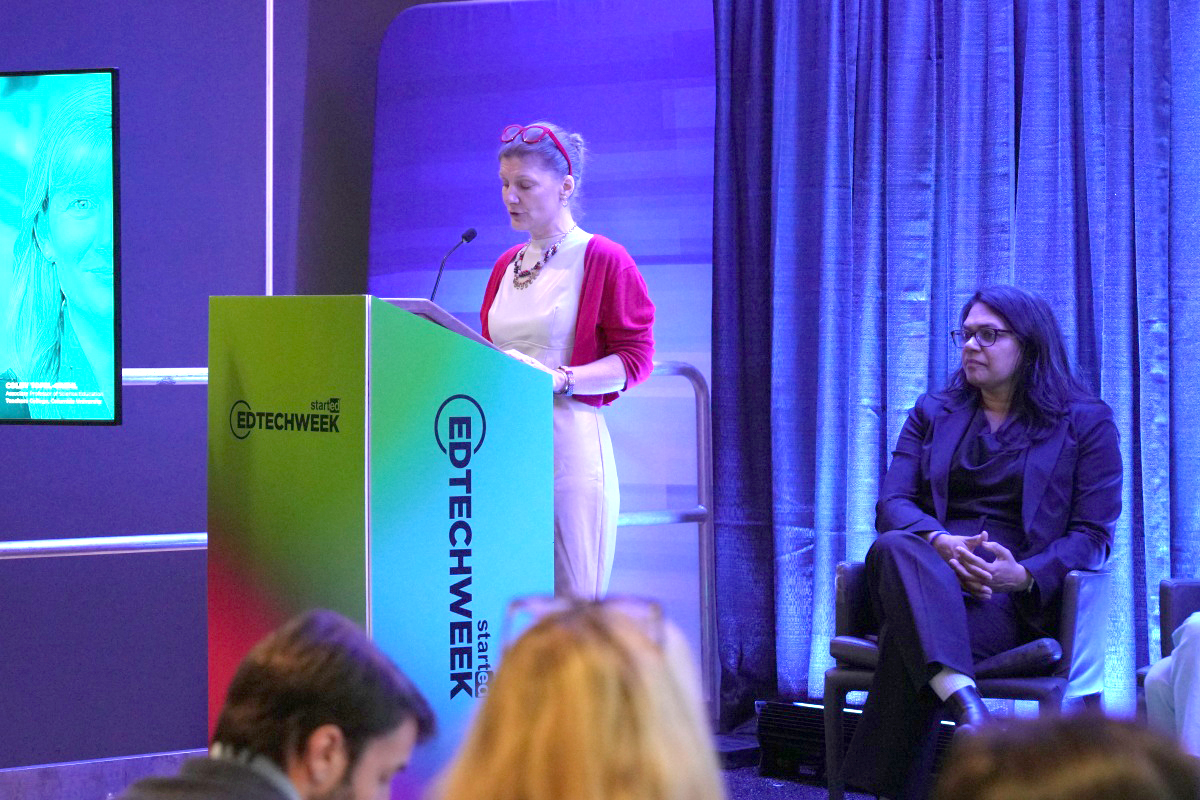
Colby Tofel-Grehl, TC’s Vice Dean for Teacher Education and School & Community Partnerships, calls for tech leaders to collaborate more closely with educators in the development of AI's future in schools. (Photo courtesy of StartEd)
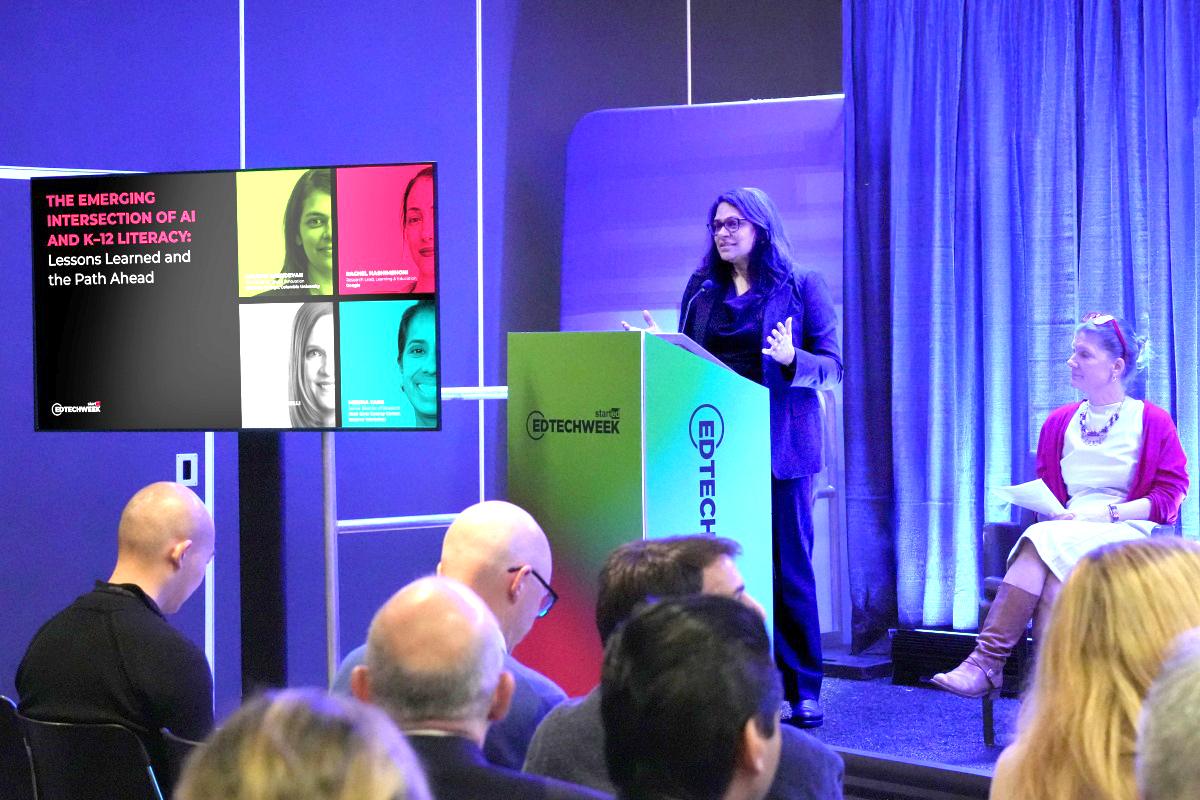
Lalitha Vasudevan, Vice Dean for Digital Innovation, Managing Director of DFI, and Professor of Technology and Education, addresses guests at the AI Summit for Educators. (Photo courtesy of StartEd)
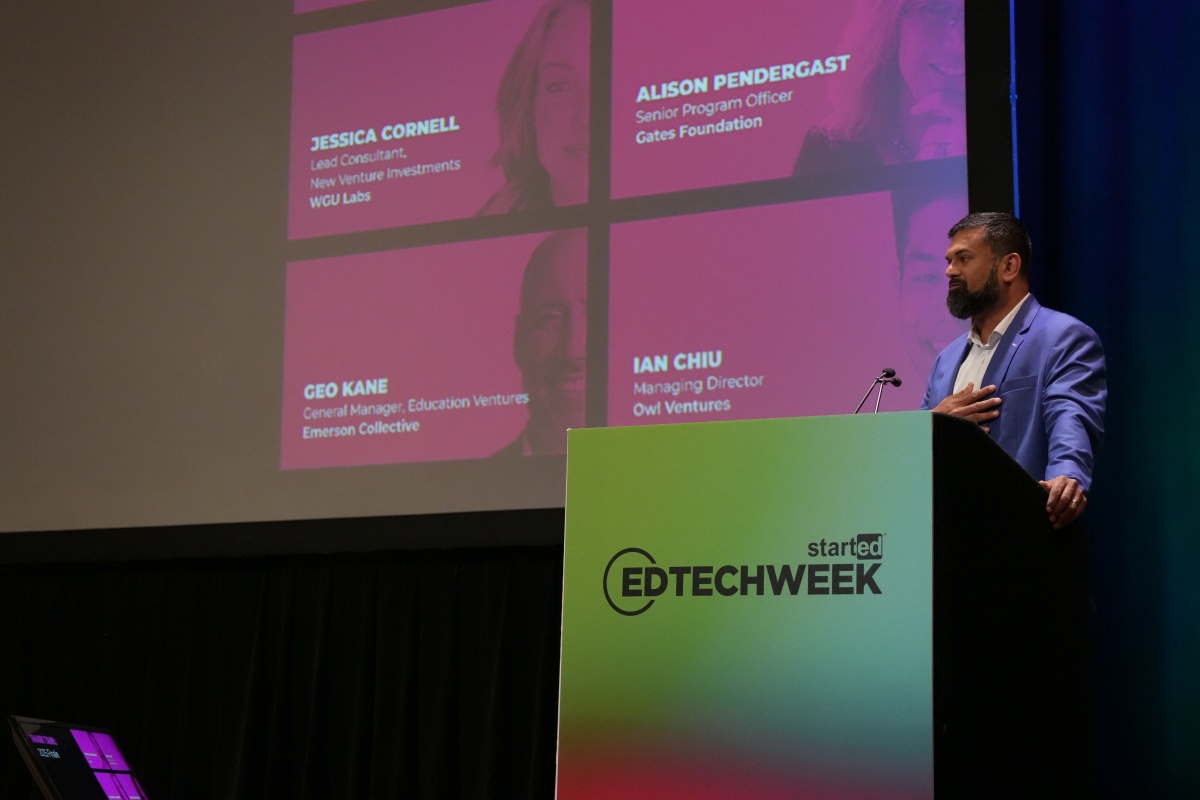
Ash Kaluarachchi, CEO of StartEd and producer of EdTech Week. (Photo courtesy of StartEd)
TC’s participation in EdTech Week aligns with the College’s broader focus on digital innovation as part of President Thomas Bailey’s Public Good Initiative and strategic priorities. In addition to preparing educators to equip students for a rapidly evolving workforce and future, TC aims to place educators and researchers at the center of the conversation so they may help tech companies develop effective, meaningful uses for AI that help students rather than harm them — a point further emphasized by TC’s Vice Dean for Teacher Education and School & Community Partnerships, Colby Tofel-Grehl, at the Summit.
It is only through our partnership with [teachers] that technology can reach its full potential of supporting community, competency and connection within and across schools.
“Teachers are professionals with complex, interlocking expertise. Educational technologies designed and developed without teacher insight and expertise will never amount to anything more than chocolate-covered broccoli,” joked Tofel-Grehl, a teacher for over a decade who pointed to ed tech tools of years past — like virtual reality goggles, SMART boards and 3D printers — that promised to revolutionize teaching, but failed to make education “new, better or faster.”
Teachers, Tofel-Grehl emphasized, can and should play a critical role in how ed tech is developed. “It is only through our partnership with [teachers] that technology can reach its full potential of supporting community, competency and connection within and across schools,” said Tofel-Grehl, who joined the College last January. “Teachers College is also here to support you as educators today and into the future. So, reach out. That's our job in support of your work. The future of education demands nimble thinkers, bold partnerships and shared creativity.”
Below, find key takeaways from experts at the AI Summit for Educators, and find more TC resources about AI in education here.
Students and teachers must have agency — especially with AI tools.
Helping students engage in active learning and productive struggle are guiding principles for effective AI usage, industry leaders and researchers discussed in numerous sessions throughout the day.
And yet, the resources available to teachers often reflect a “tension between [technological] design and the reality of classrooms,” noted Vasudevan during her moderation of the “The Emerging Intersection of AI and K–12 Literacy: Lessons Learned and the Path Ahead” panel.
Experts from Google, TurnItIn and the Joan Ganz Cooney Center at Sesame Workshop discussed their work exploring effective AI usage with Vasudevan, and the possibilities of what AI can unlock in the future — from helping teachers recognize patterns in student work and prompting feedback to enhance active reading.
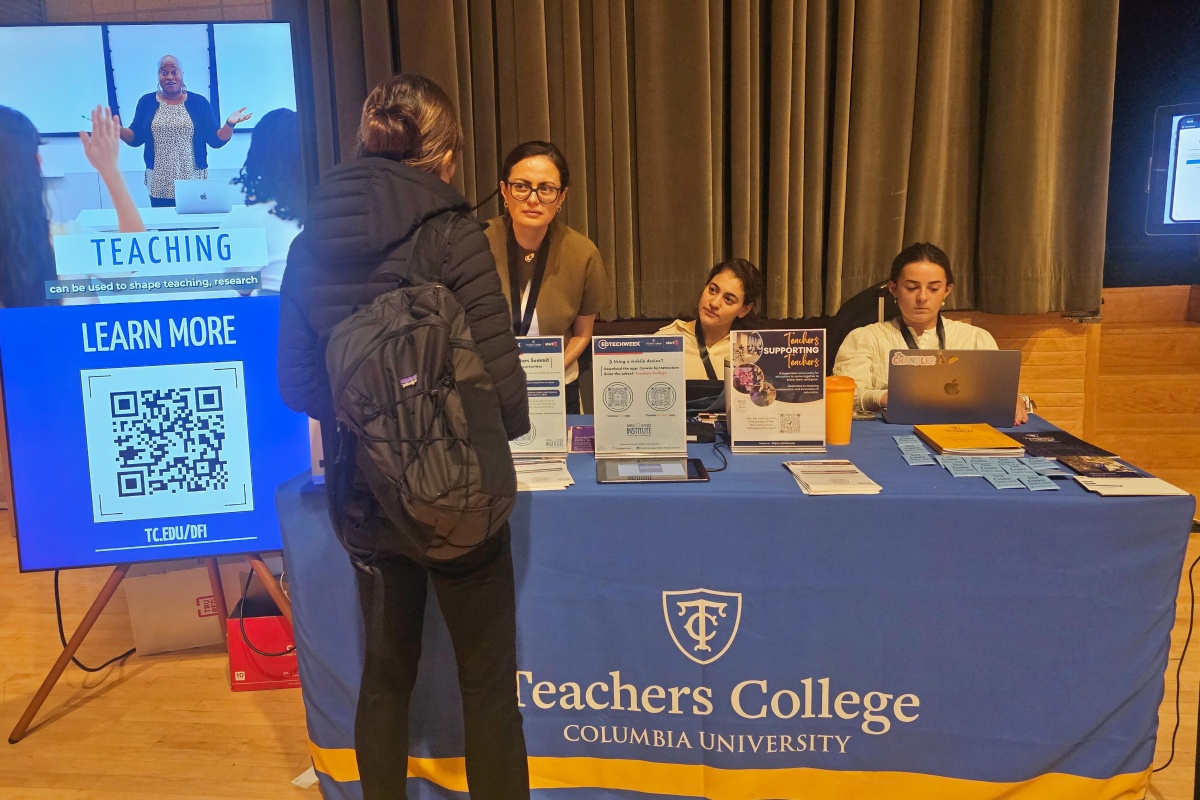
The Digital Futures Institute offered access to resources at the AI for Educators Expo. (Photo courtesy of DFI)
Being intentional about “the knowledge produced” and what informs AI tools in development is essential, Vasudevan said, but what that will look like in practice is still evolving. “We’re all experimenting and thinking about where to go, and we want to be in conversation.”
Productive struggle is also one of the focuses of Carey Swanson (M.A. ’09, Education Leadership), who helped develop AI for Education’s “Guide to Integrating Generative AI for Deeper Literacy Learning” with her team at Student Achievement Partners.
The guide outlines specific applications of AI tools that are “supportive of the cognitive lift” in contrast with uses of the same tools that are “potentially really problematic,” explained Swanson, the nonprofit’s chief literacy officer.
It's really important that we build the capacity of our education systems to understand what it is that they're dealing with. I think that should actually be a responsibility that anyone who is making an ed tech product or an approach to AI use should be undertaking.
“If you don't know the content and pedagogy that's baked into the resources that you're using, you actually might be scaling amazing things or you might be scaling garbage,” Swanson told attendees. “It's really important that we build the capacity of our education systems to understand what it is that they're dealing with. I think that should actually be a responsibility that anyone who is making an ed tech product or an approach to AI use should be undertaking.”
Professional development for educators is essential for AI success.
Even when tools are thoughtfully developed in partnership with educators, teachers will need support to properly implement artificial intelligence into classrooms. This was precisely the need TC’s Irina Lyublinskaya and Xiaoxue Du (Ed.D. ’22) aimed to address when they published Teaching AI Literacy Across the Curriculum earlier this year, the pair explained at their EdTech Week book talk.
“We realized that there really is no scaffolding for teachers about how to do it all — what exactly is practical in the classroom in different disciplines or for different age groups. There is understanding of what AI literacy is, but not how it looks,” explained Lyublinskaya during the panel with her co-author and colleagues at TC’s Smith Learning Theater.
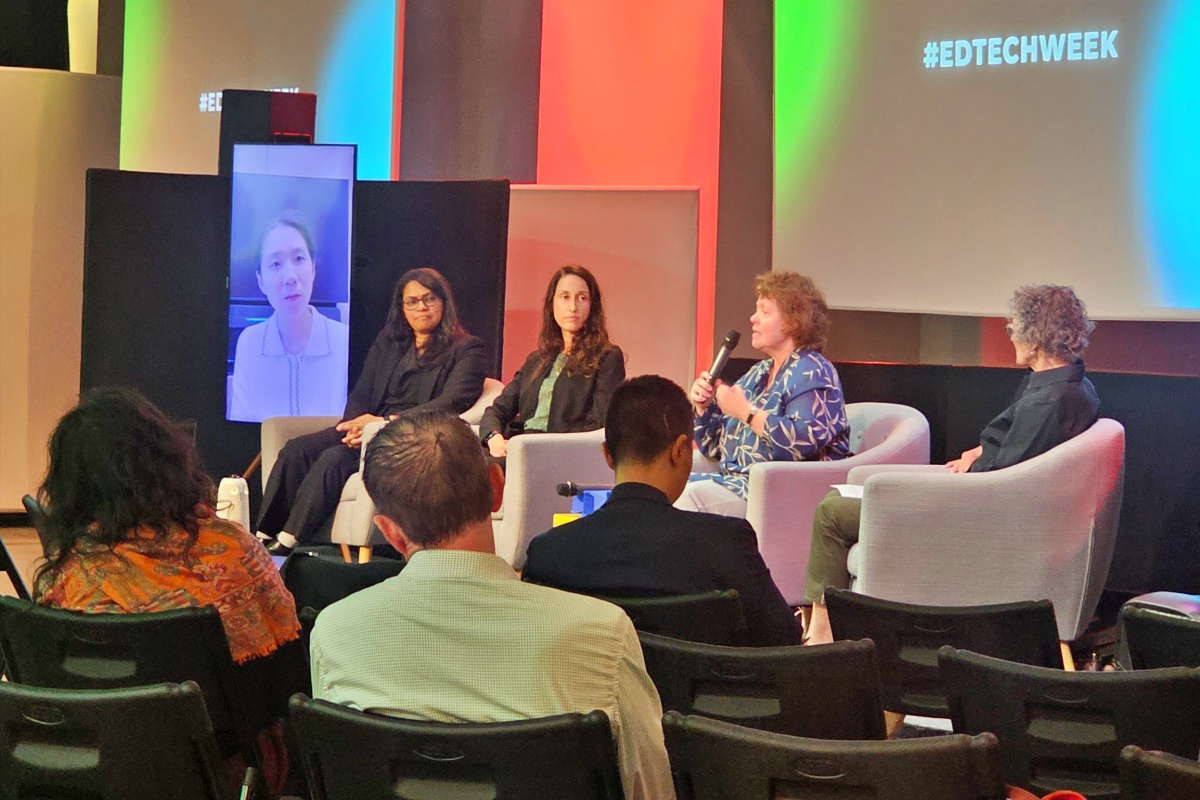
Scholars discuss Teaching AI Literacy Across the Curriculum by TC’s Irina Lyublinskaya and Xiaoxue Du (Ed.D. ’22) at TC’s Smith Learning Theater. Pictured from left to right: Du, Lalitha Vasudevan, Stacey Schultz, President of @Educate, Lyublinskaya and moderator Nancy Lesko, TC’s Maxine Greene Professor Emerita for Distinguished Contributions to Education and Executive Editor of the TC Record. (Photo courtesy of DFI)
Experts define AI literacy as conceptual knowledge of what AI is and how it works — a critical framework that students and teachers need in order to use AI tools effectively. A core mission of the book is helping teachers to practically integrate AI literacy into a multidisciplinary curriculum.
“AI literacy is doing a tremendous service, not only to the broader discourse of artificial intelligence writ large, but it's particularly focused on: how can teachers be agents of change, engagement and intentional pedagogical practice when they are invited into the black box-ness of artificial intelligence?” said Vasudevan, who joined the panel with Stacey Schultz, President of @Educate, and moderator Nancy Lesko, TC’s Maxine Greene Professor Emerita for Distinguished Contributions to Education and Executive Editor of the TC Record.
“AI literacy is everywhere,” Vasudevan continued. “This body of work strikes a really important balance between recognizing that people are coming into this set of ideas with a lot of experience already in integrating learning technologies, but also providing the scaffolds to enter into a really thoughtful engagement with what we're doing when we continue to engage with what is going be just an explosion of even more tools, even more platforms, even more technologies.”
We can help our teachers. Give them time, give them the support, give them the professional learning opportunities they need to help students.
Professional development opportunities like the AI Summit for Educators were also emphasized during the “Educators Navigating the AI Landscape: Classroom Use Cases” webinar, during which StartEd convened TC experts and tech leaders to share insights for viewers across the country.
For Professor of Practice Ellen Meier, integrating AI into schools is similar to other types of organizational change. “We can help our teachers,” said Meier, who works closely with school leaders as the Executive Director of the Center for Technology and School Change. “Give them time, give them the support, give them the professional learning opportunities they need to help students.”
Educators have a responsibility to help students build “durable skills” — an effort NYC school leaders are already undertaking.
Amid concerns about AI’s impact on the job market, school leaders, educators and tech leaders must mobilize to make students less vulnerable to expected increases in automation. New York City Schools’ Jane Martinez Dowling, Chief of Student Pathways, and her team are already systematizing what workforce prep will look like for the largest school district in the United States.
“The jobs are not going away,” said Martinez, citing a U.S. Bureau of Labor Statistics report that New York State had 500,000 open jobs in May, a 20 percent increase from eight months prior. “The challenge is how do we teach our students and how do we equip our schools with the tools and the information that they need, so that students are prepared for what the labor market is asking for [and] what employers are asking for.”
The challenge is how do we teach our students and how do we equip our schools with the tools and the information that they need, so that students are prepared for what the labor market is asking for [and] what employers are asking for.
For Martinez and her colleagues at NYC Schools, helping students forge futures alongside AI is an economic necessity and some parents are even calling for professional development to start as early as middle school.
“The most important value proposition that New York City Public Schools has is that [our students] are the talent pipeline of the future,” Martinez said in a panel with Alex Kotran, CEO and co-founder of aiEDU. “If we don't prepare our students for the world of work while they're with us, the entire city loses out.”
But amid concerns about how AI will impact workforces, there are also new possibilities. Kotran sees this as “the best possible moment to be in high school,” as today and tomorrow’s students will be the “most AI native and the most prepared,” with teachers there to help them along the way.
To move AI forward effectively, researchers and tech companies will need to meet halfway.
“Move fast and break things,” an expression coined by Meta’s Mark Zuckerberg, has come to define the spirit of tech entrepreneurs. The sentiment stands in stark contrast with the stereotypically slow pace of academic research — making the need to integrate research methodology into AI innovation and usage a challenging, yet critical proposition for those committed to the best outcomes for students and teachers.
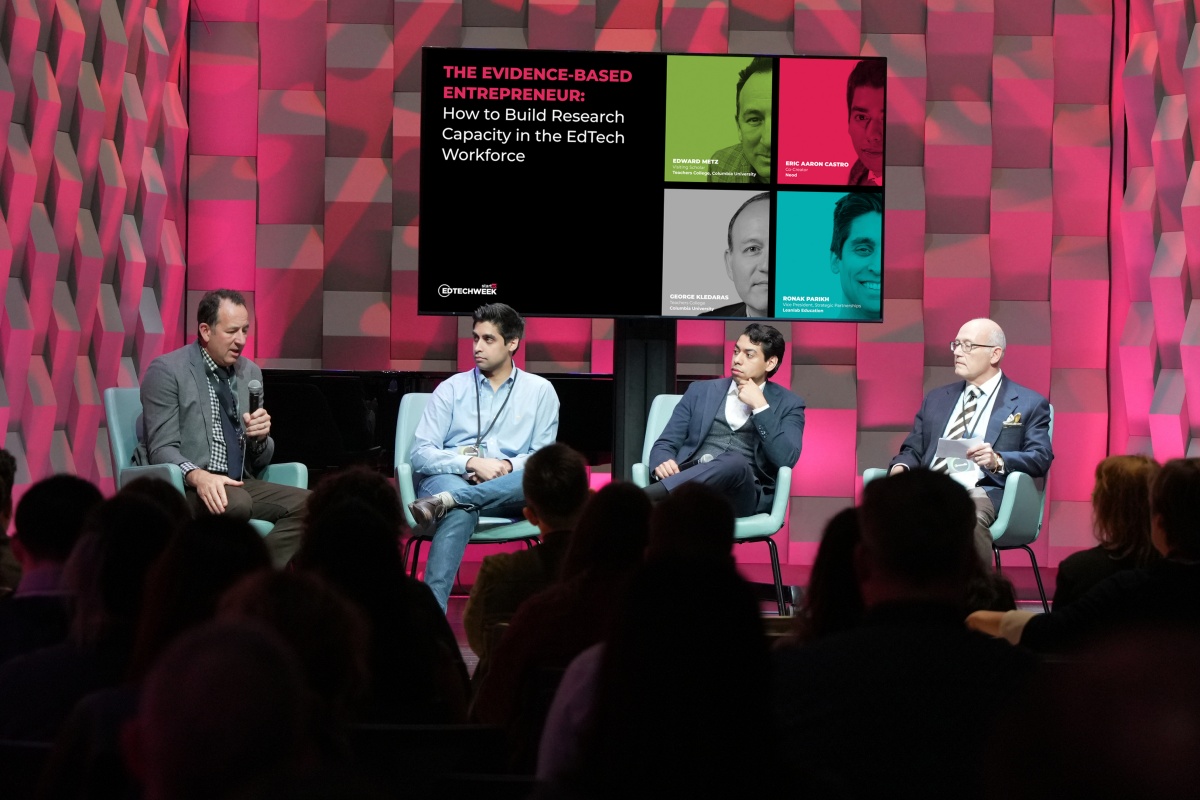
TC visiting scholar Edward Metz (far left) discusses how tech companies can partner with schools to test AI programs with Ronak Parikh (second from left), Vice President of Strategic Partnerships at Leanlab Education, and Eric Aaron Castro (second from right), co-creator of Neod, in a panel moderated by Teachers College Trustee and fintech leader George Kledaras (far right). (Photo courtesy of StartEd)
Partnerships with schools and integrating research from day one are key to helping tech companies effectively stress-test and scale products, explained TC visiting scholar Edward Metz, who spent more than 20 years as a research scientist focused on ed tech at the Institute of Education Sciences. Metz joined ed tech entrepreneurs in conversation with Teachers College Trustee George Kledaras, a fintech leader who has spent decades at the forefront of trading technology, blockchain innovation and algorithmic execution.
Learn more about AI and education work happening at Teachers College:
- Explore AI resources for teachers and dive deeper into the work happening at TC’s Digital Futures Institute.
- Gain expert insights from TC’s recent Alumni Day panel, “How AI is Changing How We Learn, Think, and Grow,” with Maria Hamdani (M.S. '21), VP of Assessment & Strategic Partnerships at the Center for Measurement Justice; Charles Lang, Senior Executive Director of the Digital Futures Institute and coterminus professor; and Assistant Professor Erik Voss, who is using AI to advance language learning.
- Learn more about AI literacy from Irina Lyublinskaya, Professor of Mathematics & Education, and Xiaoxue Du (Ed.D. ’22).
- Meet recent TC alumni working across artificial intelligence.
- Learn about last year’s EdTech Week, focused on play