M.A. in Music and Music Education (Hybrid)
Earn your master’s in music education in an innovative hybrid format with online coursework and summer residencies. Advance your career, inspire the next generation of students, and create a new future for music education.
About the Hybrid Summer Master of Arts in Music and Music Education
The Hybrid Summer Master of Arts in Music and Music Education (M.A. M&ME) at Teachers College, Columbia University, offers you an intellectually rigorous and creatively engaging education that prepares you for the challenges and rewards of teaching music in the 21st century.
The Hybrid Summer M.A. M&ME has no parallel, offering both in-person summer residencies and an online learning experience. Teachers College, Columbia University is the only Ivy League institution with a postgraduate Music and Music Education program and one of just a few universities that offers a hybrid M.A. in this area of study. With our M.A. M&ME, students get the best of everything: a world-class education, online coursework during the academic year, and two immersive Summer Residencies in New York City—one of the world’s premier cultural hubs.
As part of Teachers College, the music education master’s program gives you the opportunity to develop musical, pedagogical and leadership skills—in tandem. As a cohort-based program, it immerses you in a community of thinkers, practitioners, and scholars. You will share experiences and form bonds that impact your life throughout your time at Teachers College and long after you graduate.
Program Curriculum
The Hybrid Summer M.A. in Music and Music Education (M.A. M&ME) is a 32-credit/point program that combines online coursework with intensive summer residencies, enabling students to complete the program—expeditiously and conveniently—while continuing to work. We offer a flexible and individualized program for each student to accommodate interests, schedules, and desired career paths. Most students complete the program in two years, participating in two four-week Summer Residencies and taking online courses part-time during the Fall and Spring semesters. Students may choose, however, to take fewer online courses during the academic year and, instead, participate in a third Summer Residency.
The M.A. M&ME is a cohort-based program, meaning students who begin the Summer Residency together learn together in online and on-campus courses for the duration of the program. This model enhances learning, fosters creativity, builds life skills, and creates a sense of community. Students form bonds that often lead to lifelong friendships, as well as professional opportunities.
Learning Outcomes of a Music Education Master’s Program
In the music education master’s program you will grow as an educator, as a scholar and as a musician, with skills you can immediately apply to your classroom or studio. This graduate degree provides:
- A comprehensive understanding of music education, including the historical, philosophical, psychological, and sociological foundations of music education.
- Pedagogical flexibility that readies you to teach in a variety of educational settings, including K-12 schools, colleges, private studios, and communities.
- Inclusive and adaptive teaching skills so you can create inclusive learning environments and adapt teaching strategies to meet the needs of all students.
- A greater cultural awareness and global perspective of music's role across cultures, allowing you to teach effectively in diverse, multicultural settings and champion a wide range of musical traditions.
- The ability to incorporate technology in music education — such as MIDI, synthesizers, apps and other digital music tools — as well as strategies to stay up to date with technological advancements.
- Increased research and critical thinking skills that enable you to conduct in-depth research and then integrate these findings into your educational plans.
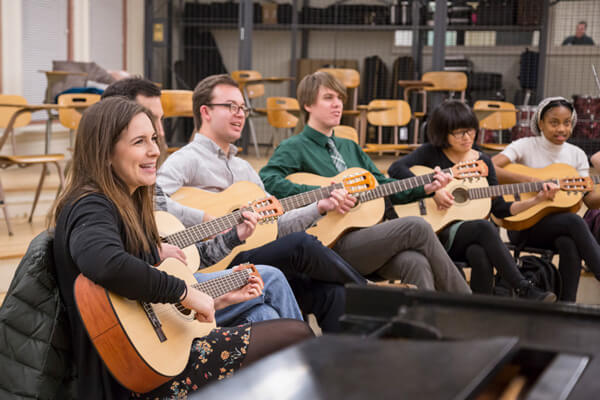
- Improved performance skills, developed through participatory vocal and instrumental courses that enhance both your teaching abilities and your own musical talent.
- Growth as an educator and a musician, encompassing both your professional knowledge and personal identity, complemented by strategies for reflective practice and self-assessment.
- A supportive community of music educators who can be sources of collaboration and inspiration during the master’s in music education program — and long after you graduate.
Program Highlights
Program Curriculum
Our cutting-edge curriculum includes fieldwork, ensemble experiences, and classroom training, equipping you with the knowledge, skills, and confidence needed to excel in 21st century educational settings.
Experiential Learning
We support your personal career goals through a student-centered approach to learning that includes opportunities to take Teachers College courses outside the music education master’s program.
Summer Residencies
Students experience two exhilarating four-week Summer Residencies that offer robust learning experiences; weekly lunches with faculty and peers; and field trips to landmark institutions, as well as to venues off the beaten path.
Our Students
The Hybrid Summer M.A. is geared toward music teachers with global perspectives who work in private, public, charter, and international schools, as well as studio and community settings. They seek to earn a valuable credential from a top music education program while continuing to teach. Students are intellectually curious and eager to develop their pedagogical skills to become better teachers, advance their careers, and become agents of change in music education.
Our Faculty
The faculty in the Music and Music Education program at Teachers College (TC) recognize the importance and uniqueness of the arts in our society and strive to offer flexible and individualized programs for the preparation of musician-educators.
They are seasoned practitioners, most of whom transitioned to higher education from K-12 classrooms. They are internationally renowned in their areas of expertise and bring an invaluable range of perspectives to the Master of Arts in Music and Music Education (M.A. M&ME) program. Their depth and breadth of experience includes comprehensive musicianship, early childhood music, instrumental pedagogy, vocal and choral performance, assessment, improvisation, jazz, technology, and the full spectrum of public and private school music through graduate school and research practices.
As leaders in the field, M.A. M&ME faculty members are authors of textbooks that graduate music education students across the world read, and their scholarship regularly appears in leading journals.
FAQs
We use the descriptor “hybrid” to indicate that students can complete the program while continuing to work through a combination of online courses during the academic year and on-campus courses during two Summer Residencies.
For teachers who hold Initial Certification in New York State, earning a master’s degree — such as the Summer M.A. in Music and Music Education — can fulfill state requirements for professional certification.
A master’s in music education can allow musicians and music teachers more flexibility in their careers. Graduate education is a great option for those who wish to teach a different grade, move to a different state or expand their skills. It is also helpful for musicians who’d like to transition into teaching.

Admission Information
Displaying requirements for the Spring 2027, Summer 2027, and Fall 2027 terms.
Master of Arts
- Points/Credits: 32
- Entry Terms: Spring, Summer
- Enrollment Formats: Full-Time Hybrid, Part-Time Hybrid
Application Deadlines
| Entry Term Available | Priority Deadlines | Final Deadlines | Extended Deadlines |
|---|---|---|---|
| Spring | November 15, 2026 | November 15, 2026 | N/A |
| Summer | January 15, 2027 | April 1, 2027 | N/A |
| Fall | N/A | N/A | N/A |
Select programs remain open beyond our standard application deadlines, such as those with an extended deadline or those that are rolling (open until June or July). If your program is rolling or has an extended deadline indicated above, applications are reviewed as they are received and on a space-available basis. We recommend you complete your application as soon as possible as these programs can close earlier if full capacity has been met.
Application Requirements
| Requirement | |
|---|---|
| International applicants are not eligible to apply for this program and are encouraged to consider other program options (those living outside of the United States with a valid U.S. passport are eligible and encouraged to apply) | |
| Online Degree Application, including Statement of Purpose and Resume | |
| Transcripts and/or Course-by-Course Evaluations for all Undergraduate/Graduate Coursework Completed | |
| Results from an accepted English Proficiency Exam (if applicable) | |
| $75 Application Fee | |
| Two (2) Letters of Recommendation | |
| Optional digital portfolio (included in online application) |
For admission-related inquiries, please contact AHadmission@tc.columbia.edu.
Requirements from the TC Catalog (AY 2026-2027)
Displaying catalog information for the Fall 2026, Spring 2027 and Summer 2027 terms.