
Teachers College/ILAS, Columbia University
The Institute makes available statistical information and analysis on digital measures in education per country after school closures due to Coronavirus (COVID-19).
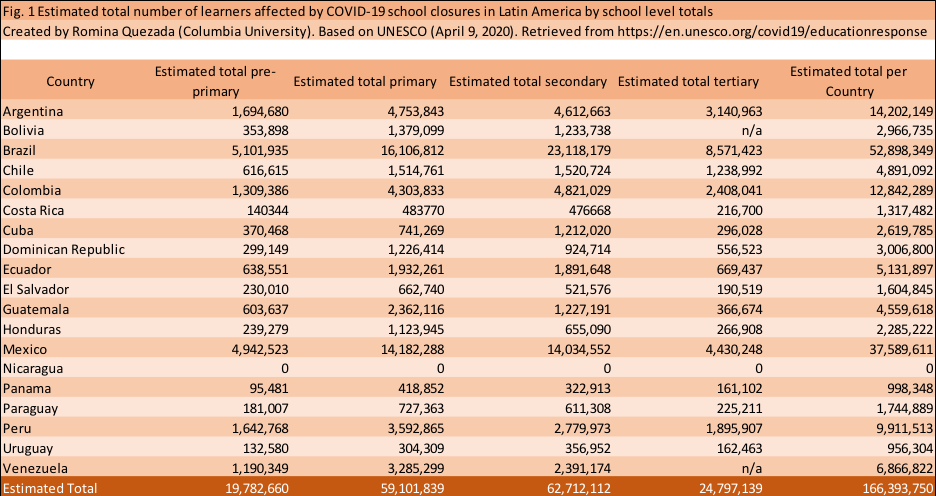
The Institute of Latin American Studies (ILAS) at Columbia University has put together Latin American National Responses to COVID-19 in Digital Learning, an Excel file that gathers information on the measures adopted in Latin American countries regarding digital learning to abide by COVID-19’s social distancing policies.
The file has four tabs gathering information mainly from statistical agencies worldwide: ECLAC, UNESCO, and WIDE. The first three tabs provide contextual information on the number of students affected due to school closures per country, gender, and level, a table on the number of measures taken by country to face social distancing in education, and a table with its corresponding graphs displaying e-readiness in Latin America’s largest commercial markets according to VISA’s E-readiness index. Figure 1 above is an extract from Tab 1.
Tab 4 provides a comprehensive summary of the context, the measures taken, and a description of each measure. The information gathered shows that all countries in Latin America but Nicaragua are undertaking some kind of digital learning strategy to continue providing education during the COVID-19 emergency situation. The majority of the countries have a platform or portal that provides educational material, although some countries prioritize the use of TV and radio. With a few exceptions, using already existing educational channels and platforms instead of creating new ones has been the trend in most of Central America. In those cases, available material does not seem to correspond to a specific grade curriculum, whereas for countries with online platforms implemented because of COVID-19, educational material tends to be divided by grade. Universities tend to follow virtual classes. Nonetheless, the situation is preoccupying because most measures seem to be improvised, and the recurrent education problems in the region (urban/rural gap, non-completion of education) are likely to increase due to unequal access to digital learning.
The Excel file is accompanied by a description and comment on its content, available on ILAS’s website.