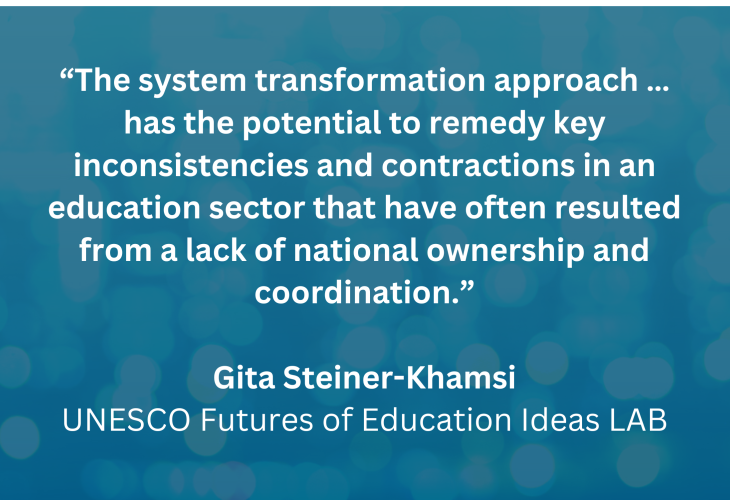
Below is an excerpt from Professor Gita Steiner-Khamsi's blog post for UNESCO's Futures of Education Lab. Here is a link to the full article.
These days, there is much talk about the need for systems thinking, about scaling innovations, and about the transformative approach in education. The last global gathering in New York was called the Transforming Education Summit; the 2025 Strategic Plan of the Global Partnership for Education has subscribed to “transformational change” and instated several grant mechanisms to ensure “system-wide impact”; both Results for Development and Brookings advance scaling innovations; and finally, one-third of the chapters of UNESCO’s flagship Futures of Education report use the term “transformation,” or variants thereof, in their titles (UNESCO, 2021). These terms are currently used in an inflationary manner. By default, buzzwords eventually become fuzzwords used by many and, therefore, malleable in their meaning. Such buzz or fuzz words lend themselves ideally to be tailored in ways that fit the organization’s own mission.
At closer examination, however, the term “system” is frequently used interchangeably with “national education system” (Steiner-Khamsi, 2023). Furthermore, in practice, scaling innovations implies scaling up the externally funded pilot projects nationwide with funding from the national budget. Finally “transformative” evokes associations with effective and sustainable reform. What are we to make of this ongoing shape-shifting that accompanies the new terms?
Apparently, the terms strike a chord with a great number of experts that use the new vocabulary to distance themselves from past structures, beliefs, and practices in international cooperation. To see it positively, the new terms may be seen as a constructive way to reflect on the shortcomings of the past. Therefore, the question becomes: what do these new terms or concepts attempt to remedy, and what alternatives do they project onto the future?
I would like to highlight three current debates that have placed these new concepts at centre stage: (i) the new emphasis on the use rather than the production of research evidence for policy and planning, (ii) the awareness that the feedback loop between the global and national level is broken and needs to be fixed, and (iii) the priority attributed to local solutions over universal best practices which had been uncritically promoted, funded and disseminated to every corner of the world.
*This blog post was prepared for UNESCO's Futures of Education Ideas LAB