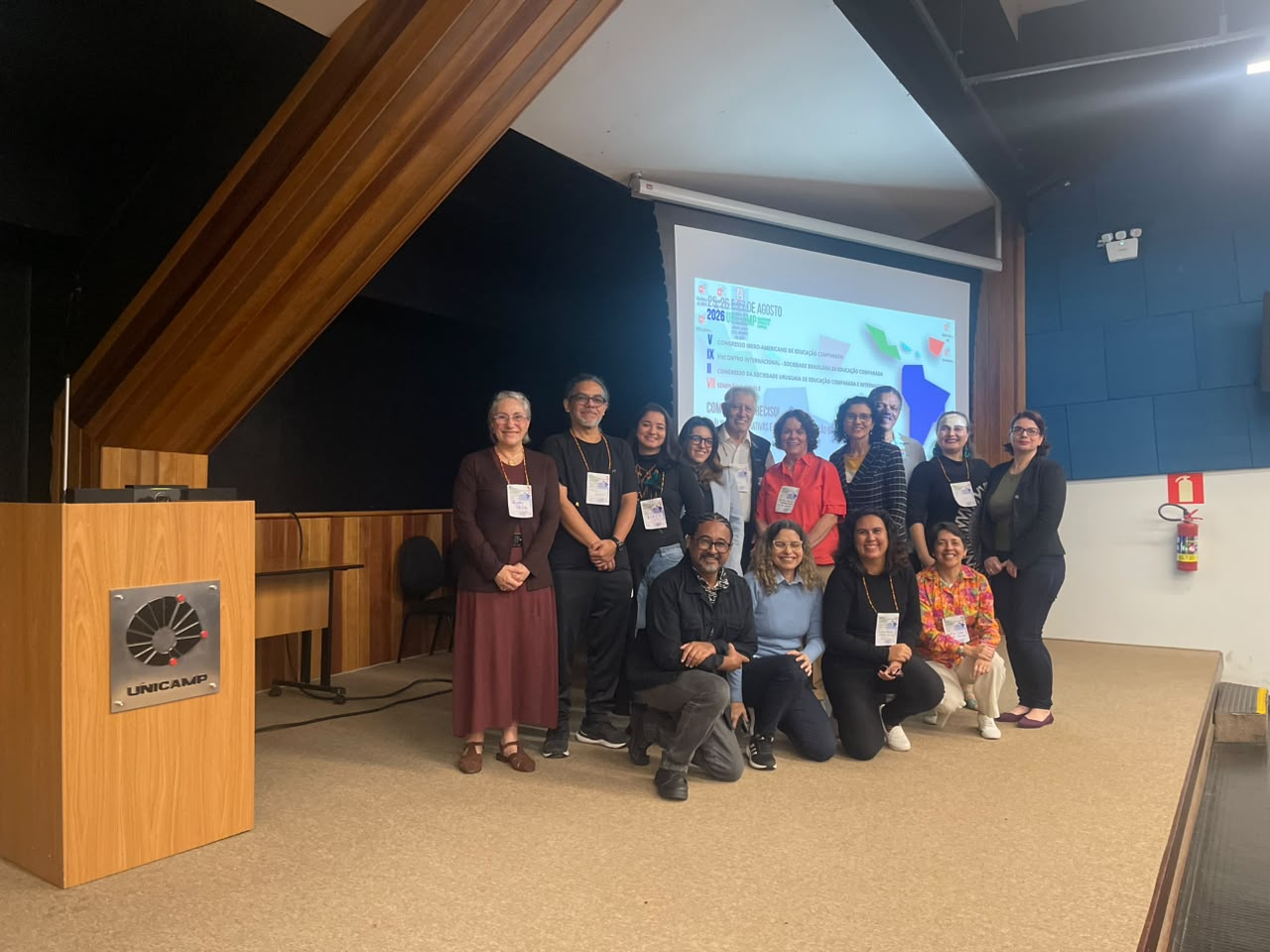
Professor Regina Cortina was invited to Brazil to take part in the conference of the Ibero-American Society of Comparative Education, co-sponsored by the Brazilian Society of Comparative Education and the Uruguayan Society of Comparative Education. The conference was held August 25–27, 2026, on the campus of the State University of Campinas (UNICAMP) in the state of São Paulo. She gave two presentations there.
Women Leaders in Education
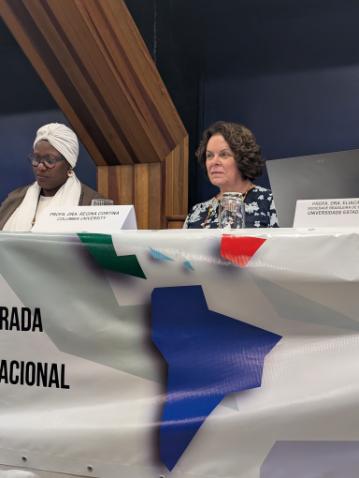
The first was a keynote speech, “Women Leaders in Education,” after which Professor Cortina joined a panel with Eutália Barbosa, executive secretary of Brazil’s Ministry of Women, who was serving as acting minister at the time; Débora Jeffrey, the first Black woman to serve as dean of the School of Education at UNICAMP; and Maria Cecília Lorea and Patrícia Vieira Duarte, faculty colleagues from Universidade Federal de Pelotas in Brazil and Universidad de la República in Uruguay.
Gender Hierarchies in High-Ranking Universities
The second presentation was with Dr. Marcella Winter, who completed her Ph.D. in International and Comparative Education in 2024 and is now a postdoctoral fellow at the Getúlio Vargas Foundation, a not-for-profit higher education institution and think tank based in São Paulo. Together they presented a collaborative research project, Gender Hierarchies in High-Ranking Universities in Chile, Colombia, and Brazil. The collaboration also includes the work of Dr. Sara Pan Algarra, who completed her Ph.D. in 2026, as well as Nina Yacher, a doctoral student, and Jonathan Beltrán Alvarado, a doctoral candidate, both in the International and Comparative Education Program (ICEP).
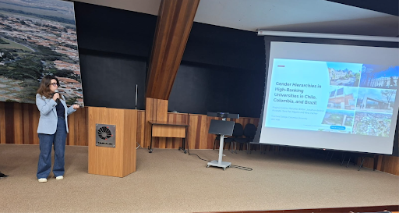
The paper compares gender segregation in six high-ranking universities: two public and two private institutions in Chile and Colombia, and two public research universities in Brazil. The study draws on longitudinal administrative data from 2007 to 2022 and cross-sectional faculty, leadership, and research data from 2019 to 2025.
Patterns of gender hierarchy proved remarkably consistent across all six institutions. From a comparative perspective, that consistency suggests the pattern is reproduced not by any one national model, but by something these universities share: they value research more than teaching, and women are concentrated in the teaching positions that carry less weight.
Decolonial Theories at the Getúlio Vargas Foundation
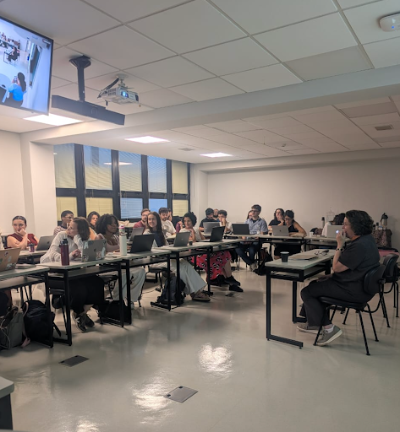
Before the conference, Professor Cortina was invited to give a talk on decolonial theories in Latin America to Dr. Winter’s students at the Getúlio Vargas Foundation. The doctoral and master’s students were keenly interested in the topic, and the conversation continued for two hours after her remarks. It was an opportunity for them to learn about theoretical perspectives from the Global South and to hear how that knowledge can be turned into practice through the Latinidad Curriculum Initiative, which Professor Cortina co-leads at Teachers College.
Overall, Professor Cortina’s time in Brazil underscored the value of cross-institutional exchanges for advancing a more equitable and pluriversal vision of comparative education in Latin America.