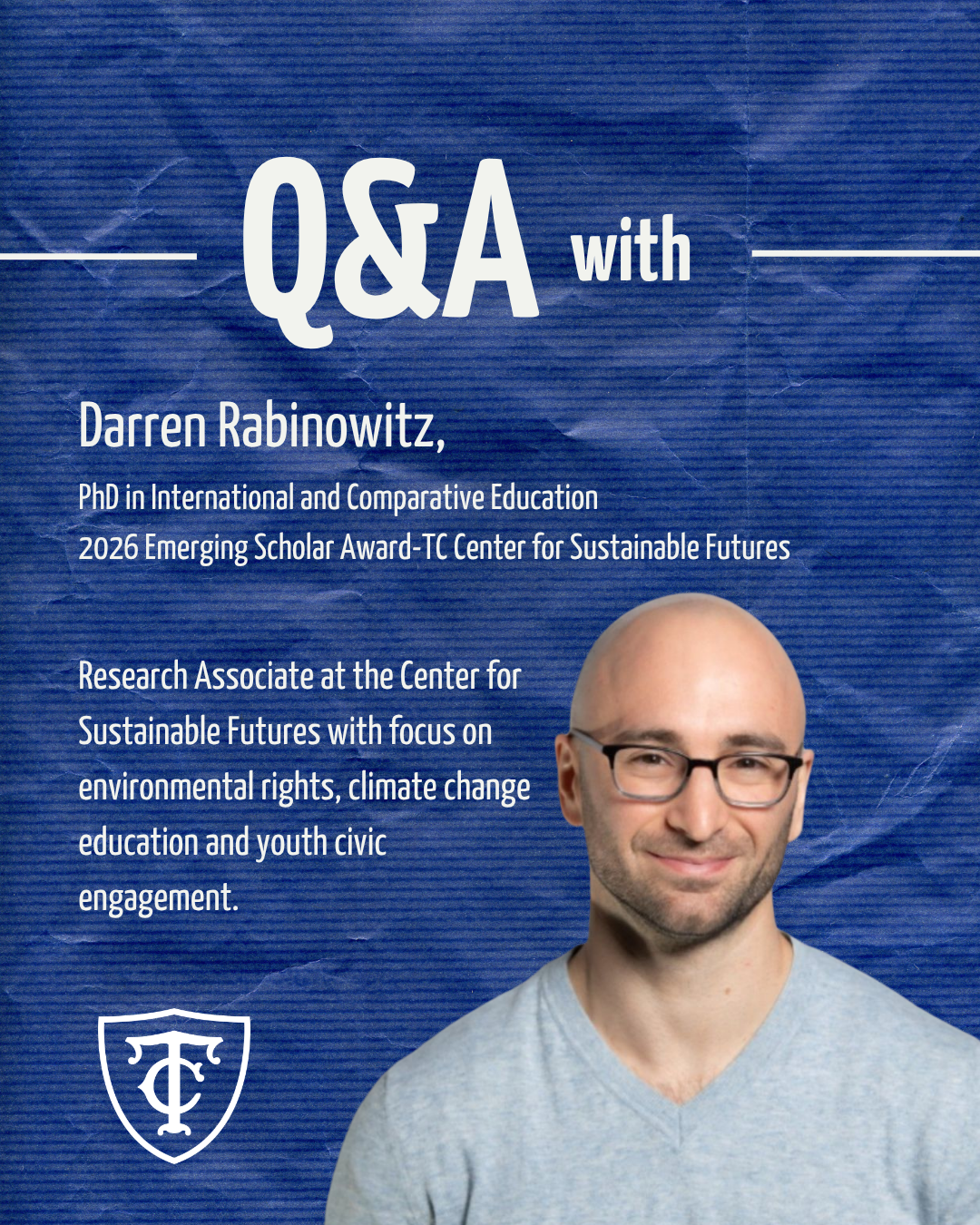
As conversations around climate change, environmental justice, and the future of education continue to grow in urgency, scholars and educators are increasingly asking how learning can respond to today’s interconnected global challenges.
In this Q&A, Darren Rabinowitz, PhD in International and Comparative Education and recipient of the 2026 Emerging Scholar Award at the TC Center for Sustainable Futures, reflects on the relationship between sustainability and education, the responsibilities of future educators, and the transformative role learning can play in moments of global “polycrisis.” Drawing from his work on climate change education, environmental rights, and youth civic engagement, Darren shares insights, recommended readings, and questions he believes the next generation must begin asking now.
Q: What first drew you to studying youth climate activists in Norway? Was there a specific encounter that sparked this research? Or a personal connection?
A: There are several reasons why I was drawn to studying climate activism. One of them being that I grew up learning in nature. My mother is a horticultural therapist and my father was a tour guide and they both placed great importance in being and learning outside. Some of my earliest memories are learning from a Lenni Lenape elder how to walk quietly in the woods. This education was part of a Pre-K outdoors education program hosted at the Great Swamp Watershed Association in northern New Jersey. It was common in my family to go on hikes in the Adirondack and Catskill mountains, camp, fish and harvest cherry tomatoes from my mothers garden in the late summer months. My mother often calls herself a ‘guardian’ rather than a ‘gardener’ when it comes to her responsibility to the land that provides for us to live and I feel the same sense of responsibility.
As for my interest in studying activism, several of my grandparents' generation were union members and strong labor rights activists. They would often tell me and my siblings that only together, not alone, will we improve our reality. Also, my mother was born in South Africa and hearing her stories of being a student at the University of Cape Town's campus during the height of campus protest against the apartheid regime familiarized me with social movements and the intersections between education and activism.
The primary spark for me to study youth climate activism was attending New York City’s Youth Global Climate Strike in 2019. I was in awe of the mass mobilization and how youth around the globe organized to demand action on climate change and protection for future generations. I found hope and inspiration amongst youth of all ages, on strike from school to protect the only home humans and more-than-human life have. I thought about how nature was my classroom as a child and what it would mean for learning and life if the environment was irreversibly harmed for future generations.
Q: Did any of your interlocutors say something that genuinely caught you off guard or shifted how you were thinking about the research?
A: Yes there were several moments that caught me off guard during my dissertation research but I will share just two.
First, when I was in Norway conducting my field work, I held interviews with youth climate activists in Southern Norway. This area is considered the fossil fuel capital of Norway. The activists I spoke with who lived there or were from this area spoke about how challenging it was to be a climate activist when many of those who live around them are employed by the fossil fuel industry. Further, they shared that the education they received was influenced by what scholars have called petro-pedagogy or a learning that intends to restrict possible climate solutions to individual acts of conservation that fail to challenge the structural growth of fossil fuel production and consumption (Eaton & Day, 2020, p. 458). They recalled annual school field trips to Norway's fossil fuel museum, visits to the ONS Energy conference and national narratives woven throughout their schooling that conjoins Norway's economic reliance and future prosperity to continued fossil fuel extraction. The ways in which the petroleum industry obfuscates and augments climate education is not always as clear in its presentation yet presents as a critical area for future research.
Second, I was surprised by how youth activists spoke about the difference between rural and urban youth climate activism. Rural activists presented themselves as more critical of climate litigation as a movement tactic due to the slow nature of the justice system. For example, during the multi-year process of the People v. Arctic Oil trial, they shared that extractive industries and projects that harmed local environments in their communities persisted. That litigation is not quick enough to protect their homes or communities from development projects or extractive industries that disregard their environmental impacts. In response, rural youth were more likely to choose more direct forms of action such as civil disobedience to inhibit extractive industry projects. Ultimately, rural youth climate activism is under-researched and requires additional exploration as to how rural youth describe their perspectives of the climate crisis and environmental degradation in relation to their climate activism and education.
Q: What would you want a graduate student entering this field today to carry with them from your research?
A: There are a few important considerations from my research a graduate student can draw which are critical for the field today.
First, all too often when we address the social and ecological challenges of today, there is tendency to develop new frameworks, agendas and policies without considering what has been before. The global environmental regime elevated the idea of environmental rights and encouraged more than 80 countries around the globe to embed them in their most sacred documents; their constitutions. In my research, I see these rights as policy relics or a result of a meeting between global environmental norms and a national prioritization of environmental protection. While many of these rights were adopted in the 1970s and 90s, they have been largely underutilized.
The case of Norway suggests that these rights are available to be leveraged by policy actors, civil society and activists. For example, Norwegian policy actors leveraged the right to advance environmental education reforms even during moments of shifting education priorities toward standardized assessments. Youth activists, on the other hand, used the right to educate themselves, their peers and the public around the paradox of having a right to a safe and clean environment within the constitution yet witnessing a growing fossil fuel industry which threatens the very capacity to assure the right is delivered to current and future generations. Environmental rights, among other policy relics, can be used to legitimize and prioritize climate environmental and climate policy such as environmental and climate change education.
Second, graduate students must see that values formation and how youth learn decision-making not only happens in schools but also occurs in informal and non-formal spaces that youth participate in. For example, youth activist spaces are under-researched in the ways they shape youth agency, belonging, knowledge of contemporary issues and solutions. In my research, youth sought activist spaces to fill a gap in their climate education. They largely possessed the knowledge of climate change and the scientific understanding from their formal education, but grappled with the lack of systems thinking, solutions orientation and action absent from their classrooms. As such they sought out alternative learning spaces to garner the climate education they were missing alongside their peers.Third and importantly, listening to youth and their desires for their own education is fundamental. Youth are highly aware of what they would like to see in their education and will often find alternative learning spaces to answer questions that remain from their formal education. Graduate students should consider what youth want in their education when it comes to the policies, curriculum and instruction that will shape their education.
Q: For someone who wants to work at the intersection of education and climate justice, what's the most important thing your research suggests they need to understand?
A: Education is an underutilized tool to teach climate action and, ultimately, advance climate justice. Yet, there are barriers which stymie education's capacity to be truly transformative. It is critical to ensure that teachers and educators are receiving the training, resources and support to teach not only the knowledge of climate change but also critical systems thinking and how young people can take meaningful action. Additionally, how parents, elders, indigenous communities, faith-based organizations and local business leaders are included in climate education efforts are critical to ensure it's not only a whole school approach to climate justice but a sustained community-wide endeavor.
The power of networks is fundamental not only between schools and formal education professionals teaching climate change, but also between schools and other organizations and spaces of youth climate engagement such as environmental organizations, political organizations and the broader youth organizational ecosystem. These networks have the capacity to share localized approaches to climate change education and best practices that are context specific and culturally relevant. Further exploring the regional and within country differences in student climate competencies is imperative to understanding why variation occurs in student climate learning outcomes in knowledge, attitudes, and behaviors toward climate action.
Q: (The MA program at TC sits right at this intersection of sustainability and education.) From your perspective, why does that combination matter right now?
A: The Teachers College Center for Sustainable Futures has been developing the M.A. in Sustainability and Education program for several years and it is a huge step forward in making it clear that Columbia University is committed to elevating the role of education in addressing climate change and sustainability issues. Scholars have described this moment in global history as a moment of polycrisis - or multiple intertwined crises such as authoritarianism, the climate crisis, upsurge of war, economic instability and the malicious effects of AI happening simultaneously. While the task of addressing these issues is daunting, graduate programs, like the new M.A. program, are well situated to prepare graduate students to address the nuance of how sustainability and climate change are interwoven in the polycrisis. Further, ensuring that graduate students understand the transformative power of education and possess the professional skills needed to support current and future learners fills a dire need in the sustainability and education sectors.
Q: What kinds of questions do you hope the next generation of educators and sustainability leaders will be asking that aren't being asked enough today?
A: The next generation of professionals need to ask whether the current economic, political and social status quo is fit to not only sustain but restore the climate, biodiversity and the environment. This line of thinking must also be applied to education. We must critically ask whether education is complicit in perpetuating the same crisis we find ourselves in today. If it is, then how must we change learning, education and professional development to correct the course. Future education and sustainability leaders must question whether schooling teaches learners to be in right relation with the land, move toward a pedagogy of restoration and undergird how harm to the environment is violence toward ourselves and the more than human life we share the planet with.
Q: Is there a book, a podcast, or even a movie/show that you recommend for those interested in the intersection of sustainability and education?
A:
- Miseducation: How Climate Change Is Taught in America by Katie Worth
- Agency, Democracy, and Nature: The U.S. Environmental Movement from a Critical Theory Perspective by Robert Brulle
- Returning the Gift in Minding Nature by Robin Wall Kimmerer
- Climate Education beyond COP26 by Fresh Ed Podcast https://freshedpodcast.com/kwauk-iyengar/
- “Young People Have Had Enough”: Global Climate Strike Youth Activists on Why They Are Marching https://www.youtube.com/watch?v=j3reFtbiUXw