Regulatory Basis for Local Context Review
Institutional Review Boards (IRBs) are required to consider local context because federal regulations expect them to understand the environment in which research takes place. Under the Common Rule (45 CFR 46.107(a)) and FDA regulations (21 CFR 56.107(a)), IRBs must be sufficiently qualified through the experience and expertise of their members to recognize community attitudes, assess risks and benefits, and evaluate whether research aligns with institutional policies, resources, professional standards, and applicable laws.
Without adequate knowledge of the local context, IRBs cannot accurately evaluate whether risks are reasonable, whether consent processes are appropriate, or whether participant protections are sufficient for the population involved. This includes consideration of local laws, institutional policies, and social or cultural norms that may be more restrictive than U.S. regulations.
In certain circumstances, such as planned emergency research conducted under an exception from informed consent (21 CFR 50.24), regulations go further by requiring community consultation. These requirements underscore that local context is not optional; it is integral to ethical review, particularly when traditional consent processes may not be feasible.
Institutional Responsibility and Federalwide Assurance
Institutions conducting human subjects research operate under a Federalwide Assurance (FWA), which is a written agreement committing the institution to comply with applicable human subjects protections. This includes not only U.S. federal regulations, but also any additional requirements imposed by funding agencies, host institutions, and relevant state, local, or international laws.
When research is conducted outside the United States, U.S. federal regulations may not apply at the performance site. However, institutional oversight responsibilities remain in effect. As a result, IRBs must obtain sufficient information about the local legal, ethical, and cultural environment to ensure that institutional standards for participant protection are met. Local context review is one mechanism by which this obligation is fulfilled.
Customs, Beliefs, Values, and Practices
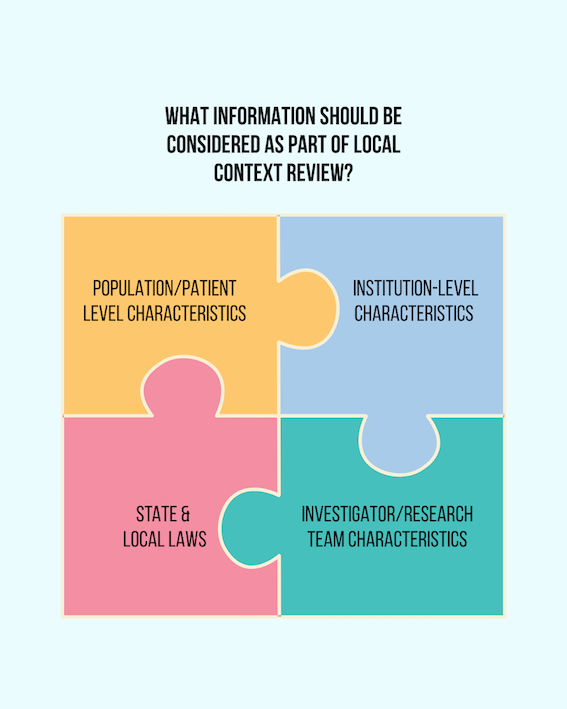
Local context encompasses a wide range of cultural, legal, and social considerations that may affect how research is perceived, understood, and experienced by participants. These may include, but are not limited to:
- Decision-making norms, such as whether participation decisions are made individually, within families, or at the community level
- Modes of communication, including preferences for oral versus written information and varying levels of literacy
- Comfort with signing documents, particularly when documents resemble official or legal records
- Restrictions on technology or transportation, which may affect participation, data collection methods, or study feasibility
- Belief-based restrictions, including norms related to contraception, medical interventions, or gender roles
- Health insurance norms, which may influence consent language or participant expectations
These factors are not peripheral. They directly affect recruitment, consent, risk assessment, and participant protections.
Local Context Review in International Research
For research involving non-U.S. collaborators or international performance sites, local context review is a required component of the IRB review process.
At Teachers College, local context review is conducted using a structured Local Context Review template. This review is completed by a qualified local context reviewer, such as a representative of a local ethics committee, a local ethics expert, or a knowledgeable local collaborator, and includes disclosure of conflicts of interest and a confidentiality agreement.
International research submissions must address the following:
- Local context review using TC’s template, documenting whether recruitment, consent, compensation, privacy protections, and other study procedures are consistent with local laws, institutional policies, and cultural practices
- Translation verification for consent documents and other participant-facing materials, with attention not only to linguistic accuracy but also to cultural appropriateness and comprehension
- Compliance with applicable privacy and data protection laws, such as GDPR or PIPL, including confirmation that proposed data handling practices are feasible and acceptable in the local context
Researchers should consult TC’s International Research guidance for required templates and detailed submission instructions.
What Local Context Review Affects in IRB Review
Local context considerations directly inform multiple aspects of IRB review, including:
- Recruitment procedures and outreach methods
- Consent and assent processes and language
- Risk assessment and the reasonableness of risks in context
- The need for additional safeguards
- Privacy and confidentiality protections
Local context review helps ensure that these elements are evaluated not only against regulatory standards, but also against the realities of the setting in which the research will occur.
Triggers for Additional Local Context Expertise
Certain study characteristics may warrant additional local context expertise or closer scrutiny, including:
- Differences in standards of care between the U.S. and the local setting
- Use of placebos, sham procedures, or randomization, particularly where access to care is limited
- Deception or incomplete disclosure
- Known compliance issues, such as recent audits or noncompliance findings
- Institutionally sensitive topics or research involving stigmatized populations
- Studies conducted in communities with distinct cultural, political, or historical considerations
These factors may independently or collectively increase ethical, cultural, or regulatory sensitivity and require enhanced review.
Final Note
Local context review is not a substitute for ethical research design, nor is it satisfied simply by having a local collaborator. It is a structured process that helps IRBs assess whether research is appropriate, respectful, and protective of participants in the specific environment where it will take place.
For comprehensive guidance, required templates, and submission instructions, visit TC’s:
International Research and External Collaborations resources.