By Andrea Kim, PhD Candidate in Sociology and Education & Rhea Jaffer, EdD Candidate in Technology, Media, and Learning
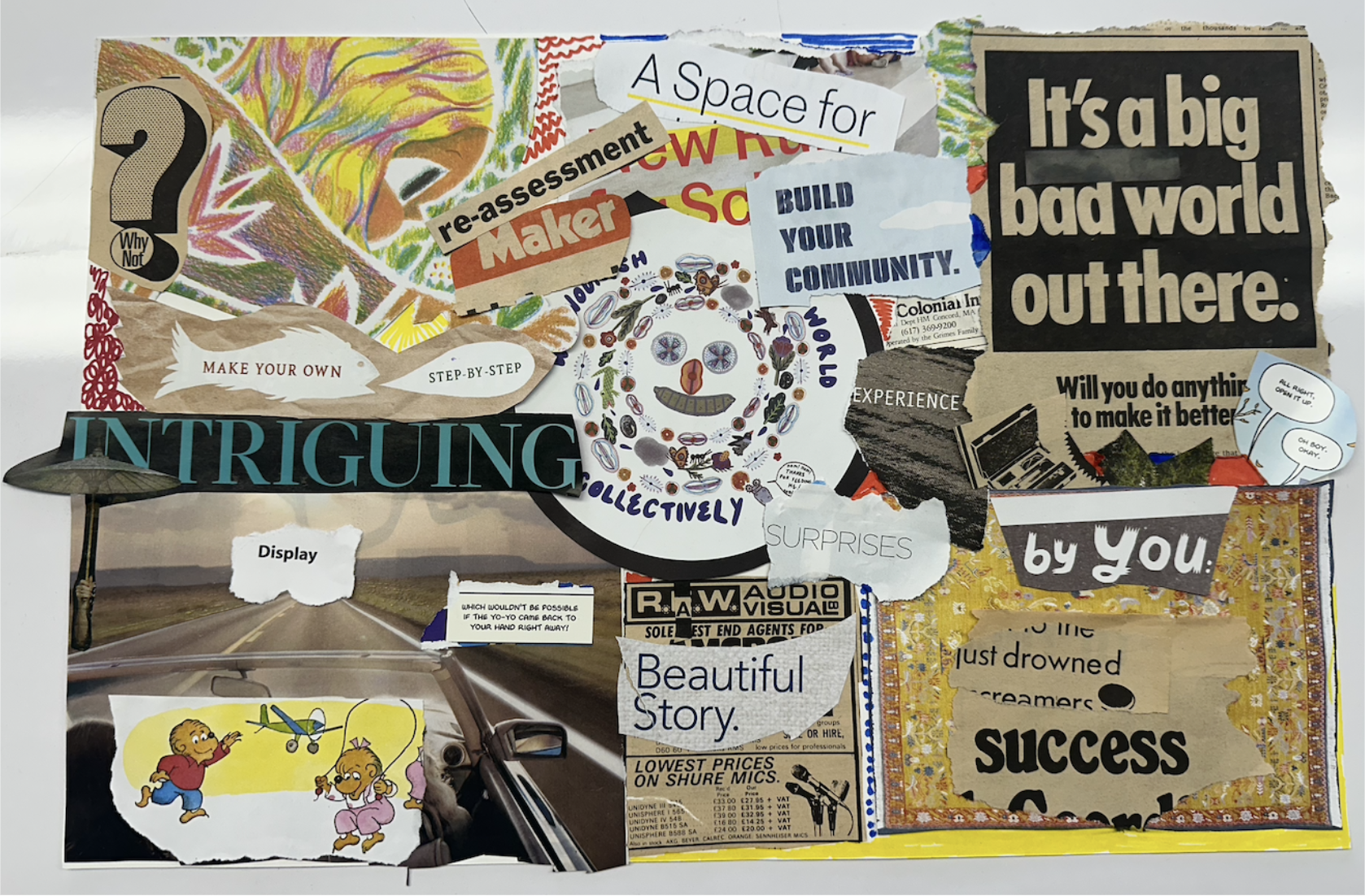
Andrea and Rhea, two Teachers College doctoral candidates, explore multimodal research and data analysis through collaborative collaging during DFI’s Multimodal Scholarship Working Group.
Introduction (Andrea and Rhea)
Multimodal collage: A story of two doctoral candidates making sense of their research journeys
As two doctoral students from distinct fields—Andrea in Sociology and Education and Rhea in Technology, Media and Learning—we were drawn to multimodal scholarship for different reasons, both searching for something that not only looks different, but feels different.
We met through a constellation of multimodal spaces, including DFI events, MASCLab, and a doctoral seminar on Multimodal Methods, that eventually led to friendship: two doctoral candidates with a love for noodles, and navigating academia. Our curiosity, and ultimately this collaborative reflection, came from shared unease with what counts as “real” or “serious” scholarship and fatigue with the dissertation process, where fun had been drained and the joy and purpose of learning felt lost. Without that sense of joy or connection, the work began to feel insular—and we found ourselves asking: if our work isn’t to engage the public outside the ivory walls, what is this all for? In reflecting on this question, we realized that both of us, in our own ways, were seeking permission: permission to play, to experiment, to unlearn what we’d internalized about legitimacy and rigor in the academy.
This Perspectives piece is organized through collage, a generative mode we learned and practiced in a multimodal methods course with Dr. Haeny Yoon and Dr. Lalitha Vasudevan. We include collage in two forms. First, we offer the visual collages we created together and individually, using them as artifacts that reflect the processes we describe. Second, we use collage as a writing strategy. This introduction represents our collective voice. The sections that follow place our individual reflections side by side, allowing our perspectives to speak to one another through juxtaposition rather than through a single, unified narrative. In structuring the piece this way, we extend the spirit of multimodal scholarship and invite readers to experience the layered, relational, and sometimes messy nature of our collaborative meaning-making.
Andrea: Permission to Play Through Collage
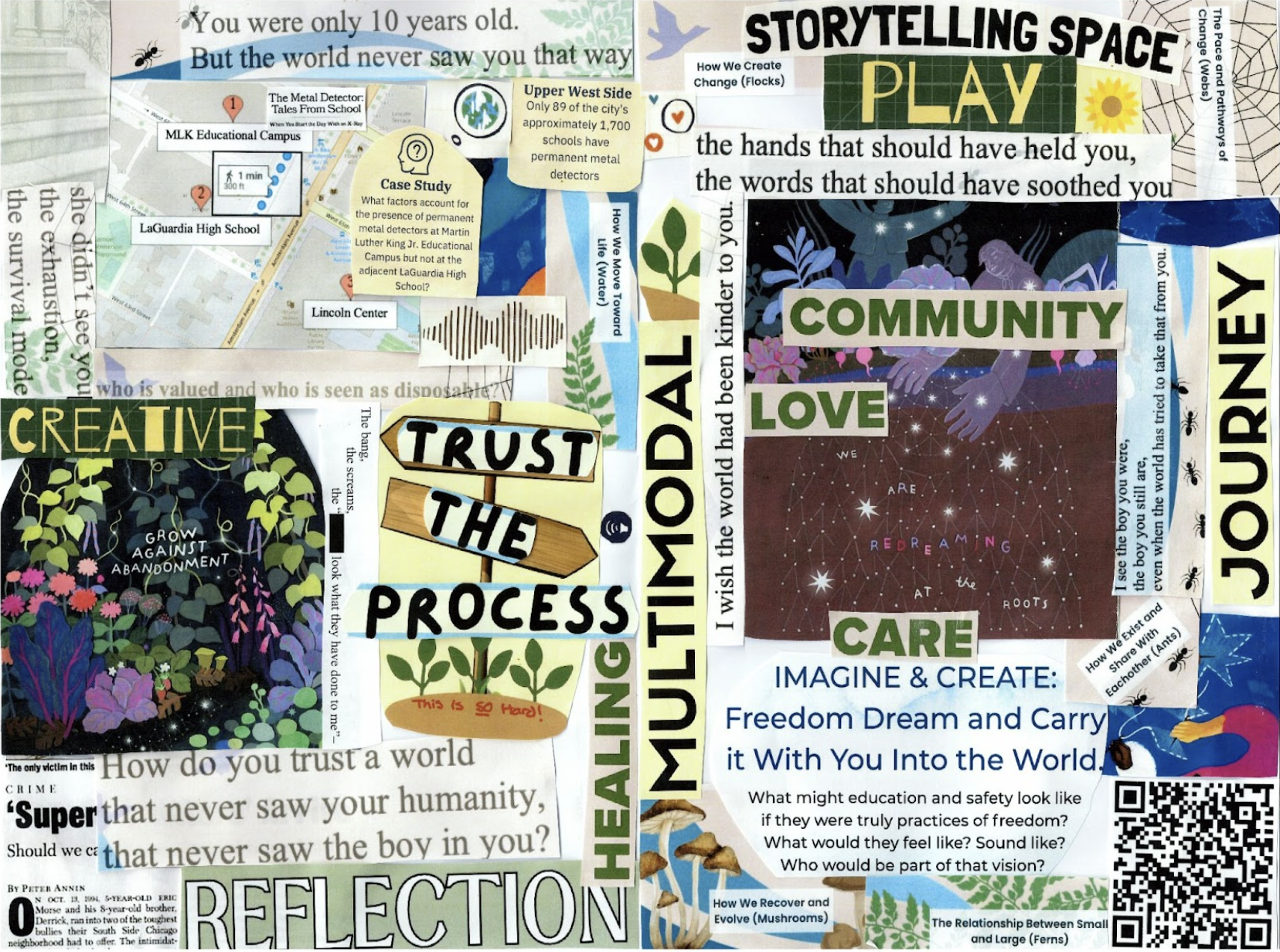
Andrea’s multimodal final collage, created in Dr. Lalitha Vasudevan and Dr. Haeny Yoon’s multimodal class using magazine and newspaper clippings, public digital artwork, glue on paper, and excerpts from her dissertation writing.
Andrea’s multimodal final collage, created in Dr. Lalitha Vasudevan and Dr. Haeny Yoon’s multimodal class using magazine and newspaper clippings, public digital artwork, glue on paper, and excerpts from her dissertation writing.
When I think about play, I think of the obvious kind: fun, hands-on, childlike, imaginative. So much of my schooling, however, taught me to restrict that side of myself—to quiet the impulse to explore, to stay within the lines of what counts as “serious” work. I have questioned what counts as “real” scholarship. Even when I tried to resist the questions, I still caught myself wondering, Is this right or wrong? Will this be accepted? These questions, over time, crept into my why, and the joy and purpose that brought me to TC got lost. The process that was supposed to nurture curiosity began to drain it.
That began to shift when Rhea and I took a class called Multimodal Methods led by Dr. Haeny Yoon from the Early Childhood Education Program, and Dr. Lalitha Vasudevan from the Technology, Media and Learning Program. Each week, we had space not only for what I jokingly called “research therapy,” but also to experiment with various modes of meaning-making. We collaged, recorded, photographed, and wrote, not to produce polished “products,” but to explore what ideas feel like when we move beyond words. Even within text itself, I found new methods of expression, especially through redaction. The act of removing language became a form of critique, challenging the narrow academic expectation that knowledge must follow familiar, polished forms in order to be valued.
For the first time in my doctoral journey, I felt permission to play. I began collaging archival materials to shape my theoretical framework, experimenting with sound and image to deepen my inquiry, and even writing poetry, a form I hadn’t touched since middle school. Through these experiments, I realized that there’s nothing un-scholarly about play. In fact, it allows us to center emotion, story, and experiences—elements often stripped away or taken for granted in academic writing. Research can and should be playful and deeply human. Looking back, I realize that even my early questioning—Is this right or wrong? Will this be accepted?—wasn’t just doubt: it was intuition. A quiet reaching toward more human, more multimodal ways of making meaning that I hadn’t yet learned to name.
Through these experiments, I realized that there’s nothing un-scholarly about play. In fact, it allows us to center emotion, story, and experiences—elements often stripped away or taken for granted in academic writing. Research can and should be playful and deeply human.
Through this permission, I began to see how the very instincts I was taught to quiet through academic traditions—curiosity, imagination, fun—were never flaws, but the foundation to what makes research more human. And as humans, we are inherently multimodal: We communicate through language, sound, images, gestures, emotions, and experiences. Yet, academia has often forced us into one-dimensional, text-based frameworks that ignore the richness of our multimodal selves.
By embracing play, we reclaim the full spectrum of how we experience and express knowledge. It’s not about abandoning rigor; it’s about expanding the possibilities for how we engage with our work and the world.
Rhea: Collaging Process as Practice
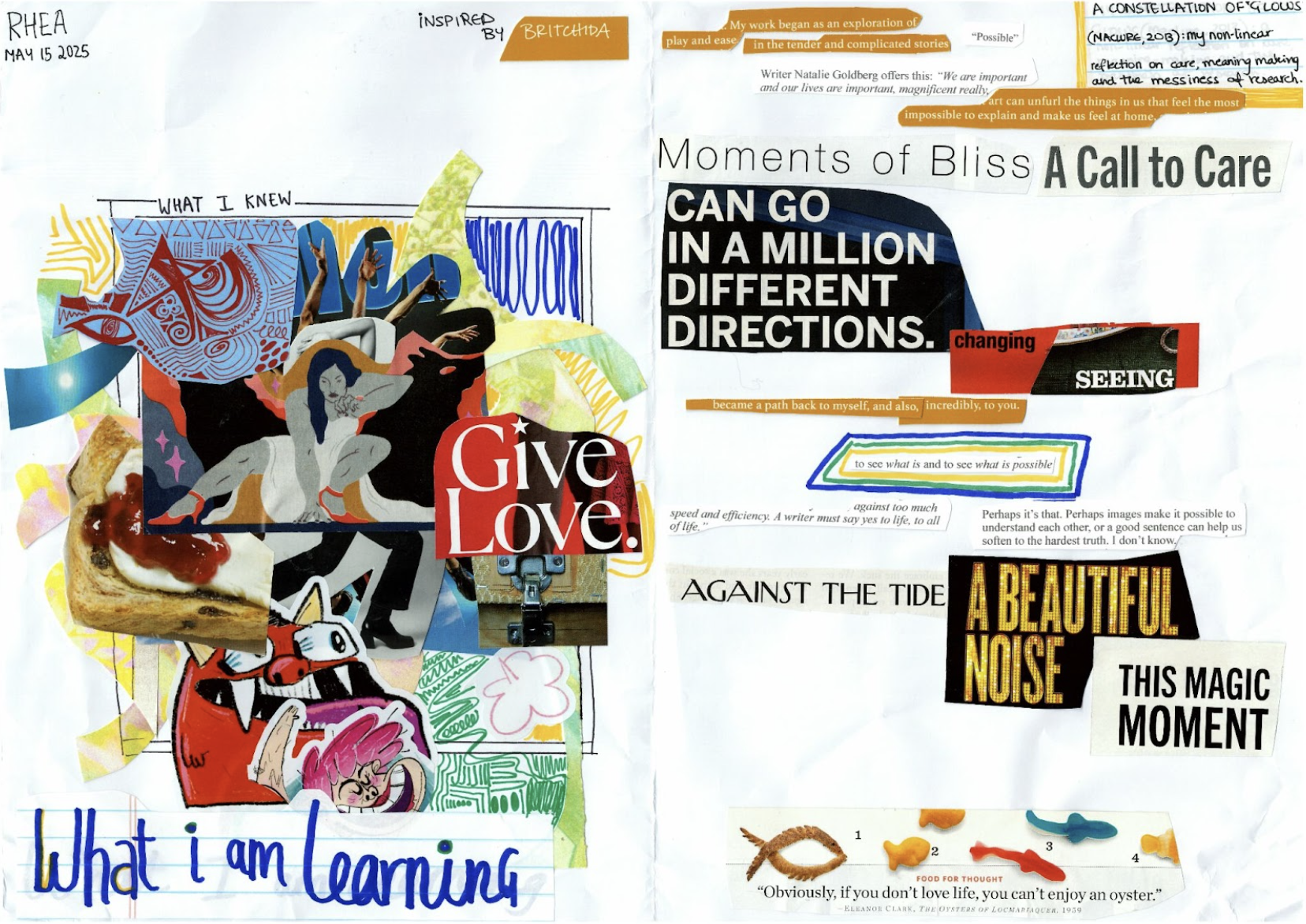
Rhea’s multimodal final collage, A Constellation of “Glows” (Maclure, 2013, p. 228): a non-linear reflection on Care, Meaning making and the Messiness of Research. Created in Dr. Haeny Yoon and Dr. Lalitha Vasudevan’s Multimodal Methods class using magazine clippings, doodles, artist prints and stickers, paint markers and glue on paper.
Rhea’s multimodal final collage, A Constellation of “Glows” (Maclure, 2013, p. 228): a non-linear reflection on Care, Meaning making and the Messiness of Research. Created in Dr. Haeny Yoon and Dr. Lalitha Vasudevan’s Multimodal Methods class using magazine clippings, doodles, artist prints and stickers, paint markers and glue on paper.
“It was an act of devotion. A little like writing or loving someone – it doesn’t always feel worthwhile, but not giving up somehow creates unexpected meaning over time.” – Miranda July
While Andrea found freedom through play, I found mine through process: the act of staying with the messy, the relational, and the unfinished. When we began this class, I was a little resistant. I saw research as a set of careful steps—structured, controlled, and clinical. My ideas about where value lies, rooted in some of the cultures of learning I’ve inherited, taught me that value lived in clarity, coherence, practicality, and proof. I equated rigor with rigidity and separated thinking from feeling. Within these frameworks, I often felt paralyzed by the need to prove legitimacy, to question whether I was being a “serious-enough” scholar.
But as the weeks unfolded, I found myself shifting. The invitation to think multimodally, through image, collage, conversation, space, sewing, sound, and memory, opened a door I hadn’t realized I’d closed: the possibility that research could be grounded, relational, human, and creative. For instance, during a walking interview that began with the prompt “tell me about a song you’ve loved for a long time”, I learned more about a colleague than in any formal interview I’ve conducted. The movement, the shared pace, and the looseness of the form made the conversation comfortable, mutual, and unexpectedly deep.
At the same time, broader geopolitical shifts formed the background of my work. While they did not redirect my research projects, the narratives and their possible implications felt persistent in email chains, text messages and across the news. The language was charged and difficult to ignore. I began shaping fragments into a series of poems, mostly to help me make sense of all that was unfolding. To my surprise, patterns surfaced in these poems in ways that felt strikingly similar to those I recognize from critical discourse analysis. I had not expected a creative constraint to sharpen my understanding. And finally, collaging became a form of thinking. It helped me analyze connections in my thinking that I wasn’t yet able to articulate, allowing meaning to surface visually and intuitively. Moving across these forms unearthed a kind of depth I’d forgotten research could hold. They generated moments of reflection and dialogue that felt more honest and alive than datasets I’d previously parsed.
And finally, collaging became a form of thinking. It helped me analyze connections in my thinking that I wasn’t yet able to articulate, allowing meaning to surface visually and intuitively.
My understanding of the method expanded around messiness. I began to see that uncertainty, hesitation and emotion are not obstacles that need to be cleaned away but part of the knowledge we are trying to surface. My previous conception of research placed value on what happened after the mess: evidence based, prescriptive design, clean analysis, clear findings, usually mixed methods and very focused on outcomes and fidelity of implementation. I had struggled with the idea that softer, stranger, affective modes are also valid.
Going forward, I’d like to shed some of my old ideas and bring more nuance, feeling, co-production, and risk into my work. There is value not just in being coherent but also in the “mess”–in hesitation, intuition, play, tension, emotion, and what is not being explicitly said. I want to be a researcher who does meaningful work in ways that are human, relational and open, work that invites people in rather than holding them at a distance or simply as objects of inquiry. I’m beginning to understand that aliveness in research does not necessarily come from perfect coherence but from paying attention to what moves us, surprises us, and unsettles us. That is the kind of work I hope to make—slow, deliberate, relational, and alive.
How to Embrace Play and Resistance in Your Own Work (both Andrea and Rhea)
In many ways, collaborating, collaging, and writing this piece together are manifestations of our commitment to embody the principles we’ve gained through multimodal scholarship.
We invite you to join us: to keep playing, keep taking risks, keep resisting outmoded notions of research and academia, and to let our collective imagination flourish to make scholarship feel, sound, and look different in support of more meaningful and insightful research.