By Minh Le, Principal Instructional Designer
At nearly every AI-integrated teaching workshop I’ve led in the last two years, a central question echoes: To what extent should students be allowed to use AI in their coursework, and how can we make that clear without compromising learning?
As educators navigate the rapidly shifting terrain of generative AI in higher education, the way we define and design assessment demands thoughtful reevaluation. It is not just a matter of academic integrity, but a deeper pedagogical question: What kind of thinking do we want students to develop, and how can the use of AI in assignments support rather than short-circuit that process?
During the faculty retreat in preparation for Fall 2025 semester, I introduced the AI Assessment Scale, a resource I found particularly useful for surfacing these concerns and clarifying expectations. Developed to help educators structure and communicate how AI tools may or may not be used in different assignments, the AI Assessment Scale offers a shared vocabulary and set of levels to work from.
Inspired by this framework, I also created a visual icon system to represent each level of AI engagement, providing faculty with a practical way to bring this abstract framework into their course materials.
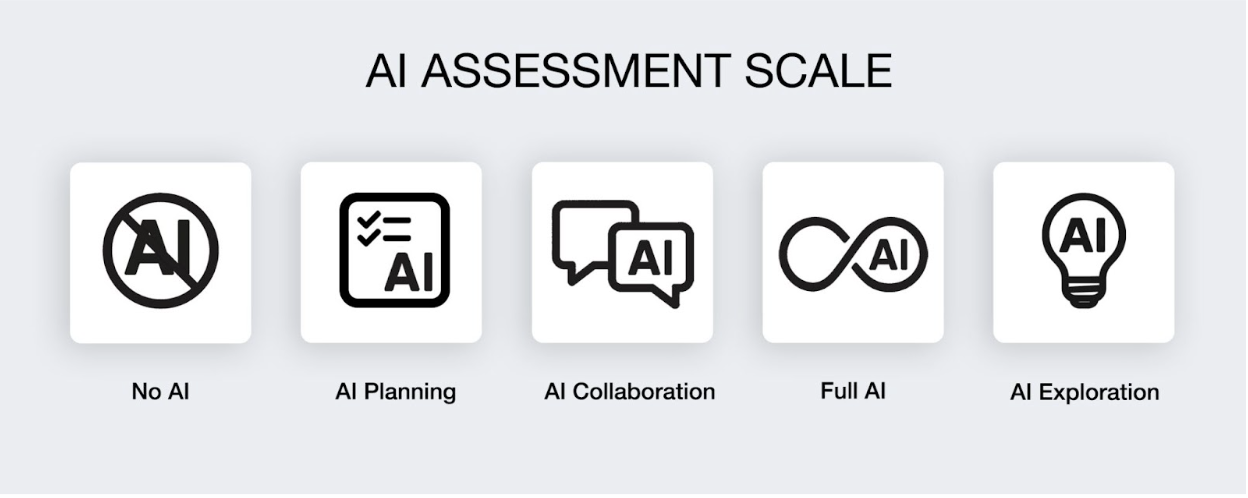
The icon system provides intuitive visual cues that communicate instructors’ expectations and guide students’ use of AI in assessment
The Problem: Ambiguity, Anxiety, and the AI Dilemma
Faculty often feel caught between competing demands: fostering critical thinking and originality, preparing students for a future where AI is ubiquitous, and maintaining academic rigors. Students, in turn, report confusion about what is permitted, particularly when AI tools like ChatGPT blur the lines between assistance and authorship.
This ambiguity generates understandable anxiety on both sides. Instructors may avoid mentioning AI at all, hoping to sidestep the issue. But silence often leads to misunderstandings, inconsistent policies, and inequities in enforcement. What we need instead is clarity, transparency, and shared pedagogical intent.
What Is the AI Assessment Scale?
The AI Assessment Scale (AIAS) (Perkins et al., 2024) addresses this need by offering five clear levels of AI involvement in student work:
- No AI – The assessment is completed entirely without Al assistance in a controlled environment, ensuring that students rely solely on their existing knowledge, understanding, and skills.
- AI Planning – Al may be used for pre-task activities such as brainstorming, outlining and initial research. This level focuses on the effective use of Al for planning, synthesis, and ideation, but assessments should emphasise the ability to develop and refine these ideas independently.
- AI Collaboration – Al may be used to help complete the task, including idea generation, drafting, feedback, and refinement. Students should critically evaluate and modify the Al suggested outputs, demonstrating their understanding.
- Full AI – Al may be used to complete any elements of the task, with students directing Al to achieve the assessment goals. Assessments at this level may also require engagement with Al to achieve goals and solve problems.
- AI Exploration – Al is used creatively to enhance problem-solving, generate novel insights, or develop innovative solutions to solve problems. Students and educators co-design assessments to explore unique Al applications within the field of study.
These categories help instructors align AI use with the learning goals of a particular assignment. For example, an introductory writing course might restrict AI use to preserve the development of foundational skills, whereas a digital media seminar might embrace exploratory AI work as part of its creative inquiry.

The use of AI tools like ChatGPT may be restricted to foster the development of writing skills (Image generated by Sora)
The scale was designed with adaptability in mind and has evolved to keep pace with new technologies and pedagogical needs. In my opinion, its greatest strength is that it supports transparency: Students know exactly what is expected, and faculty can more confidently design assessments that meet their aims.
From Scale to System: Making AI Guidelines Visual
To help operationalize the AI Assessment Scale in day-to-day teaching, I created a set of simple black-and-white icons, one for each level on the scale. Inspired by the familiar look and function of Creative Commons licenses, these icons can serve as immediate visual cues for students.
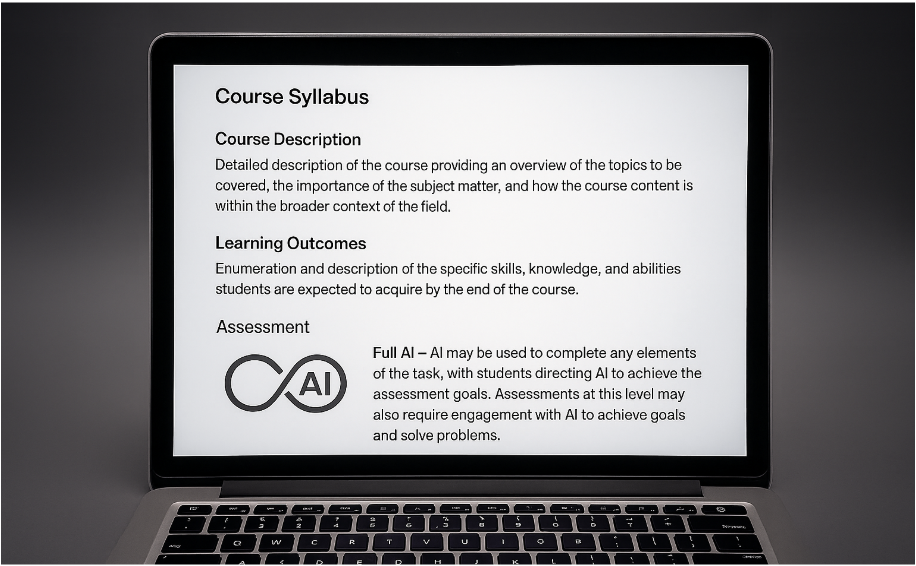
The AI Assessment Scale can be integrated into course syllabi to indicate to what extent AI is permitted in the course (Image generated by Sora)
Faculty can include them in syllabi, assignment descriptions, and LMS modules (e.g., Canvas), providing a quick and consistent way to indicate the degree of permitted AI use. This visual layer not only enhances accessibility but also normalizes conversations around AI. It tells students, "We’ve thought about this. You’re not alone in figuring it out."
Reflections from Practice: Introducing the System
At the faculty retreat where I first introduced the scale and icon system to TC faculty, the response was striking. Faculty welcomed the clarity but also expressed relief in having a structured way to talk about AI that didn’t require becoming an AI expert overnight.
Many questions emerged: How do we choose the right level? What if a student misuses AI under the wrong assumptions? What happens if the technology changes mid-semester? These questions are valid and underscore the importance of treating the AI Assessment Scale not as a rigid rulebook, but as a living tool: one that faculty can adapt to their disciplinary contexts and revise over time.
By embedding the icons into the course structure, educators emphasize a pedagogy of transparency that values communication, shared expectations, and reflective learning. It also encourages students to develop ethical and intentional relationships with technology, rather than rely on it uncritically.
Looking Ahead: A Transparent, Pedagogically-Grounded Future
The purpose of assessment has never been simply to evaluate student output. At its best, assessment scaffolds growth, nurtures inquiry, and invites students to take intellectual risks. In this light, the AI Assessment Scale offers more than just policy guidance; it becomes a medium for rethinking how we define learning in the age of machines.
We are not only asking whether students can use AI, but what it means to learn with AI. The icon system I developed is one attempt to make these conversations more visible, literally. But it’s also a gesture toward a broader design ethos: Good pedagogy makes expectations clear, meets students where they are, and evolves as our tools and understanding evolve.
Invitation
I invite fellow educators to explore the AI Assessment Scale and consider how visual systems like icons might support your own teaching. As we experiment, reflect, and share, we contribute to a more equitable and meaningful learning environment: one that doesn’t ignore AI, but uses it thoughtfully and transparently.
References
Perkins, M., Roe, J., & Furze, L. (2024). The AI Assessment Scale Revisited: A Framework for Educational Assessment. arXiv. https://arxiv.org/abs/2412.09029
Perkins, M., Furze, L., Roe, J., & MacVaugh, J. (2023). The AI Assessment Scale (AIAS): A Framework for Ethical Integration of Generative AI in Educational Assessment. arXiv. https://arxiv.org/abs/2312.07086 arXiv
AI Transparency Statement
As an effort to promote AI awareness and transparency, this statement discloses how I used AI in writing this article. I captured and developed the initial idea for this piece in Thought Spark (an idea-development app) and used ChatGPT to assist in brainstorming the article's direction and outline, drafting initial iteration, and proofreading to ensure clarity and cohesion. All AI contributions were always guided, verified, and refined by me at each stage.