
Screenshot compilation from various Roblox rant videos in our sample
By Blake Danzig, DFI Research Assistant, and Ioana Literat, Professor of Technology, Media and Learning
Imagine scrolling through YouTube and landing on a video of a blocky, colorful cartoon avatar bouncing through a neon obstacle course. Over the gameplay footage, a sped-up synthetic voice rattles off: "At this point I'm convinced my teacher is speedrunning [i.e. in gaming lingo, racing to finish a videogame as quickly as possible] how fast he can make everyone lose motivation. Bro could be explaining the formula for free money, and I'd still be fighting for my life to stay awake."
This is a Roblox rant. If you haven’t seen one, you’re likely not between ages 10 and 17.
GIF of a Roblox rant expressing 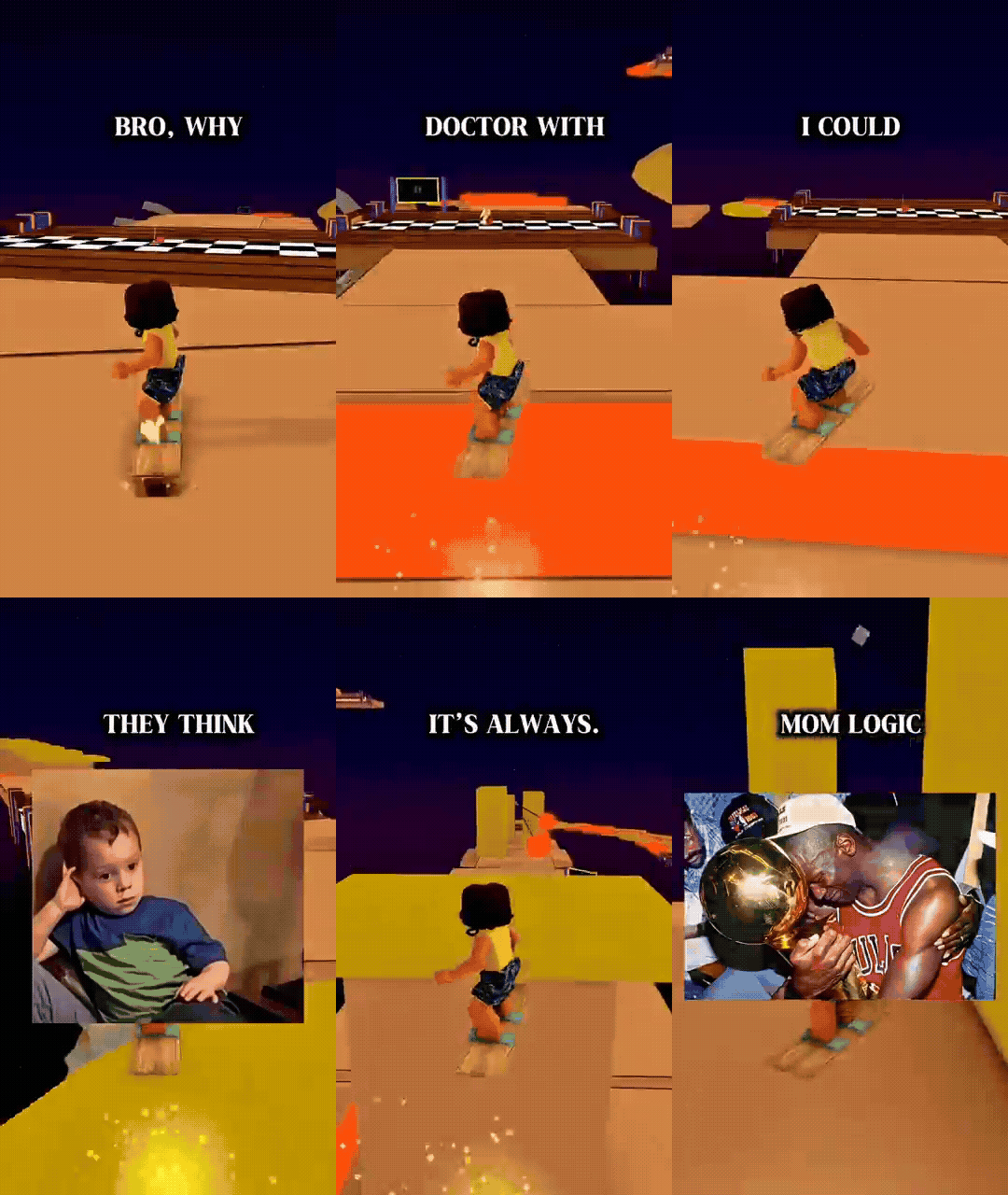
frustration with parents' views
of young people's use of technology
Over the past year, this format has taken off on YouTube Shorts, YouTube’s destination for shortform video. Young creators record themselves playing Roblox—the massively popular online gaming platform, where more than a third of its 150+ million daily active users are under 13—while an AI-generated voice delivers pointed social commentary over the gameplay footage. The topics generally have nothing to do with Roblox itself: school policies, parental authority, algorithmic injustice, viral news, the broken promises of technological progress. The gameplay is the backdrop. The rant is the point.
In a recent study, we analyzed 456 of these videos, tagged #robloxrant on YouTube Shorts. What we found complicates easy narratives on all sides: about youth passivity, about AI and creativity, and about what political voice looks like when institutional channels fail.
Not ranting. Critiquing.
The word "rant" carries baggage: it implies something a bit unhinged, self-indulgent, perhaps immature. Adults who may stumble across these videos (though they probably don’t) often see exactly that: a kid complaining about their teacher over cartoon footage. What we see, however, are examples of sophisticated, uber-creative multimodal critique.
In video after video, youth creators demonstrate a nuanced understanding of power dynamics and how to challenge them. One ranter describes being sick at school in gaming terms: "your hp is at low health and your main quest is to just survive until the bell rings without your head exploding." To get help, you embark on a "side quest", mustering the courage to ask for a bathroom pass, only to reach the "final boss": the school nurse. The institutional assumption that students can easily access care when they're unwell is exposed as a fiction. The nurse's office, framed as an enemy to defeat rather than a place of support, becomes an object of collective critique.
In our forthcoming research article, we understand this as not just complaining, but as a sophisticated rhetorical move—what the literary theorist Mikhail Bakhtin called the "carnivalesque": a space where normal hierarchies are inverted, where the powerful become objects of mockery, and where those without institutional voice can speak.
Young people have always found these spaces. What's new is the platform, the form, and the scale.
The mask that enables the voice
(Part of) the genius of the Roblox rant format is its layered anonymity. The creator's face never appears, as they're represented by a Roblox avatar. Their voice is replaced by AI text-to-speech, often sped up to a chipmunk pitch. The gameplay backdrop provides plausible deniability: "It's just a game video." These layers function like a carnival mask, enabling young people to say things they could not safely say in a classroom, at a dinner table, or under their own name online.
What is also worth noting is that Roblox rants are almost entirely AI-assisted, and yet, far from diminishing creativity, the AI voiceover has become infrastructure for it. Youth aren't using AI as a shortcut or a crutch here, but rather as a compositional choice: one that enables anonymity and signals genre membership to other young viewers. Meanwhile, these same creators are coordinating multiple layers of meaning simultaneously: the gameplay backdrop, the AI voice, embedded memes, text captions timed to sound effects, direct quotes from authority figures delivered in modified voices. The compositional literacy on display would be recognizable to any media scholar — and would be invisible to most of the adults dismissing it as "brain rot."
This Roblox rant GIF 
is about a student
being blamed for
using AI in school
The range of the rant
The content of Roblox rants is striking in its range and political sophistication. Youth challenge bathroom pass policies ("My bladder doesn't run on the school's schedule"), critique platform algorithms that reward "brain rot" while suppressing creativity, and call out problematic new AI-powered moderation features. One ranter argues that AI shouldn’t decide what you can watch and jokes about YouTube “trying to play stepmom” and being "grounded by the algorithm”.
They also process current events—from celebrity legal cases to electoral politics—in real time with online peers. For example, commenting on the role of social media in the recent election in Nepal1, a ranter asks: "What do you mean Nepal just elected their new prime minister in Discord?", then humorously riffs on the implications ("Does this mean court trials are going to be held in Among Us lobbies?") before landing on an important observation about the opportunities and challenges of democracy in Nepal ("I mean, on the flip side, this is letting the people decide.") This is civic reasoning, filtered through gaming vernacular and delivered with comedic timing. It is also the kind of political thinking that adults too rarely credit young people with doing.
The parental authority rants are perhaps the most affecting. One creator, whose parents discovered their YouTube channel and threatened to delete it, speaks with quiet urgency: "To them [parents], YouTube isn't a job. It's not work. It's just me wasting time in front of a screen... But this is real to me. Every video, every comment, every single one of you. It all means something." This is a young person making the case, in public, for the legitimacy of their own labor and creativity.
The question adults should be asking
Now, why does this all matter? We argue that Roblox rants are, ultimately, a mirror. What they reflect back is a portrait of institutions that have yet to make room for youth voice, and of young people who have decided not to wait.
When youth build elaborate carnivalesque spaces—complete with masks, gaming vernacular, and AI voiceovers—to voice perspectives that should be welcome in classrooms, family conversations, and policy discussions, something is amiss in those spaces. The rants make visible both youth agency and the institutional failures that make such circuitous paths to voice necessary in the first place. Educators, parents, and policymakers who may dismiss these videos as trivial complaints or AI-assisted laziness are missing the signal in the noise.
Young people are telling us, with considerable wit and compositional skill, exactly what is failing them. The least we can do is listen, even if we have to learn what "speedrunning demotivation" means first.
1 In September 2025, Nepali Gen Z protesters used the Discord server “Youth Against Corruption” to organize mass protests, topple the government, and democratically elect former Chief Justice Sushila Karki as interim Prime Minister. Following a social media ban and violent clashes, 150,000 members debated and voted online, creating a new form of digital democracy to fill the power vacuum.
Blake Danzig is a doctoral student in the Technology, Media and Learning Program at Teachers College, Columbia University, and a researcher in the Snow Day Learning Lab and at the Digital Futures Institute.
Ioana Literat is a Professor in the Technology, Media and Learning Program at Teachers College, Columbia University, and co-director of the Media and Social Change Lab (MASCLab).