
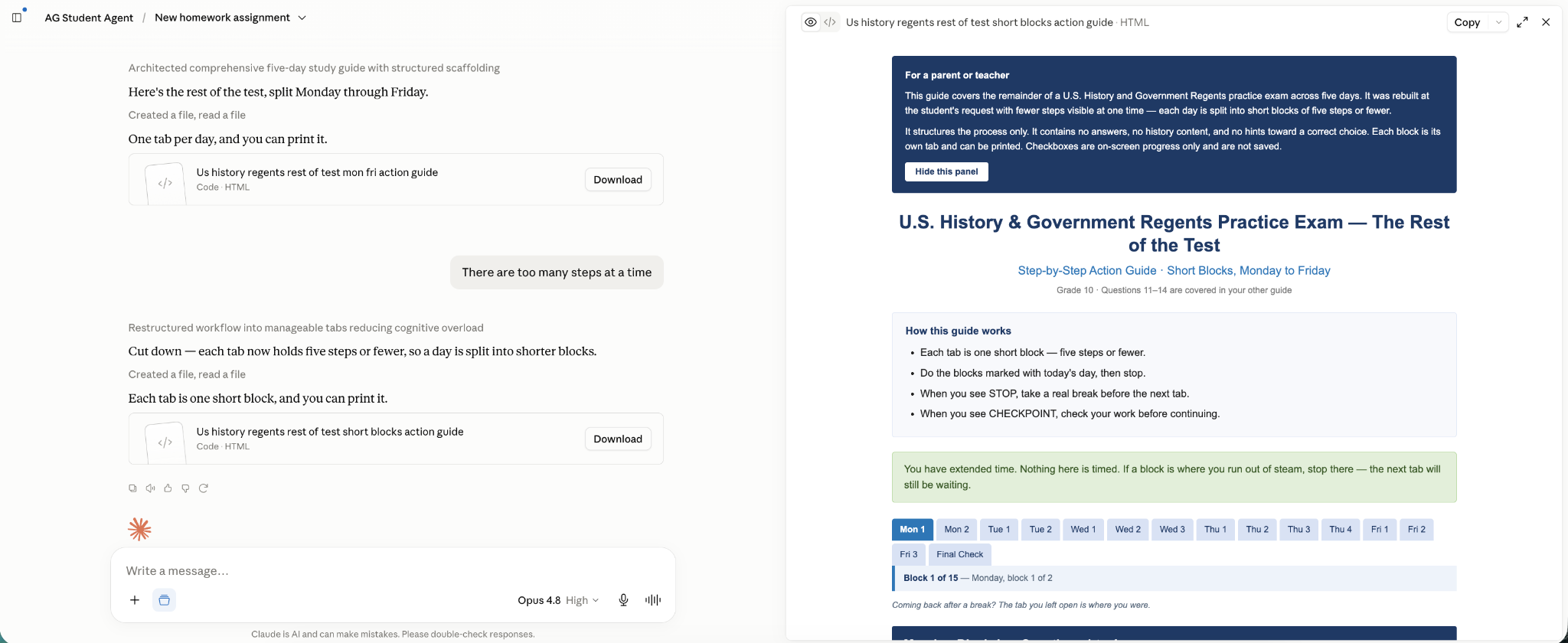
Screenshot of an Action Guide being created by an agent
By Joel Lederer, DFI AI in Education Fellow
When I first came to the Digital Futures Institute as an AI in Education Fellow, I wasn’t sure what to expect. For about a year-and-a-half previously, I had been going deep down the Generative AI (GenAI) rabbit hole and learning a lot about how LLMs worked and what they could do. I’d failed a lot, hit a lot of dead ends, and learned a great deal.
It reminded me of my time in the late 1990s in the Seattle dotcom startup world; there were no rules and no map, just exploration. I’d been reading as much as I could about GenAI, and I took a number of online and in-person courses, all promising to teach me “how to use AI”. It was disheartening. Every course or workshop I encountered was essentially for absolute beginners. I quickly understood that GenAI courses aimed at educators assumed that, outside of Computer Science, teachers were very close to technologically illiterate. It was disheartening and frustrating.
However, at DFI, I found a community of like-minded, intellectually curious people who understood both pedagogy and technology. They presumed that teachers across disciplines were out there, curiously exploring this emergent technology. Thus, my work on an AI and education case with DFI began in earnest.
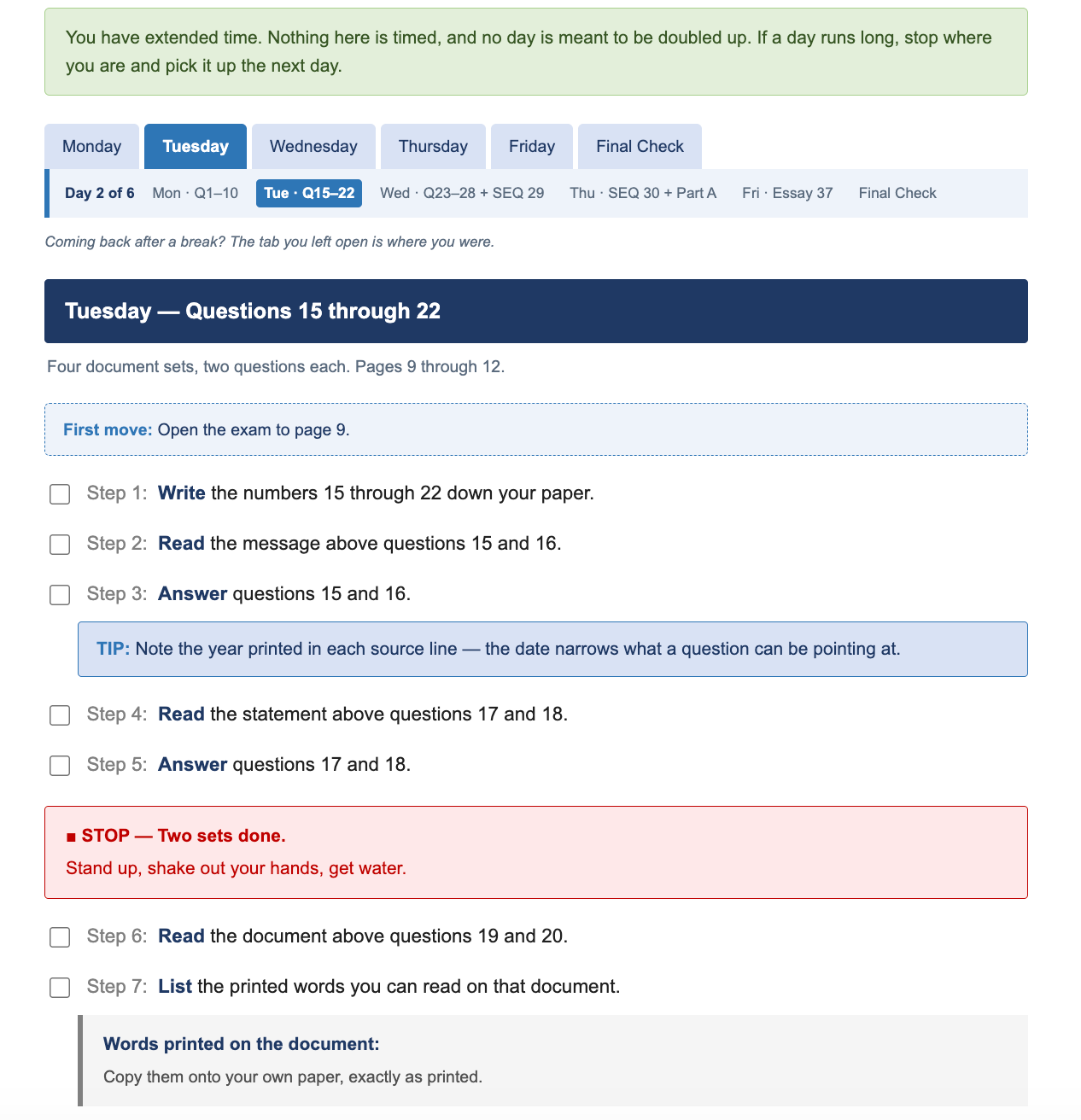
Screenshot of an Action Guide
How can AI support students with ADHD?
The initial goal of my work was to create a basic AI-based cognitive scaffolding system for ADHD students. In the New York City public school system, I teach high school English, but I was designing this system to be used with both younger and older students across disciplines; I envisioned that any student who struggles with executive function issues might benefit.
The GenAI system is, essentially, a means of automating differentiation (using AI to create individually-tailored instructional materials). It produces what I call Action Guides, which are step-by-step walkthroughs of assignments based on a student’s learning needs and profile. After completing a simple intake/setup process, something which is meant to be done by a teacher, counselor or parent, the student then simply interacts with an AI agent, uploading assignment materials such as PDFs or .docx files, and adding any additional context manually. When they finish this quick and simple process, the AI returns an Action Guide for that assignment. The Action Guide walks them through the assignment step by step, giving them information in small chunks so as to not overwhelm. The Action Guide also instructs students to take out necessary materials such as a textbook, a pencil, and paper, and it builds in breaks for stretching and water or snacks, as aligned with research-based best practices for supporting ADHD student workflows.
My early analysis of this application in the classroom shows that proper scaffolding could have a significant positive impact not just on ADHD students' engagement with schoolwork, but also on any students' struggle with the effects of cognitive erosion on attention and working memory. The Action Guide collaborative process is a positive use of GenAI, meaning that it is not an avenue to cheating on work, nor is it a pathway to cognitive erosion. It’s an application of existing research-based best practices in a manner that empowers students, increases accountability (meaning that the application has the potential to produce documentation that could be instrumental in informing IEP writing and supporting student progress), and reduces teacher workload due to the automated nature of the tool.
What does the tool actually do?
The Claude-built/ Claude-based agent is designed to produce the type of stepwise scaffolding that a skilled Special Education teacher would create if they were both available equally to every student and if they also had the time to produce individuated scaffolding for every student who needed it. (This is where experienced teachers can laugh out loud.) The AI-based Action Guides deliver the exact same assignment that every other student in a class gets, with the same level of rigor and the same product goals; the only difference is that students with ADHD get the work in a manner that works for them.
As I move forward, I’m working on expanding functionality to include students whose profiles include Dysgraphia, Anxiety Disorder, and ASD (Autism Spectrum Disorder), or students who are classified as 2e (Twice Exceptional) and who display a combination of neurodivergent traits. Based on research I've found and on the capabilities of GenAI, these use cases align very well with what the Action Guide already does well. While I’ve focused on the ADHD use case so far, I’m excited about expanding the system to help more students.
The Action Guide is a completely individuated tool, in which it can be created one at a time for specific assignments and custom-tailored to one student’s specific needs and working style. Also, over time, students may require more or less scaffolding, and the Action Guide can be adapted to accommodate those changes. Teachers have been expected to have a digital level of productivity using only analog tools for years now, but with the advent of GenAI, this promise of widespread technology could finally become more possible. It’s a time-saving solution that actually saves time instead of simply creating more work for educators, and the positive impact that I’ve seen on the work of students who have used the prototype I built is undeniably real. I’ve seen my ADHD-diagnosed students use the Action Guide and go from being completely lost to having a much clearer understanding and expression of mastery. Cliche as it is, it’s a game-changer.
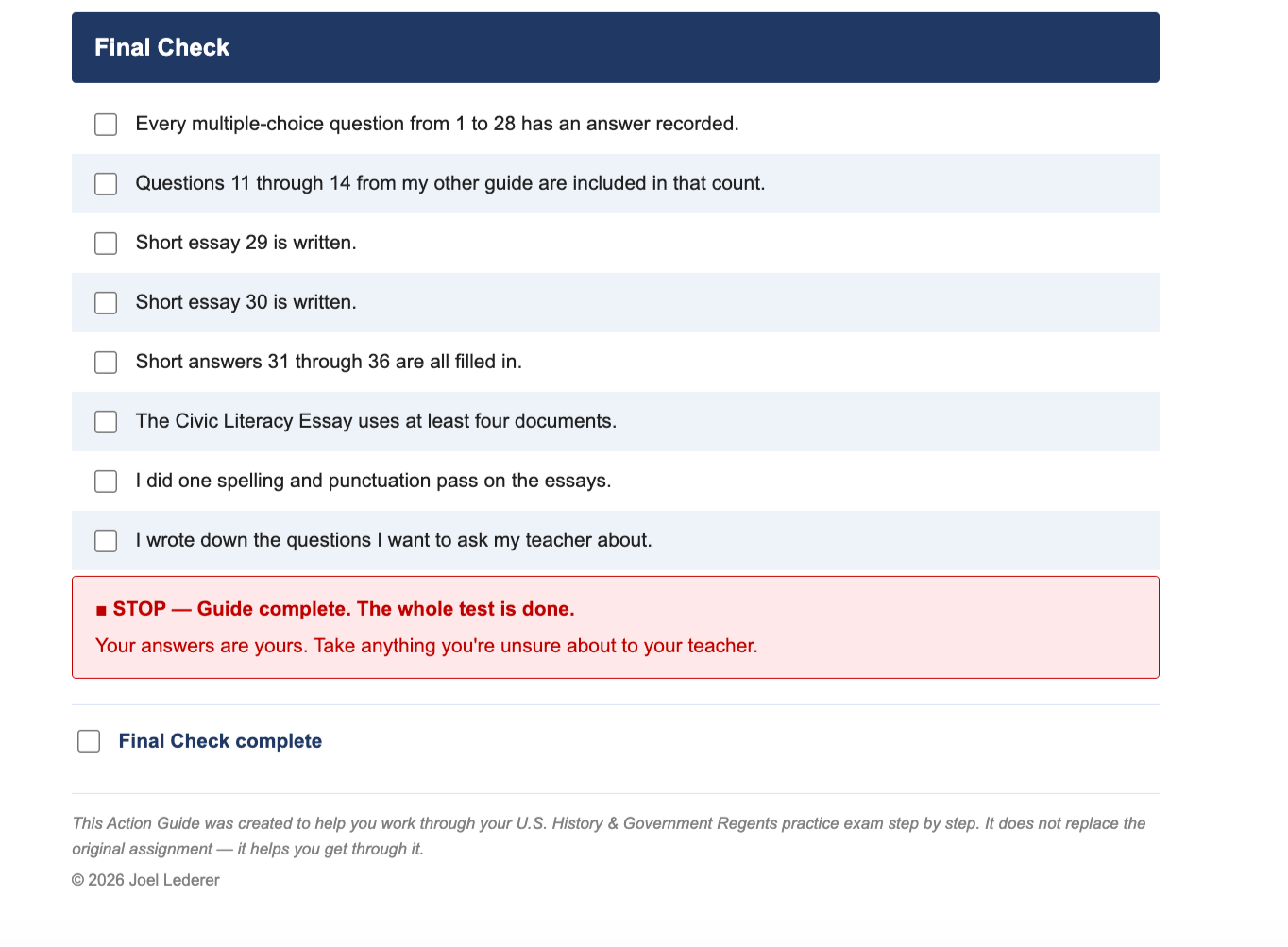
Screenshot of a completed Action Guide (Final Check)
Tech that supports teachers, parents, and students
Why did I try out GenAI tools? Well, the first reason, if I’m totally honest, is because it’s fun to make little AI robots. Ultimately, however, my goal is to get this tool into the hands of kids who need it wherever they may be. After 24 years in the NYC public school system, I know that teachers are stretched thin and that Special Education staff are often stretched even thinner. I’ve worked in both small schools and incredibly large ones, and I know that resources can be hard to come by. I imagine students in underserved and understaffed districts having access to Action Guides at a low cost or, if possible, for free. That kind of equity would be amazing, and it’s very possible with GenAI.
The Action Guide application was born out of a desire on my part to help the students I saw struggling in my classes. Thanks to working with a supportive ed-tech community like DFI, I’m able to dream bigger and to work towards creating an application that would make it easy for more kids to get the support they need. I learned long ago that, as a classroom teacher, most of the impact I might have on my students is an impact that I’ll never see. But as teachers, we can only plant the seeds and hope they grow. This project is growing, and seeing tangible progress is incredibly satisfying. The seeds are planted, and I’m excited to see what might come next.
At EDTECH WEEK on October 14, 2026, Joel Lederer will be speaking on a panel titled "Reclaiming Teacher Agency in an AI-Integrated School" with Lalitha Vasudevan, DFI's Managing Director & Teachers College Vice Dean for Digital Innovation, and Clare Berends-Eitel, DFI's Director of Learning Design.