By Billy Collins, DFI Studio and Media Producer
Abstract: Explainer videos’ concise and visually engaging format is well suited for distilling complex information for broad audiences. Explainer videos have been applied with measurable effect in science education and communication, where they are aligned with the field’s pedagogical and rhetorical conventions. Judging from their efficacy in the sciences and beyond, explainer videos have similar potential within the social sciences as a tool for education and outreach. However, when applied to the social sciences, explainer videos’ expository, top-down rhetorical format has incongruencies with constructivist thought and practice (Berger & Luckman, 1966; Guba & Lincoln, 1994). These practices tend to further employ self-reflective and participatory formats that highlight process and subjectivity, and directly or indirectly include and acknowledge the audience. Given these discrepancies, this paper asks how explainer videos could be applied to social science communication, how they compare to other popular forms of academic media, and how they may fit into a broader communications strategy.
Keywords: Explainer videos; Research translation; Educational videos; Expository documentary; Social science research communication
Research Translation in the Digital Age
The media team within the Digital Futures Institute (DFI) at Teachers College, Columbia University utilizes the term research translation to describe the process of interpreting, condensing, and communicating academic research to broad audiences. However, reaching this goal often demands a compromise between accessibility and depth. This is especially true for video, where today’s mobile-focussed media environment continues to reward shorter form content (Violot et al., 2024). Media makers working in an academic setting are faced with the challenge of keeping up with contemporary trends, while also upholding the integrity of the research or topic of choice. From direct-to-camera social reels, to short documentary films, to video podcasts, there are ever increasing options for communicating research. However, each format has its own strengths and limitations when applied to different fields.
As a media creator who has collaborated with researchers in both the physical and social sciences, I have had the opportunity to experience how each broader field obtains and shares knowledge. My work in academic media took root in the physical sciences, where I received an MFA in Science and Natural History Filmmaking, worked as an Outreach Officer and filmmaker for a study of an Antarctic subglacial lake, and as a Multimedia Designer for a microbiology laboratory. Today, as the Studio and Media Producer at the Digital Futures Institute at Teachers College, Columbia University, I have seen my work transition from beyond physical science into social science and education research. This transition has illuminated differences in how each broader field accesses, understands, and communicates knowledge, and calls into question what media formats are best suited to each area of research.
One video format that has grown popular in science communication and beyond are explainer videos. The media team at DFI is developing approaches for explainer videos as part of our wider mission of research translation. Explainer videos are produced by a wide variety of online creators, including but not limited to individual YouTubers, journalists, NGOs, and non-academic research centers. The DFI media team are developing these videos from an academic research standpoint and are basing our considerations and practices upon our particular context within an academic institution. In this paper, I will explore both the conceptual and practical considerations when developing explainer videos for social science and education research and weigh the tensions that arise when applied to these fields and how they might be addressed as part of a larger media and communications strategy.
What is an Explainer Video?
Explainer videos (also known as “explainers”) can be broadly defined as a category of short online videos intended to educate broad audiences on a particular topic or concept. An explainer video is often short, between one to five minutes in length. While they can use any combination of visual styles, they typically include a mixture of animations, info-graphics, photos, and text (Kramer & Bohrs, 2018). For their audio component, they typically include a music track and a voiceover that is often informal, fast spoken, with a casual or slightly humorous tone (Schorn, 2022). An explainer video may also have an on-screen presenter or animated character to present information. It is important to note that the boundaries that define an explainer are not well defined. However, for the purposes of discussion in this working paper, their key features are their educational and factual presentation style, an authoritative yet casual speaking tone, and use of infographics or animations to clarify a learning goal or topic.
Online videos have become an increasingly popular source of information, especially amongst younger populations (Koch & Bleisch, 2020), and explainer videos’ attention-grabbing format has been shown to produce more positive outcomes for recall than text or audio alone (Schneiders, 2020). As such, explainer videos have become a useful communication tool across diverse fields and industries. Within academia and education, an area where explainer videos have yielded positive results is in science communication, where concepts readily benefit from a visual accompaniment (Schneiders, 2020). In a 2021 study, researchers teaching earth observation techniques compared two groups that were shown the same lesson in different mediums: one with photos and text, and one as an explainer video. They found that the students who watched the explainer videos improved their test scores by 21%, whereas students who viewed text and illustrations alone improved by 13%. While the authors did not consider this to be a significant difference, explainer videos remained as successful for improving test scores as did text and illustrations. The authors discuss how videos’ online ubiquity and placement in online learning spaces such as Massive Open Online Courses (MOOCs) makes them a significant source of scientific educational content in the digital age and should be understood and given equal consideration to more traditional text based instructional materials (Hodam et al., 2022).
The strengths of this format are reflected by their prevalence online. YouTube has become a dominant source for informal scientific education online with a large ecosystem of creators and users (Welbourne & Grant, 2016; Yang et al., 2022). A 2016 statistical analysis of popular science YouTube videos found that short documentary and animation were the most popular genres (Munoz et al., 2016). While the study did not explicitly define explainer videos as a genre, short documentary and animation are common stylistic components of explainers.
Scientific explainer videos are increasingly ubiquitous, and a quick search on YouTube demonstrates their popularity. For example, I searched YouTube with the common earth science question, “How do plate tectonics work?” Out of the first twenty-five videos that appeared from the search, seventeen met my criteria of an explainer video. There was also a noticeable recency trend where explainer videos made up 92% of the most recent half of videos uploaded between 2018 and 2024.
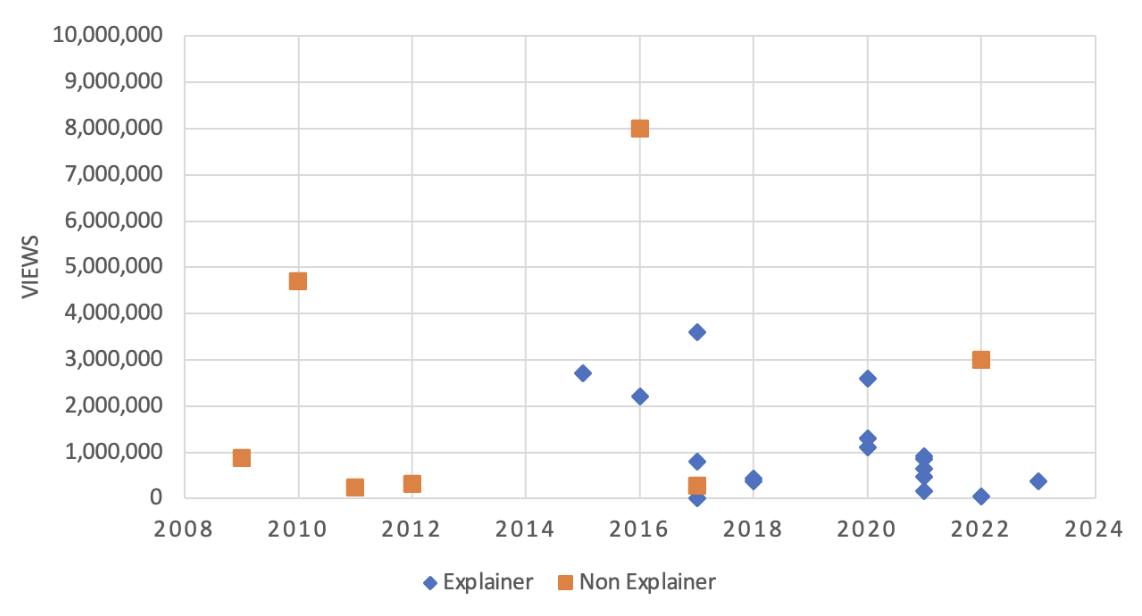
Scatterplot graph showing aggregated YouTube search results for the question, “How do plate tectonics work?” from 2008-2024, comparing explainer and non-explainer video types
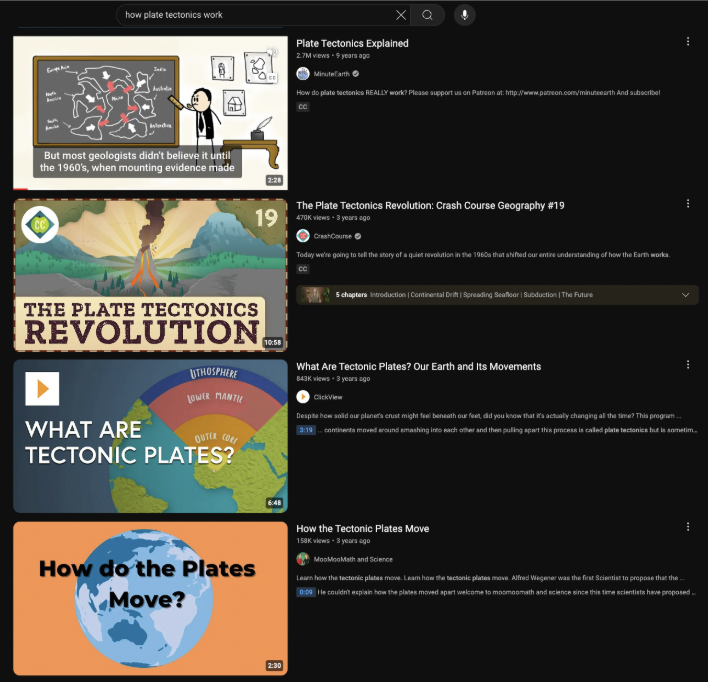
This screenshot shows the first four YouTube videos returned in searching, "How do plate tectonics work?"
Explainers Videos and the Expository Mode
Explainer videos support the conventions of science communication well, as scientific topics often involve physical processes that lend themselves to visuals or motion graphics. Broadly speaking, the purpose of scientific discovery is to uncover objective and repeatable truths about the physical world. This objectivity is well suited to explainer videos’ fact-centered format.
Bill Nichols, a film theorist who pioneered the study of documentary film, categorized documentary into six “modes”: expository, poetic, participatory, performative, and reflexive (Nichols, 2017). Of each of these categories, I argue that explainer videos lie within the expository mode. Nichols (2017) categorizes the expository mode with the key markers of an omniscient “voice of god” voiceover, footage and editing directly supporting the claims of the narrator, and information and events presented as an objective truth. The expository mode has been the predominant form of documentary since its inception, and for general audiences, this mode is what typically comes to mind when considering a documentary film (Nichols, 2017).
In present times, explainer videos can be considered a more streamlined, digital-age manifestation of an expository documentary. While their upbeat, and succinct presentation style has adapted to suit modern tastes, their reliance on an authoritative voice and use of imagery and editing to support an objective reality or truth, align with the conventions of the expository mode.
It should be mentioned that the expository mode’s authoritative rhetoric can cause subjective ideologies and propaganda to be interpreted as objective truths (Nichols, 2017). Throughout history, documentaries have been used as government propaganda and as vehicles for convincing audiences of particular viewpoints, whether or not they are true (Geltzer, 2018; Rizzo, 2025). Online explainer videos are no different. Through using the persuasive conventions of the expository mode, explainer videos can be used to spread disinformation, whether intentional or not, through a veneer or authority and objectivity. In addition, even when information is attempted to be told truthfully, that information is filtered through layers of subjective choices that ultimately influence how audiences perceive a truth or fact.
Short form online videos have not been studied with the same level of scrutiny as documentary film. I believe this is partly due both to their recency and also because they are not viewed as serious works of “film,” worthy of academic discourse. However, explainer videos, along with other short online formats, have become a significant source for information in the digital age and therefore should be given proportional consideration. As communications theorist Marshall McLuhan said, “The medium is in the message” (McLuhan, 1964), and as an academic media creator, I believe that there is value in understanding the affordances of the formats we use to communicate research, along with the belief systems are implicitly carried within those mediums. Even though short online videos have evolved to meet the needs of online spaces, their basic ingredients are derived from the conventions of what came before, and thus carry similar epistemological frameworks. Understanding the frameworks that underlie how we construct and understand “truth” or “knowledge” can provide key insight into how different forms of media are used to communicate research.
Positivism vs. Constructivism in Regards to Explainer Videos
I have now argued that explainer videos lie squarely within the expository mode of documentary film. When considering the expository mode in epistemological terms, it mirrors the tenets of positivism. Positivism is a philosophical belief system that asserts that knowledge can only be gained through scientific or mathematical proof (Comte, 2009/1848). This belief implies the existence of an attainable objective truth. Thus, positivism can also be considered an influential belief system that underlies scientific fields that study phenomena outside the realm of human behavior (Comte, 2009/1848; Park et al., 2020). It should be mentioned that modern scientific methods do not adhere strictly to positivist epistemology as they use a range of methods such as probability and falsifiability to understand phenomena. However, positivist sentiments remain an underlying influence of scientific practice. Explainer videos’ expository approach is easily adapted to scientific topics where information is based upon objective truths. However, the expository mode may have limitations when applied to the social sciences, as many fields of study in the social sciences have considered the limitations and moved beyond positivism.
For much of the 19th century and early half of the 20th century, social scientists emulated the physical sciences through favoring purely quantitative research, partially in order to be taken seriously by the fields of physical science that predated them. During this time, social scientists called their research “social physics” and believed that large-scale statistical measurements of social variables could reveal underlying patterns and laws also found in the natural sciences and physics (Barnes & Wilson, 2014). However, starting in the mid-late 20th century, social scientists across disciplines began embracing more qualitative approaches that acknowledge social, cultural, and subjective factors (Beger & Luckmann, 1966). These epistemological approaches informed by constructivism and critical theory acknowledge that truth is not purely objective, but is context dependent, constructed by individual experience, and influenced by a complex interaction of social forces (Guba et. al., 1994).
Broadly speaking, social science researchers who employ constructivist thought may value qualitative forms of data such as open-ended surveys or observations, and acknowledge participation and subjectivity in their research. Incorporating qualitative approaches can help account for the complexity of social systems as they exist in the real world (Lincoln & Guba, 1985). Acknowledging subjectivity also accounts for the positionality of the researcher and allows for a critical examination of how their biases or background may affect their results (Holmes, 2020). Qualitative research may also give greater voice to participants of marginalized backgrounds through providing opportunities to share their experiences and perspectives (Smith, 2012).
When compared to Bill Nichol’s documentary modes, the conventions of qualitative research align much more closely with categories other than the expository mode. The participatory mode involves the filmmaker interacting with the film’s subjects and acknowledges their presence in the creation of the film. The performative mode emphasizes the filmmaker’s subjective experience and their relation to the topic, often blurring the boundary between performance and documentation. The reflexive mode directs attention to the filmmaking process and in turn elucidates the constructed nature of nonfiction filmmaking (Nichols, 2017). Similar to the way social scientists have embraced qualitative approaches to research, these modes all employ subjectivity as a vehicle for filmic truthtelling: where both the filmmaker’s positionality and the constructed nature of non-fiction film are laid out to bare. Thus, communicating qualitative research through a short, narrated explainer video is somewhat at odds with the epistemological values of constructivism and critical theory. While explainer videos are very useful for communicating a straightforward idea or topic, their short expository format may lack the nuance, depth, and subjectivity often found in qualitative social science research.
In summary, explainer videos’ expository format aligns with positivism’s assertion that science can produce objective truths, whereas contemporary social science research more often adheres to the constructivist belief that truth is filtered through individual experiences. Therefore, explainer videos’ expository format is at greater odds with contemporary social science practice compared to other documentary modes that involve greater subjectivity and reflexivity.
Explainer Videos: In Social Science vs. Physical Science
In my transition from collaborating in the physical sciences to the social sciences, I noticed a general difference in the epistemological approaches of each field. In simple terms, one of the goals of physical science is to break down a complex system into smaller understandable parts that can be repeatedly tested to make reliable and accurate predictions. However, much of the research I have seen at Teachers College, a graduate school of education, functions in the reverse direction. It often takes a social system or phenomenon that is commonly accepted, and peels back its layers to reveal its hidden complexities and nuances. In these scenarios, where understandings are often dependent on complex social context, simple top-down explainer-style videos may not provide the context necessary for well-rounded understandings of research.
Another reason why explainers and the expository mode are more easily adapted to the physical sciences is that the research does not deal in topics the general public interacts with on a daily basis. For example, topics in physics, microbiology, and geology are important for understanding the world around us, but most of us do not need to know much about these areas to function in society. However, social science research often deals in social and political systems that every person must navigate. Therefore every person accumulates their own social science expertise simply by experiencing the world around them (Lewis et al., 2023).
Likewise, there is far more media and commentary made by non-researchers in the social sciences such as celebrities, podcasters, and popular authors. Therefore, when we learn about the physical sciences, we more readily assume the authority and expertise of a researcher, presenter, or narrator. But, in the social sciences, where public expertise is far more diffuse, we are less willing to readily accept the expertise of researchers and academics (Lewis et al., 2023). This may also reduce immediate trust in a disembodied voice of god style narration typical of an expository documentary or explainer video.
It should be mentioned that while the expository mode is well suited to the physical sciences with popular examples such as BBC’s Planet Earth (Fothergill 2006) or PBS’s NOVA (Cort & Schmidt, 1974–present), it is by no means the exclusive mode in which scientific research is translated. Over time, the science communication field has moved away from purely expository modes towards more personal and subjective modes of communication. For example, research universities that provide communication resources and guides for scientists encourage them to include their personal connection to their research. For example, Northeastern University’s guide says “A personal or professional anecdote will make a potentially complex topic seem more approachable, and it may leave an audience with something to remember” (Northeastern University, 2020.) In addition, within the science communication field, there has been a push to include more thought and practice from the humanities in order to better connect to general audiences (Kahan, 2012; Krishna, 2019). The distinction is that the physical sciences can be unproblematically communicated through expository modes such as explainer videos and beyond, whereas the social sciences are more beholden to the constructivist tenets of their research and therefore are less suited to the expository mode.
It should also be noted that despite this discrepancy, there are successful social science YouTube channels that use expository formats. For example, PBS’s Otherwords series on their Storied YouTube channel explores concepts surrounding linguistics and receives hundreds of thousands of views to millions of views on individual videos (PBS Terra, 2026). The videos are presented in an short documentary explainer-style format with an expert host presenting information supported by archival footage and animations. While this expository style has been successful for this channel, it may not be as suited to the DFI media team’s positionality within an academic institution. While the host of the videos has a PhD and is an expert in the field, there is no indication that the topics they discuss are related to their specific research, and therefore, they present from a more detached point of view. The DFI media team works directly with researchers to share their research, and therefore the gap between the information being presented and the researcher is much smaller. This proximity to research, as well our context of being within an academic institution, warrants additional considerations for applying media formats to our wider research translation mission.
Potential Approaches for Explainer Videos in Social Science Research
If the expository mode is not ideal for social science research, what other modes are better suited? In our media work at DFI, we most often create video content between roughly five and thirty minutes that aims to balance depth and accessibility. We most often use traditional seated interviews, sometimes with supporting b-roll or simple graphics that allow the researcher to tell their story and explain their work in detail. Likewise, we produce and assist with a variety of podcasts that allow researchers to go further in depth and share their personalities, experiences, and perspectives. Beyond the media team, DFI works to showcase, encourage, and provide support for multimodal research across Teachers College. A few examples of multimodal dissertations supported in part by DFI are a gallery installation showcasing the research process and research subjects’ artwork (ARTIVISM 4SHAREDHUMANITY 2025, Von Joo 2024), a participatory podcast spanning multiple years of research with a group of high school students (Oliver, 2022a, 2022b), and a hip-hop album that uses spoken word samples from the project’s participants (Mooney, 2022a, 2022b).
These formats allow researchers and participants to express their personal connections to research and convey new understandings that cannot be expressed solely by text or verbal explanation. These mediums are useful for sharing amongst communities, often within academia, that appreciate nuance, depth, and novel forms of expression. However, their reliance on specialized or insider knowledge and extended length are not ideal for online spaces where attention spans are short. Therefore, in order to reach broader audiences that are less familiar with these topics, a next step could be to create animated explainer videos. As our media team develops these kinds of videos, we are considering approaches that can adapt explainer videos to the social science research we often support at Teachers College.
Expanding Academic Participation
Key challenges of communicating any area of academic research are the language and knowledge barriers in niche fields of study, and this is especially true for the social sciences. Participation and literacy in the social sciences relies on understanding concepts and nomenclature that is often iterated many times over to a point where general populations may be unable to grasp an overarching message. Some very common terms used in social science and education research—such as intersectionality, positionality, pedagogy, scaffolding, and metacognition—are often used in academic spaces, but are rarely used in day-to-day life. Many of these concepts also often require one to rethink and reframe ingrained beliefs about social systems or behaviors which can be challenging for those not regularly exposed to this type of discourse. Within DFI’s research translation work, explainer videos are a potential avenue to help define terminology and introduce concepts as an entryway into academic discourse. This is how the expository form of explainer videos can play a role in this field - by making shared vocabulary and concepts accessible for discussion, even when the debate around those topics is unresolved.
Much of the scholarship at Teachers College can’t be easily condensed into short explainer-type videos. However, some of the basic terminology and concepts that underlie research can be readily communicated this way. One example of an explainer DFI created with this goal in mind is an animated text based video that uses creative imagery to explain the concept of the terms “multimodal” and “modes”. The video creates a meta-commentary through changing the font, color, visual, and auditory context surrounding the term “mode” to visually demonstrate how communication tools we use combine and interact to generate new meaning. DFI has used this video as a way both to clarify what “multimodal” means to Teachers College faculty and students and also link them to DFI’s multimodal research support network.
A short explainer video produced by DFI demonstrating the meaning of “multimodal”.
In comparison to the other media formats we create, explainer videos’ strength lies in their accessibility. Through providing an entry point into academic topics, the aim is for explainers to function as a bridge for inviting more voices from the general public, adjacent industries, or even academia into scholarly discourse. Likewise, for scholars who want to to include their research subjects into their research process, explainer videos could function as a resource to help them understand nomenclature and concepts, and in turn, make meaningful contributions to the research process.
Generating Multiple Meanings and Understandings
Explainer videos’ visually focussed format provides opportunities for expanding understandings beyond basic definitions or concepts through their emphasis on visuals and animations. For DFI’s purposes, the visual component of an explainer has the potential to encourage multiple interpretations and more expansive understandings of terminology or concepts. While the seated interview and podcast formats we most often produce allow for more in depth explanations and personal stories, they rely mostly on spoken language to communicate concepts. Even though explainer videos contain narration, they further depend on visuals to communicate their point. In a well-formulated explainer, the audience should be able to understand a large degree of what is being communicated through the visuals alone.
Likewise, when describing social science concepts that may be abstract or immaterial, there is room to be visually creative. Animations or infographics can serve more as metaphors or even generate new meanings around a concept. Through detaching a concept from its linguistic anchor and translating it into imagery, new forms of understanding and expression can come through. For example, combining and contrasting two elements in an animation that are not typically paired in the real world can generate entirely new meanings.
In this explainer video produced by the DFI media team, custom animations were used to illustrate concepts surrounding one of DFI’s core mission areas, play (and education). Towards the end of the video, the narrator asks whether we can value play in and for itself versus immediately bringing it into the realm of evaluation and assessment. To support this idea, DFI Media Support Associate Abu Abdelbagi animates a series of multiple choice bubbles on screen similar to a standardized test. Next, moving dots and lines appear and begin to play a new version of the classic video game Pong (Atari, 1972), where the dots bounce off the multiple choice bubbles and change their color.
"Can we think about school and schooling as playful?"—a video created by the Digital Futures Institute (narrator: Prof. Haeny Yoon; animator: Abu Abdelbagi)
The imagery in this animation implicitly suggests ideas of moving beyond rigid structures in education and into new realms of possibility, creativity and play. Through combining two elements that do not normally go together, the viewer is given real-life references that both anchor the meaning of the narration and expand upon the statement. Likewise, the animation contains some meta-commentary through being an example of something that is playful and creative. Through the use of clever visual metaphors, this animation provides a good example of how visuals can layer new meanings and bolster understandings of concepts.
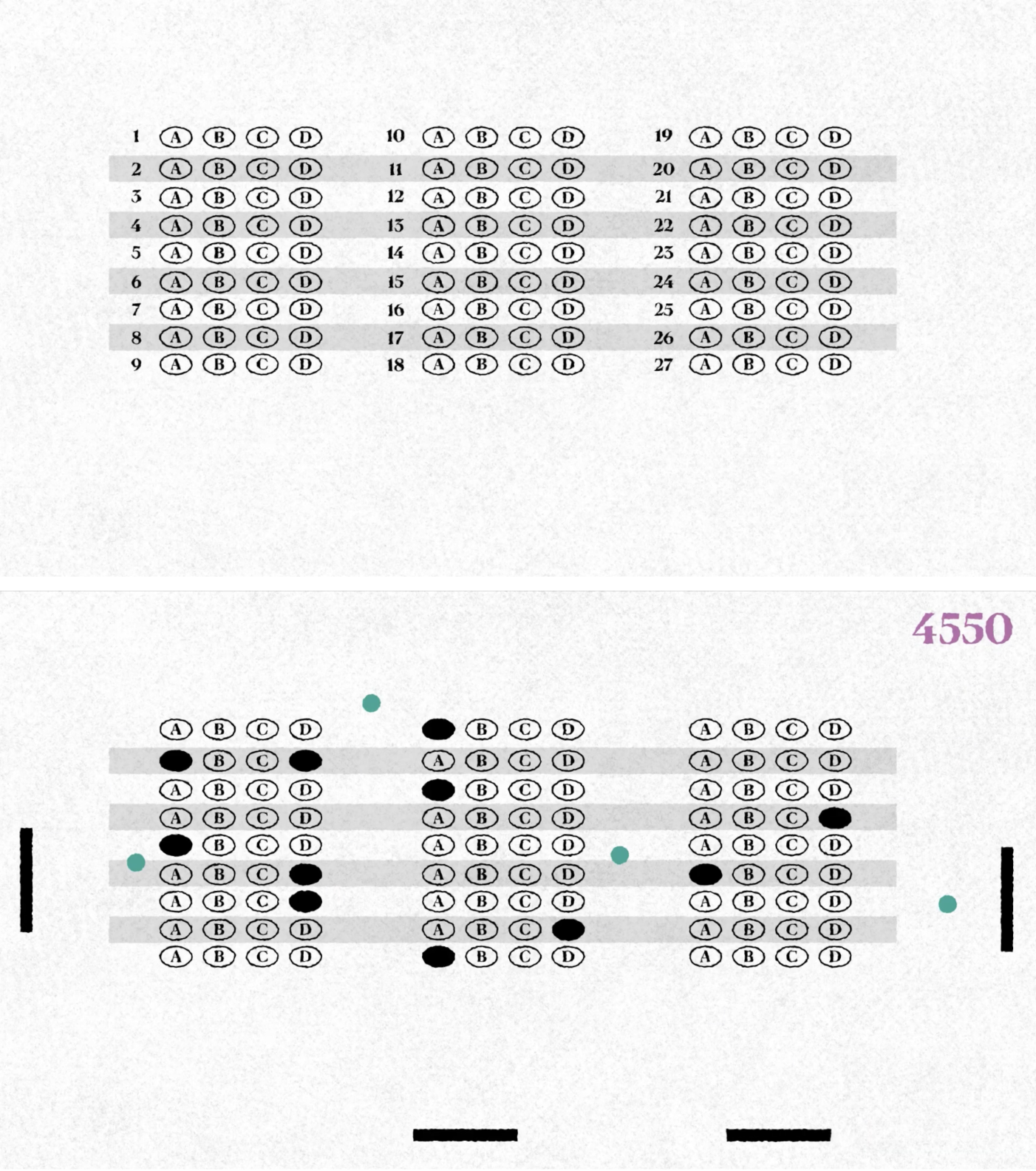
A custom animation turning a standardized test (image 1) into a pong game (image 2). Credit: Abu Abdelbagi, DFI
When creating an animation, there are infinite amounts of ways in which to represent and relate signifying elements to embody concepts or draw new meanings. Likewise, the aesthetic choices made in an animation can provide additional layers of meaning. Aesthetic choices from the font to character design to art style can greatly affect the meaning of a visual. Generally, multimodal visual communication lends itself to multiple interpretations through inviting viewers to open up their understandings in new directions. Thus, this approach of visual communication can be harmonious with constructivist thought and practice through its expansive possibilities.
But how do these kinds of animated visuals differ from supplemental footage (b-roll) or stock video used to support a video interview? Supplemental footage or stock even when used metaphorically are more bound to their literal definition. The possibilities that come with custom animation offer the opportunity to create a visual language that is much more expressive and expansive in how we can approach a concept.
Introducing Reflexivity and Subjectivity
Another approach to apply constructivist thought to social science explainers could be to introduce some layers of subjectivity or reflexivity. A prototypical explainer video contains a disembodied narrator that does not acknowledge their personhood or the audience and straightforwardly explains the concept of video. However, in more recent years, the explainer format has been borrowed by and expanded upon by content creators to become much more personal. While there are many popular explainer style YouTube channels that do not include a presenter, creating a personal brand has become a key ingredient for online video creators’ success (Tarnovskaya 2017).
Anecdotally, I noticed a shift beginning in the late 2010s where online explainers and video essays began including the creator/presenters in their videos much more often. Fostering a personal connection or para-social relationship with audiences generally increases engagement and leads to greater success on platforms like YouTube (Wang & Palmatier, 2025; Welbourne, 2016). While these creators are not necessarily using this approach to uphold epistemological values, this format does introduce further subjectivity and reflexivity, and in turn upholds more constructivist values. Through the simple act of presenting themselves onscreen, this type of creator-presented explainer implies that information is being filtered through an individual’s perspective. This is especially useful for the social sciences where there may be greater inherent distrust in the efficacy of the content. Being transparent about the speaking source may allow audiences that are aware of online misinformation to place greater trust in the efficacy of the information being presented. This notion is supported by a 2021 study that demonstrated viewers found scientists presenting their own research on video to be more competent than if done by a third-party presenter (Ruzi, 2025).
While DFI hasn't yet created a video of a researcher explaining their work in an "influencer" style, there is opportunity to both uphold qualitative research values and also improve engagement through having a researcher as an on-screen presenter. However, this style does introduce challenges when collaborating with presenters who are less comfortable on camera, as they must be enthusiastic and possess a degree of media savviness in order for this video style and narrator to be compelling and engaging.
Practical Considerations for Creating Academic Explainers
An important consideration for creating explainer videos as an in-house media team at an academic institution are the practical challenges that come with making this kind of video. Making an explainer video is a time-intensive process with many interconnected steps. From preproduction and storyboarding, to script writing, to recording, to creating custom animations and graphics, to rounds of feedback from collaborators, the process takes months to complete. Likewise, they require a high degree of technical skill with animation software that must often be learned and relearned during the process. Lastly, there is the potential for them to be costly when contracting creators outside our institution.
Compared to a podcast or a short video interview, an explainer video requires a vastly greater amount of time, effort, and resources to create. For this reason, the DFI media team has to be highly selective about which topics to translate through an explainer. An ideal explainer topic will have an overarching message that can be condensed into a short form piece, have topics that may lend themselves to animations and visuals, and involve researchers and collaborators that are willing to be an active participant in the creation of the video.
With all these considerations, this begs the question of whether explainer videos are worth the effort. At this stage, we do not have the answer for this, but their potential to be a resource for improved understandings of Teachers College’s research, and their ability to reach broader audiences make them a potentially invaluable resource for our larger research-translation goals. There is also value in exploring new methods for communication as a media team, and stretching the limits of our capabilities into higher production value materials such as explainers. In a similar vein, as a media team, we hope to make material that contains a degree of artistry and expressiveness. Explainer videos provide opportunities for artistic expression, which contains value in and of itself. Likewise, creative multimodal interpretations such as explainer videos can bring new excitement to research topics and generate understandings that would otherwise be limited by text based or spoken formats.
Another important consideration is that even though explainer videos remain challenging to create at this moment in time, new generative AI technologies are likely to streamline processes in the near future. With generative AI tools, animations or graphics that previously would take days or weeks to create may only take a few minutes. There are, however, ethical, artistic, and environmental considerations to take in account when using these technologies, and they may not always be the appropriate tool to use for every project.
Explainer Videos and DFI’s Mission Areas
Despite their practical challenges and rhetorical inconsistencies, explainer videos remain a compelling format for social science research translation. This paper seeks to explore their underlying challenges, affordances, and conventions so that they may be adapted with intention to fields of study that are not easily condensed to short-form video. While the process of creating videos in real-world situations may not take into account all of these considerations, it is valuable to consider the epistemological frameworks of any form of media. We are continuing to ask these questions as we also navigate the logistical and practical challenges of creating animated explainer videos. Although their effectiveness in our research translation approach remains to be seen, explainer videos are well aligned with DFI’s four mission areas of multimodal scholarship, play, technology for social good, and digital pedagogy. With these mission areas in mind, the DFI media team hopes to continue experimenting with this format—both as an outlet for creativity and also as an avenue for sharing Teachers College’s research with wider audiences.
References
Adler, M. V., Madsen, J., Hedberg, J., Steinberg, R., & Parra, L. C. (2025). Effect of explanation videos on learning: The role of attention and academic performance. Education and Information Technologies, 30(9), 11797–11825. https://doi.org/10.1007/s10639-024-13292-9
ARTIVISM 4SHAREDHUMANITY. (2025, December 3). Movable parts, Dr. Lucius Von Joo [Video]. YouTube. https://www.youtube.com/watch?v=CYnoK1YGGzs
Atari, Inc. (1972). Pong [Video game]. Atari, Inc.
Barnes, T. & Wilson, M. (2014). Big Data, social physics, and spatial analysis: The early years. Big Data & Society, 1. https://doi.org/10.1177/2053951714535365
Berger, P. L., & Luckmann, T. (1966). The social construction of reality: A treatise in the sociology of knowledge. Doubleday.
Comte, A. (2009). A general view of positivism (J. H. Bridges, Trans.). Cambridge University Press. (Original work published 1848).
Cort, J., & Schmidt, C. (Executive Producers). (1974–present). Nova [TV series]. WGBH.
Fothergill, A. (2006). Planet Earth [TV series]. BBC Natural History Unit.
Geltzer, J. (2018). Fake news & film: How alternative facts influence the national discourse. Southwestern Law Review, 47(2), 297–323.
Guba, E. G., & Lincoln, Y. S. (1994). Competing paradigms in qualitative research. Handbook Of Qualitative Research (pp. 105-117) Sage.
Hodam, H. & Rienow, A. & Jürgens, C. (2021). Creating and testing explainer videos for earth observation. Remote Sensing, 13(20), 4278. https://doi.org/10.3390/rs13204178
Holmes, A. G. D. (2020). Researcher positionality — A consideration of its influence and place in qualitative research: A new researcher guide. Shanlax International Journal of Education, 8(4), 1–10. https://doi.org/10.34293/education.v8i4.3232
Kahan, D. (2012, July 24). Science communication needs the humanities. Yale Climate Connections. https://yaleclimateconnections.org
Koch, W., & Beisch, N. (2020). Ergebnisse der ARD/ZDF-Onlinestudie 2020: Erneut starke Zuwächse bei Onlinevideo [Results of the ARD/ZDF Online Study 2020: Another strong increase in online video]. Media Perspektiven, 9, 482–500. https://www.ard-media.de/media-perspektiven/publikationsarchiv/2020/detailseite-2020/erneut-starke-zuwaechse-bei-onlinevideo
Krämer, A., & Böhrs, S. (2018). The use of explainer videos as a learning tool: An internal and external view. In A. Khare & D. Hurst (Eds.), On the line (pp. 189–202). Springer International Publishing. https://doi.org/10.1007/978-3-319-62776-2_15
Krishna, N. (2019, November 11). Science communication is broken: The humanities are the cure. The Daily Campus. https://dailycampus.com/2019/11/11/2019-11-11-science-communication-is-broken-the-humanities-are-the-cure/
Lincoln, Y. S., & Guba, E. G. (1985). Naturalistic inquiry. Sage Publications.
Lewis, J., Bartlett, A., Riesch, H., & Stephens, N. (2023). Why we need a Public Understanding of Social Science. Public Understanding of Science, 32(5), 658-672. https://doi-org.ezproxy.cul.columbia.edu/10.1177/09636625221141862
McLuhan, M. (1964). Understanding media: The extensions of man. McGraw-Hill
Mooney, B. (2022a). Dissertation | Explore academic insights. Brian Mooney, Ph.D. https://www.brianmooney.com/dissertation
Mooney, B. (2022b). To speak a true word: Remixing hip hop pedagogies, poetics, and literacies [Doctoral dissertation, Columbia University]. https://doi.org/10.7916/df6j-ym97
Munoz Morcillo, J., Czurda, K. & Robertson-von Trotha, C. Y. (2016). Typologies of the popular science web video. JCOM, 15(04), A02. https://doi.org/10.22323/2.15040202
Northeastern University (2020). 10 tips for effective science communication. Northeastern University Graduate Programs Knowledge Hub. https://graduate.northeastern.edu/knowledge-hub/tips-for-effective-science-communication/
Nichols, B. (2017). Introduction to documentary (3rd ed.). Indiana University Press.
Oliver, K. M. (2022a). Becoming tapestry: A dissertation podcast. https://becomingtapestry.net/
Oliver, K. M. (2022b). Becoming tapestry: A multimodal ethnographic podcast exploring storytelling and belonging in a faith-adjacent foster youth mentoring network [Doctoral dissertation, Teachers College, Columbia University]. Columbia University Libraries Digital Repository. https://doi.org/10.7916/n0th-tp95
Park, Y. S., Konge, L., & Artino, A. R., Jr. (2020). The positivism paradigm of research. Academic Medicine, 95(5), 690–694.
PBS Terra. (n.d.). Otherwords [YouTube channel]. YouTube. https://www.pbs.org/show/otherwords/
Rizzo, S. (2025). Film criticism of documentary movies as a media literacy tool. International Council for Media Literacy. https://ic4ml.org/journal-article/film-criticism-of-documentary-movies-as-a-media-literacy-tool/#:~:text=Abstract,for%20the%20production%20of%20meaning
Ruzi, S. A., Smith, A. A., & Lee, N. M. (2025). Communicating biodiversity research on YouTube: An experimental comparison of scientists and third-party presenters. Public Understanding of Science, 34(3), 380-398.
Schneiders, P. (2020). What remains in mind? Effectiveness and efficiency of explainers at conveying information. Media and Communication, 8(1), 218–231. https://doi.org/10.17645/mac.v8i1.2507
Smith, L. T. (2021). Decolonizing methodologies: Research and Indigenous peoples (3rd ed.). Zed Books.
Tarnovskaya, V. (2017). Reinventing personal branding: Building a personal brand through content on YouTube. Journal of International Business Research and Marketing, 3(1), 29–35.
Violot, C., Elmas, T., Bilogrevic, I., & Humbert, M. (2024) Shorts vs. regular videos on YouTube: A comparative analysis of user engagement and content creation trends. 16th ACM Web Science Conference 2024 (WebSci '24), Stuttgart, Germany.
Von Joo, L. (2024). The boundaries of adventure playgrounds [Doctoral dissertation, Teachers College, Columbia University]. Columbia University Libraries Digital Repository. https://doi.org/10.7916/f96e-2703
Von Joo, L. (2023). Building Play. https://www.buildingplay.com/
Wang, X., Li, Y., & Palmatier, R. W. (2025). The impact of face presence in user-generated videos on consumer engagement. International Journal of Research in Marketing, 42(4), 1323–1342.
Welbourne, D. J., & Grant, W. J. (2016). Science communication on YouTube: Factors that affect channel and video popularity. Public Understanding of Science, 25(6), 706–718.
Yang, S., Brossard, D., Scheufele, D. A., & Xenos, M. A. (2022). The science of YouTube: What factors influence user engagement with online science videos? PLOS ONE, 17(5), Article e0267697. https://doi.org/10.1371/journal.pone.0267697