Should We Stop Saying “Kids These Days”?


Listen to Episode
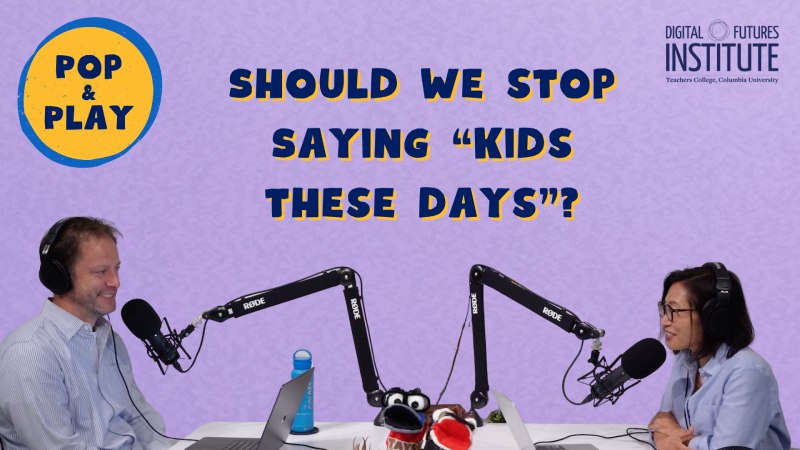
Kids these days just don’t know what it was like back in our day. Which makes sense, cause they’re, you know, kids. This week on Pop and Play, Haeny and Nathan talk about the good, the bad, and the nuance of nostalgia. Just a note that this episode was recorded in September, 2025.
This episode references the “Nostalgia Bone” episode of Throughline, and the article “Whatever You Want to Call It: Science of Reading Mythologies in the Education Reform Movement” by Elena Aydarova.
Our music is selections from Leaf Eaters by Podington Bear, Licensed under CC (BY-NC) 3.0.
Pop and Play is produced by the Digital Futures Institute at Teachers College, Columbia University.
Credits: Video and audio for this episode were recorded by Billy Collins and Madeline McGee. This episode was edited by Adrienne Vitullo with support from Joe Riina-Ferrie. Website support by Abu Abdelbagi. Pop and Play is produced by Haeny Yoon, Nathan Holbert, Lalitha Vasudevan, Joe Riina-Ferrie, and Billy Collins and is part of the Digital Futures Institute Podcast Network at Teachers College, Columbia University.
The views expressed in this episode are solely those of the speaker to whom they are attributed. They do not necessarily reflect the views of the faculty, administration, staff or Trustees either of Teachers College or of Columbia University.
Episode Transcript
Haeny Yoon:
Welcome to Pop Off. We take a few minutes to chat about education, play, pop culture, as it's happening in the public conversation, and you could see me and Nathan struggle to figure out what the relevance is to education and what advice we want to give you. So let's talk about the phrase, and related to, kids these days. So this week we're not going to answer the question of kids these days, do they actually play? Because we hear a lot of complaints about that, right? Kids these days don't know how to... Fill in the blank.
Nathan Holbert:
Yep, yep.
Haeny Yoon:
Whatever it is. And we love...
Nathan Holbert:
The kids these days are always on their screens.
Haeny Yoon:
Yeah.
Nathan Holbert:
Kids these days, they have a short attention span.
Haeny Yoon:
Yeah. Kids these days don't know how to touch grass and go outside, right?
Nathan Holbert:
Right.
Haeny Yoon:
So I feel like there's a lot of that, and I'm sure that we've all said that. I know that I've probably said that at some point too.
Nathan Holbert:
Kids these days can't throw a perfect spiral.
Haeny Yoon:
Oh my God. That's what Travis would say.
Nathan Holbert:
I can't throw a spiral either.
Haeny Yoon:
But I can.
Nathan Holbert:
But I'm a kid, so that makes sense.
Haeny Yoon:
Yeah. And I think the answer is always... Do kids these days know how to play? The answer is always yes. And we've spent five seasons talking about that very question.
Nathan Holbert:
Absolutely.
Haeny Yoon:
That their play looks different, it looks different for different kinds of people, it looks different across time, it looks different in different kinds of context. So at any particular moment such as now, it's not really an exception because throughout history, this has always happened. We always like to complain about kids these days. So I thought we would kind of talk about nostalgia.
Nathan Holbert:
Yeah.
Haeny Yoon:
Like memories that you have going back in the day kind of mentality. And I think there is a very important space for nostalgia and memory making and thinking about good times and things like that.
Nathan Holbert:
We do that a lot on this show, right?
Haeny Yoon:
We do that a ton on our show. I feel like everybody knows our whole life story now. But I also feel like nostalgia can sometimes prevent us from thinking about really complex issues in very nuanced ways.
Nathan Holbert:
Absolutely.
Haeny Yoon:
So I'm going to start with something very localized and then we're going to kind of move out a little bit.
Nathan Holbert:
Up and out.
Haeny Yoon:
Yeah, because I want to make an argument that nostalgia is good, nostalgia can also be really problematic, but then nostalgia can also have an impact in ways that can be really bad.
Nathan Holbert:
Problematic.
Haeny Yoon:
It's problematic.
Nathan Holbert:
Not great.
Haeny Yoon:
Yes. So I'm going to start with the whole parents starting off telling you like, I'm sure this has happened to you.
Nathan Holbert:
Back in my day.
Haeny Yoon:
Back in the day. "I used to walk a hundred miles to school uphill on an icy road. It was snowing to get to school," Right? And that would be the thing. Anytime there was a complaint, my mom or dad or somebody would be like, "I used to have to eat scraps in the dirt for food, so you should eat this food."
Nathan Holbert:
"You don't know how good you have it. Whenever I was a kid, all the pain that I experienced. "
Haeny Yoon:
Yeah. So I feel like it starts really early, right? And then you get to school and teachers tell you, "When I was a kid, I'd like a hundred worksheets. So instead of a hundred, I'm just asking you to do one." And they were so much harder, right?
Nathan Holbert:
Yeah.
Haeny Yoon:
It's like easy for us to kind of... I've definitely said that to students that I've taught.
Nathan Holbert:
That's because kids these days can't write an essay, Haeny.
Haeny Yoon:
Yes, exactly, right? So I feel like we kind of use that as a way to get kids to sort of do what we want or to shut up or to stop complaining.
Nathan Holbert:
Why do we do that?
Haeny Yoon:
Yeah. Why do you think we do that?
Nathan Holbert:
It's kind of wild, right? Because it's not motivating in any way for a kid to hear that this hypothetical or this fictional story about how hard you had it, right? It's not motivating to them, right? So why do we say it over and over again? Why do we constantly use this as a frame to talk down to kids?
Haeny Yoon:
I think because it's easy.
Nathan Holbert:
Yeah.
Haeny Yoon:
Right? I feel like when kids are... Like that moniker like, "Why is the sky blue?"
Nathan Holbert:
Yeah.
Haeny Yoon:
It's so much easier to just be like, "Because." "Because I said so." Right? And I feel like using nostalgia or back to the day mentality, I feel like, is kind of an easy way to explain something.
Nathan Holbert:
Yeah. Yeah. And it also makes it about you too in an interesting way, right? You may be a teacher or you may be a parent and you're presumably wanting to help this kid write an essay or be comfortable eating the school lunch, but really you instead make it about yourself and how actually you're great and you've had struggles. "Look how wonderful I've turned out."
Haeny Yoon:
I did what you did, so you must suffer as well.
Nathan Holbert:
Toxic twist. Yeah.
Haeny Yoon:
A toxic twist. Is that a new phrase? Do you have a trademark? Very good. Okay. But in all seriousness, I think I want to talk about like what nostalgia can potentially do then in the larger culture. So I remember a couple of years ago when the science of reading was making its way into New York City, the chancellor at the time was David Banks, who retired, I think, in 2024. And so I remember him, he was on, I feel like it was a legislative floor doing some kind of talk about reading, and he was basically like, "I remember when I was in primary school, there was not a single kid in my class who could not read because we were taught..." Like whatever, we were taught phonics or we were taught a certain way. And I think it's easy for adults to be like, "Yeah, when I was in second grade, I remember when I was seven, everybody could read." Like, do you really remember this? Could everybody read? Did you only learn phonics?
I feel like it's really like misremembering something or trying to figure out a story that could fit into the narrative that you want to tell.
Nathan Holbert:
100%. I mean, I can't remember what I did yesterday, and kids are more observant than we give them credit for, but the idea that they would be aware of everyone's kind of capabilities around reading at that age is, it strains credulity to get to that.
Haeny Yoon:
Yeah. Yeah. And then the same vein, I remember I was really obsessed with that idea of, how do people talk about certain things? And so there's this researcher, Elena Idarova, and she basically did this policy analysis. So she... The article is called Whatever You Want To Call It, and it's in Harvard Ed Review, and she basically did this analysis of the Tennessee legislature and how they talked about reading programs and phonics.
Nathan Holbert:
Oh right, sure.
Haeny Yoon:
And basically a ton of them, even in their debates to pass legislation, were like, "I'm one of the older members here," I'm going to actually quote this, "And phonics was taught as I came up through school." Another said, "Most of us learned with phonics and many of us had school teachers that had on silk stockings." It was just like such a nostalgic way of thinking about back in the day. Like back in the day, this is how I was taught, so today...
Nathan Holbert:
Therefore they have to do it too.
Haeny Yoon:
Yeah, this is how we [inaudible 00:07:41]. And I think it's a really dangerous thing, right? When you think about your back in the day mentality and you're like, "This is why this particular legislation has to pass."
Nathan Holbert:
Yeah. Oh God, yeah. I mean, I think that is, by definition, conservative, right? It's kind of not imagining progress, it's not imagining change, just not imagining the way in which a society can move and transform. Very, very dangerous. I mean, is the proposal here that the solution is one room schools and lace stockings, silk stockings? What's going on here?
Haeny Yoon:
I'm going to start doing that in my pre-service teacher ed program. Be like, "Everybody, today we're going to check about silk stockings."
Nathan Holbert:
"Here's how to put on silk stockings." It's funny that this is coming up too because my son, for one of his assignments, he was supposed to interview me about my literacy history, I think is how he framed it. And he was like, "Do you remember learning to read? What books did you read?" This kind of thing. And I was like, "Oh, I remember reading the sort of Dick and Jane and Spot books." They also have a name, what are they called? The readers, something readers. And I remember that, right? And that's one thing to say, "I remember learning to read with these books." An entirely different thing to be like, "And that's the way everyone should learn to read." I don't understand. Separating those two things shouldn't be that hard for us to do.
Haeny Yoon:
Yeah, yeah. And I feel like when I think about that too, when I think about those readers, I always have to, if I actually sit back and think about it for a second, I'm like, "Maybe that isn't how I learned to read."
Nathan Holbert:
Right.
Haeny Yoon:
Maybe that's the story, though, about how I think I learned to read.
Nathan Holbert:
Yeah, that's a really good point.
Haeny Yoon:
And that's the story that I'm going to tell now and I'm going to stick to it because it's a really nice, convenient truth.
Nathan Holbert:
Yeah, because no one can check me on it.
Haeny Yoon:
Yeah, so therefore it's true.
Nathan Holbert:
It must be true.
Haeny Yoon:
Yeah. Yeah. So I think at the end of the day, I want people to consider like what's the... I think we're always looking for an easy solution to things that are actually really tough and complicated to answer, and reading is one of them, but there's lots of other things, right? Like when we think about gun violence or when we think about mental health or all of that, like those policies are driven by people and their ideas and the stories that they tell, right? And part of it is that nostalgia that can be really dangerous.
Nathan Holbert:
Yeah. And any individual component of reading or of school or of the history that you remember existed in a broader system of things, right? And so, you mentioned the gun violence thing, this is a thing that we hear our politicians say all the time is like, "Well, when we were kids, there were guns. I grew up in a farm school and kids had guns." RFK said something just the other day that like, "We were encouraged to bring handguns to school," Which is an absolute...
Haeny Yoon:
Which I'm sure it was not true.
Nathan Holbert:
An insane thing to say. But even if it were true, it's not about whether or not guns existed, it's the context and the culture and the systems in which these things exist in. It's not about whether or not it's a weekly reader book or whatever those were called, weekly readers or those other things, those news things, those were awesome.
Haeny Yoon:
Scholastic.
Nathan Holbert:
Everyone should have those. Kids these days don't know what a weekly reader is.
Haeny Yoon:
Kids these days. Back in my day, we used to have weekly readers.
Nathan Holbert:
But it's the context in which those things existed, and that has changed, and we should work within that context and we should work within the future context that we're finding ourselves in.
Haeny Yoon:
Yeah. And I think people like to think that this time is worse than any other time.
Nathan Holbert:
Yeah.
Haeny Yoon:
Right? And I think that's actually not true. Every time was actually... I think people thought that in every time period, right? So this particular time is probably no exception to that.
Nathan Holbert:
Yeah, maybe not. I mean, I think there's probably... On the one hand, what's the point of measuring which time is worse?
Haeny Yoon:
But it's always a competition.
Nathan Holbert:
It's always a competition. And on the other hand, it can be valuable to recognize that we've been here before. We've been in really hairy, difficult, not great experiences, and we've found a way to kind of move on through that, and so focusing on the comparison of how bad is it now and how bad is it before is not the most effective way to move forward.
Haeny Yoon:
Yeah. So my last thing I'm going to say is there's this episode of the Through Line podcast. They have this really great episode, it's called Nostalgia Bone, and I've talked about it so many times in different contexts, but it basically talks about nostalgia, not necessarily as a bad or good, because I think it's really dangerous also to think about things in binaries all the time, but one of the things that they talked about was this example in World War I where all these soldiers were falling ill all the time for no reason. And they were like, "Why are all these soldiers getting ill for no reason?"
Nathan Holbert:
Yeah.
Haeny Yoon:
It's like they would smell something or they would hear a sound and then all of a sudden they would fall ill. And then they realized that what happened was these soldiers were homesick. Okay, so they would smell something that reminded of them of their mom's cooking or something and it would make them sick, right? Or they would taste something that reminded them of something and then it would make them sick because they long for home because they were away from home for so long. And so then they started to think about like this idea of nostalgia as a concept, right? That we get nostalgic for something because it helps us emotionally, right? It helps us physically. I feel like there's also these effects that happen because of it.
So in the same way, enslaved people would have the same effect happen to them, right? They would fall ill because they remembered something or a scent or an action or something someone said would remind them of something from back home. And instead of attributing it to nostalgia or homesickness like they did with the World War I soldiers, they would be accused of not working hard enough.
Nathan Holbert:
Right, like a weakness. Yeah.
Haeny Yoon:
Yeah. And as we know, the consequences are a lot more detrimental then. So nostalgia on the one hand can be acceptable, even expected, for one group of people, but unacceptable and completely forbidden for others.
Nathan Holbert:
It'd be very appropriate for us to acknowledge that a lot of the societal challenges that we're wrestling with right now collectively, especially in the United States, is this kind of nostalgia that has run amuck, this belief that there was a prior time where things were good and things now are not like those times, and it is one particular version of a history that somebody remembers and neglecting the other pain and other experiences that others have had. Yeah, not great.
Haeny Yoon:
Yeah, not great. So let's talk about why we want to talk about this.
Nathan Holbert:
Okay.
Haeny Yoon:
What's the takeaway that we...
Nathan Holbert:
Yeah, where do we go from here?
Haeny Yoon:
Yeah. Where do we go from here?
Nathan Holbert:
Yeah.
Haeny Yoon:
Do you have a solution?
Nathan Holbert:
Oh God, no. I mean, I like your point about avoiding binaries here because I think there's a lot about looking back and kind of memory, home sickness, nostalgia that can be positive, that can help us remind us who we are, that can help remind us who else was there with us or who else has had similar experiences. That can be positive and that can create community, right? But it also clearly can be something that we, if we get too stuck in, we fail to recognize kind of the beauty and the wonder and the exciting, great things that are happening now, and the ways in which that change can also be positive and good. So I really appreciate you kind of helping us wrestle with that, moving out of those binaries.
Haeny Yoon:
Yeah. And I think related to that, I feel like one really practical application that we could all take up is we could all practice not using nostalgia to explain something.
Nathan Holbert:
Yeah.
Haeny Yoon:
And so I feel like the examples that I gave, I think it's easy to use a back in the day mentality to weaponize whatever issue you want to be on the side of, right? And instead of doing that, I feel like some of us can start to think about issues really deeply and consider the idea that we might not have the answers to something, that we can't always rely on our nostalgic stories to explain something away, right? So I think maybe we should just stop thinking about that as a solution.
Nathan Holbert:
So you're saying when my kids complain about dinner, I can't do a...
Haeny Yoon:
Try not to say, "Back in the day..."
Nathan Holbert:
"When I was a kid..."
Haeny Yoon:
Exactly.
Nathan Holbert:
"...I had to eat broccoli every day, four times a day."
Haeny Yoon:
Yeah, because we know that's what happened.
Nathan Holbert:
Debbie Holbert, I'll never forget.
Haeny Yoon:
Don't isolate our listeners. And I also feel like it's okay to be nostalgic for things, right? I feel like the takeaway from our episode is not like, "Stop being nostalgic," Right? It's what makes us human. It's what makes us able to relate to people, right? It's what connects us. It's what, like you said, brings community, right? But we also want to remember then what that is for. Nostalgia can have the power to really bring us together, it can also have the power to really tear us apart and make lasting policy changes, curricular changes, political decisions, things like that that impact young people, right? So we want to think about what this is for, who it's going to impact, and then how we want to approach this idea.
Nathan Holbert:
Love it. Yeah. Well said. Thank you.
Haeny Yoon:
All right. So...
Nathan Holbert:
Way to Pop Off.
Haeny Yoon:
Yeah. I felt good.
Nathan Holbert:
I feel better.
Haeny Yoon:
Yeah. Sometimes popping off feels good.
Nathan Holbert:
You know, kids these days, they don't Pop Off like we used to.
Haeny Yoon:
Yeah. Gosh, let's implement a policy where we have to Pop Off once a day.
Nathan Holbert:
Hey, I'm into it. Well, thank you for joining us this week. We will be back in two weeks for another episode. Coming up, we are moving through season six where we've got a lot of fun play dates planned for you, so keep an eye out on our social media accounts, on Instagram and Blue Sky to find out what those are, and join us. Play along with us.
Haeny Yoon:
Also, please leave us a comment, rate the show, share the episode with your friends, and follow us on Instagram and Blue Sky. And on our Blue Sky account, we've actually curated a feed. Well, actually Nathan's curated a feed. A past...
Nathan Holbert:
We in air quotes.
Haeny Yoon:
Yes. Past Pop employee guest, so check it out.
Nathan Holbert:
Check it out. All right, thanks everybody.
Haeny Yoon:
Bye.
Nathan Holbert:
Bye.