Want a sense of how Climate Change and AI are affecting the things we care about? Check out this Op-ed series written by Gabriella Garcia.
Title: AI and Climate Science: Agreeable Allies or Polar Opposites?:
Subtitle: A 4 part op-ed series discussing the relationship between artificial intelligence, climate science, and climate change.
Artificial intelligence (AI) can boost our understanding of exactly how the climate is changing by improving how scientists create models of climate conditions. And with the effects of climate change intensifying, the need to understand this shift is also intensifying across all communities. But AI has shown a considerable amount of drawbacks, particularly environmental ones, that must be thoughtfully considered when using it as a tool to understand the climate. So right now, there is a more crucial need than ever to talk about climate change and become aware about how AI is tipping the scales.
|
The soccer stadium during the break for players to rehydrate and cool off during the Netherlands v. Tunisia match at the FIFA 2026 World Cup. Due to concerns of extreme temperatures, breaks like the one above were mandated for all matches. (Credit: Wikimedia under the Creative Commons 4.0 license. Edited.)
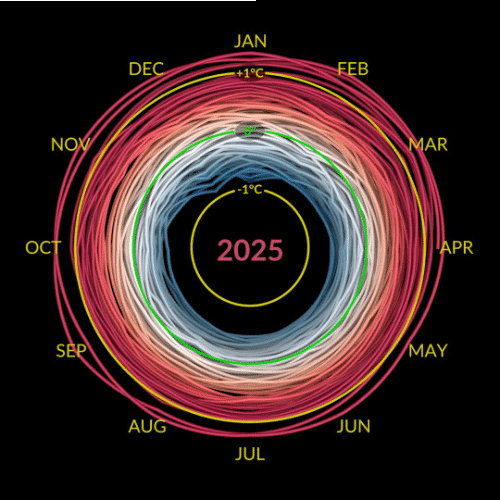
NASA’s “climate spiral”: as the line moves through the years from 1880 to 2026, it traces the global temperature and how much it deviated from the average, depicted as 0C°. Even a change in 1C° can greatly impact Earth’s weather and ecosystems. (Credit: NASA’s Scientific Visualization Studio https://doi.org/10.5281/zenodo.15881695.) |
A Changing Climate Affects More Than Just the ClimateEvery four years, the FIFA World Cup never fails to bring a festive and competitive spirit to fans, businesses, and even countries. For me and my family, like many others, this global event can become deeply personal; we embrace pride in our countries of origin while we all emphatically shout at our teams for the entire match. But, in this particular year’s World Cup, the atmosphere of festivity was dampened by numerous controversies, with a notable one being spurred by climate change. The soccer stadium during the break for players to rehydrate and cool off during the Netherlands v. Tunisia match at the FIFA 2026 World Cup. Due to concerns of extreme temperatures, breaks like the one above were mandated for all matches. (Credit: Wikimedia under the Creative Commons 4.0 license. Edited.)
This year, FIFA mandated two breaks – in addition to half time – for players to rehydrate and cool off in every match, highlighting unusually hot conditions as the culprit. FIFA’s assertion wasn’t entirely without merit: this was the hottest World Cup to date, including the previous one held four years ago in Qatar (whose local climate has been described as a “hot, hyper-arid desert.”) Beyond heat worsening player performance, studies have shown that as the climate gets hotter, human mortality rates spike. However, fans rebutted that the breaks really provided a larger benefit for FIFA outside of player wellbeing. Tens of millions of people regularly tuned in to watch the matches of the 2026 World Cup and fans quickly became suspicious that the breaks – during which many broadcasters used as new advertisement space with FIFA’s permission – allowed for both groups to increase their revenues at the expense of the fans. Climate Change Isn’t Just A Sports Issue
Although FIFA’s true motivations for including such breaks remain murky, it is an undeniable fact that the climate is changing. Just two years ago, in 2024, we lived through Earth’s hottest year on record since scientists began recording global climate conditions in 1880. NASA’s “climate spiral”: as the line moves through the years from 1880 to 2026, it traces the global temperature and how much it deviated from the average, depicted as 0C°. Even a change in 1C° can greatly impact Earth’s weather and ecosystems. (Credit: NASA’s Scientific Visualization Studio https://doi.org/10.5281/zenodo.15881695.)
While the problem of a warming climate seems distant, it is a personal issue that is likely impacting every reader of this article right now. For me, the World Cup was the tip of the iceberg. My city has been flooding more often when it rains. I’ve heard more warnings from my local government to limit any extra activity in the summer. Climate change is expected not only to increase, but exacerbate, all types of natural disasters – including flooding and heatwaves – globally.
Climate change is a looming figure in all of our lives. It’s already impacting our entertainment and pastimes, our jobs, and even our day-to-day on a global scale (just look at the World Cup!) Climate models – thanks to AI-integration – are helping us sharpen our understanding of what’s happening, what will happen to the climate, and, by proxy, what will happen to us. Though AI has certainly quickened the speed climate models improve, which bodes well for climate change mitigation, it's still a complicated figure with numerous facets to be considered, especially when it comes to issues surrounding climate. |

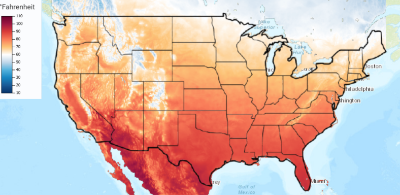
Climate models help scientists produce maps like the one above. While this looks like a normal weather map for the United States in the summer, this is actually a climate model’s prediction of the average maximum temperature for the United States in the 2090s – which is roughly sixty years in the future – if we increase our greenhouse gas emissions. (Credit: U.S. Climate Resilience Toolkit Climate Explorer https://crt-climate-explorer.nemac.org/. Edited.)
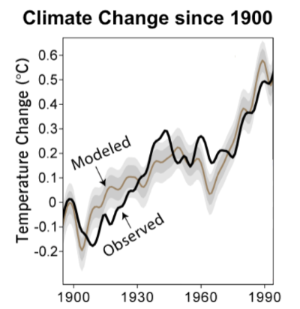
Uncertainty in climate models ultimately affects how accurate a model can be. While the “Modeled” line (which shows how our current climate models expected the climate to change) isn’t entirely incorrect, it’s noticeably different from what was actually observed. (Credit: Wikimedia under the Creative Commons 3.0 license. Edited.) |
How Do We Understand Climate Change?Quantifying climate change has been in the hands of scientists using climate models based on atmospheric physics and chemistry principles. Climate models solve various math equations taken from various scientific laws by using environmental data like temperature or humidity to represent both the current and future state of the atmosphere. Essentially, these models allow us to picture how the Earth’s climate will change over time in the long term (“how hot will next summer be?”) Climate models have been central in mitigating the effects of climate change. While we can’t know the exact state of the climate at any given time (weather is too chaotic!) the predictions these models produce help all people realize how much impact we have on the climate. This understanding can result in good, like proactively passing legislation to protect people from natural disasters. And as scientists continue to work towards better models, a complicated new ally promises to speed up progress towards this understanding without sacrificing technological efficiency: artificial intelligence (AI.) Addressing Uncertainty in Climate Models with AI One of the issues surrounding climate models that scientists often grapple with is how they produce predictions. The equations themselves that power models contain what climate scientists call “uncertainties.” While uncertainty can come from a variety of sources within a climate model, uncertainty is something that makes the overall prediction of that model less accurate. Because uncertainty is inherent in any climate model, scientists are deeply invested in quantifying how much there is to reduce overall uncertainty in the climate model. Dr. Gregory Elsaesser, a climate scientist for NASA’s Goddard Institute for Space Studies, focuses mainly on improving climate models for thunderstorm predictions and has made incredible headway in this space through integrating AI in his work. Elsaesser notes that traditional climate models (also called physical climate models) need to be run multiple times to produce a climate forecast or to validate that a certain model makes accurate predictions. “But to get to that, that final model takes so many painful iterations.” And most of that “pain” comes from the price of needing to run and re-run a climate model: it’s financially expensive and time-consuming. On the time it takes to run those models, he laments that “it would take, like, a week.” However, climate scientists like Elsaesser are finding that AI integration into physical climate models provides enormous benefits for both problems without sacrificing model accuracy, for the most part. “You can run the AI model by making a surrogate [model, which is a simplified version of the actual climate model],” he notes. “It won't be a perfect, faithful representation of the actual model, but it's good enough for you to say, you know what, rule this out or rule it in. Let's explore more.” Elsaesser’s work with AI deals primarily with a subset of AI called machine learning (ML) which allows the computer to identify patterns in previously collected real world data to make climate predictions. “We have a word called ‘tuning’ where we tune the equations so they work better,” he explains. “We can ask the ML ‘hey, which parts of the equation are uncertain?’ and go through the whole list of all the equations to reduce the uncertainty in each equation so that the whole model works better, improving our predictions.” And that is what excites Elsaesser the most about AI: ML has increased the speed of producing accurate climate models. By increasing our ability to produce accurate models, we can begin to get ahead of how the climate will change to better mitigate the effects of the change.
|
|
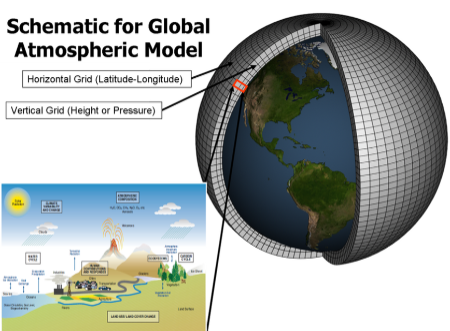
Climate models are extremely complex. The grid helps climate scientists break down our climate to more manageable chunks at specific spatial scales so we can model the climate system better. But within those grids are earth systems like the one on the bottom left, which just add to the never ending lists of complexities climate scientists have to deal with. (Credit: NOAA via Wikimedia Commons. Fair use under public domain.)
Studying clouds, like the one above hanging effortlessly above New York City, is vital to understanding the climate as a whole because of the role clouds play in the climate system. Properly quantifying and reducing the uncertainty they add to models would greatly increase our forecasting capabilities for bigger weather events like storms. |
A “Cloudy” ProblemAlthough AI subsets like machine learning (ML) have improved tuning of climate models, Elsaesser points out another issue that scientists are pushing to resolve: climate models are too simple! “You can broaden this out and say, well, there's all kinds of features. There's sea ice, there's how vegetation grows over decades and so forth…And you got to put all of that into one model. …That's the challenge.” Earth is an incredibly complex planet and it’s always in motion. A sunny morning suddenly turns into a stormy evening as atmospheric conditions shift. Clouds that you saw ten minutes ago have drifted far across the sky. This is where scientists like Dr. Kara Lamb come in. Lamb is an associate research scientist at Columbia University’s Department of Earth and Environmental Engineering focusing on how computational methods – like ML integration into models – can improve how we represent clouds in climate models. Clouds are deceptively complex; they look very simple, even peaceful, to the human eye and elevate any scenic picture. But inside a cloud is a chaotic scene: micro particles of water and ice, crashing into each other constantly. And because we can’t know the precise location of all these particles at once, this becomes one of the greatest sources of uncertainty in a climate model.
Though they add more headaches for modeling, Lamb remarks that clouds “are actually playing a significant role in controlling the Earth's climate.” The reason why we call it “climate change” is because the climate is currently taking in more solar radiation than it’s reflecting. In other words, by taking in more heat than it’s releasing, the climate is unbalanced. Clouds play a tremendous role in maintaining that balance. Just as one example, on a hot summer day, a passing cloud can be a great source of shade from the heat. Besides providing comfort, clouds lower in the atmosphere can reflect sunlight well and have a cooling effect on the land; this is one key way clouds help maintain that climate balance. (While climate change has altered the efficiency of this process, Earth’s climate would be much, much more unstable – and warmer! – without any clouds on it.) The Art of Modeling Complexities“But,” on cloud microphysics, she notes “they're very challenging to predict.” Lamb and Elsaesser both agree that today’s current climate models don’t accurately reflect the complexity of cloud microphysics, which just introduces more uncertainty into a climate model. Though scientists don’t understand everything about cloud microphysics, it’s because of this complexity along with computational limitations that simplified climate models are often used in place of more complex models. “When we're looking at climate scales [referring to the size of the climate phenomenon being studied e.g. cloud microphysics versus storm formation] and we're trying to model longer term climate,” she comments, “we have to have simpler models in order that they'll actually run in enough time that we can go and analyze the data.” One possible solution that Lamb has been working on to tackle this source of uncertainty uses various types of AI within traditional climate models. “I would say initially I was looking at more traditional machine learning methods and how they could be integrated with physical models to address some of these uncertainties,” she begins, which is similar to the approach Elsaesser described to tune climate models generally. “I think now we're actually integrating tools more and more that are like these traditional LLMs [large language models] in our research workflows for things like helping to write code.” With the use of LLMs – particularly in helping to write code or to handle large datasets – Lamb remarks that AI has shown considerable promise in two areas that climate models are desperately lagging in: speeding up scientists’ understanding of how to tune models specifically for cloud uncertainty and helping to model processes scientists don’t fully understand yet. Because clouds are also a culprit for many dangerous weather phenomena – storms, hurricanes, tornadoes, floods – this heightened ability to understand clouds faster may result in saving lives against these extreme events through informing warning systems. |



A data center for Microsoft in the Netherlands. The infrastructure for AI processes is housed in data centers, similar to the one above, and as demand for AI grows, so do the number of centers. (Credit: Wikimedia under the Creative Commons 4.0 license.) |
Environmental Concerns over AIThe ways AI has pushed climate science forward is notable, almost superhuman. There is no denying the capacity AI has as a tool to aid us in the fight to understand and prepare for a changing climate. However, AI applications in climate science aren't a perfect technology and, like all new technology, it must be considered from many angles to appropriately weigh its contribution. Most scientists are reporting that hybrid models do produce accurate forecasts and, as Elsaesser and Lamb noted above, are providing numerous breakthroughs for general climate modeling. But some scientists are finding that hybrid models often miss the mark for predicting extreme weather events like particularly bad storms. Since climate models integrated with ML primarily use pattern recognition to reach conclusions rather than by solving equations, weather extremes can be missed because they don’t follow traditional weather patterns. In addition to scientific concerns, AI has fallen under scrutiny for its high energy consumption and lack of transparency thereof. AI models, particularly LLMs and ML, need to train on data. Higher amounts of training data lead to higher energy costs; LLMs like ChatGPT use a staggering amount of energy because they’re being trained on the entirety of human data. AI models for climate science use much less energy since they’re being trained on a much smaller subset of data. There’s also another interesting nuance between AI hybrid climate models and traditional climate models. When training, both have a roughly equal training time and cost (both monetarily and energy-wise.) After training, hybrid models – because they are not constantly solving equations after they have been trained – have been shown to have an overall decreased cost in both areas than their traditional counterparts. Beyond energy, other environmental concerns have also been raised. LLMs have been at the forefront of concerns surrounding the aforementioned costs of training models. During training, LLMs are known to release an excess amount of greenhouse gases – the same ones that cause the Earth’s climate to warm. (Though as LLMs continue to improve, this consequence of training has been reduced with each iteration.) The cost of daily AI usage has also been criticized, particularly because of what’s needed to keep it running. Most of our current technology (including any device being used to read this article) has a need to keep the circuitry cool in order to ensure the machine continues to function properly. AI is no different; the servers that actually host the model are quite large and therefore have a high cooling demand. But because these servers are cooled with a large amount of freshwater (which is fit for human consumption), many have raised this as a practical and ethical concern. When it comes to concerns of the widespread use of AI, there are many mixed sentiments. But when it comes to science: “the exciting part of being a scientist is just to check that it makes sense,” Elsaesser muses. His position is one that highlights humans as stewards of a developing technology, using AI as a tool to aid scientific discovery rather than usurp it. “So long as we move that science is an entity moving forward, there will always be a component of understanding that is related to humans.” So…Where Does That Leave Us? The greatest weapon climate change has is ignorance. Many are pushing back by learning as much about it as possible. People have pushed for climate action as high as legislative change to simpler actions like having compost and recycling bins available in their neighborhoods or institutions. Scientists like Elsaesser and Lamb give talks to the academic community about AI and its impacts to foster conversations while thoughtfully considering what it means to be a climate scientist utilizing AI. But the best climate action is the one most accessible to you: learning about climate change and talking about it – its effects, mitigation strategies, and AI-integration – as much as you can. |