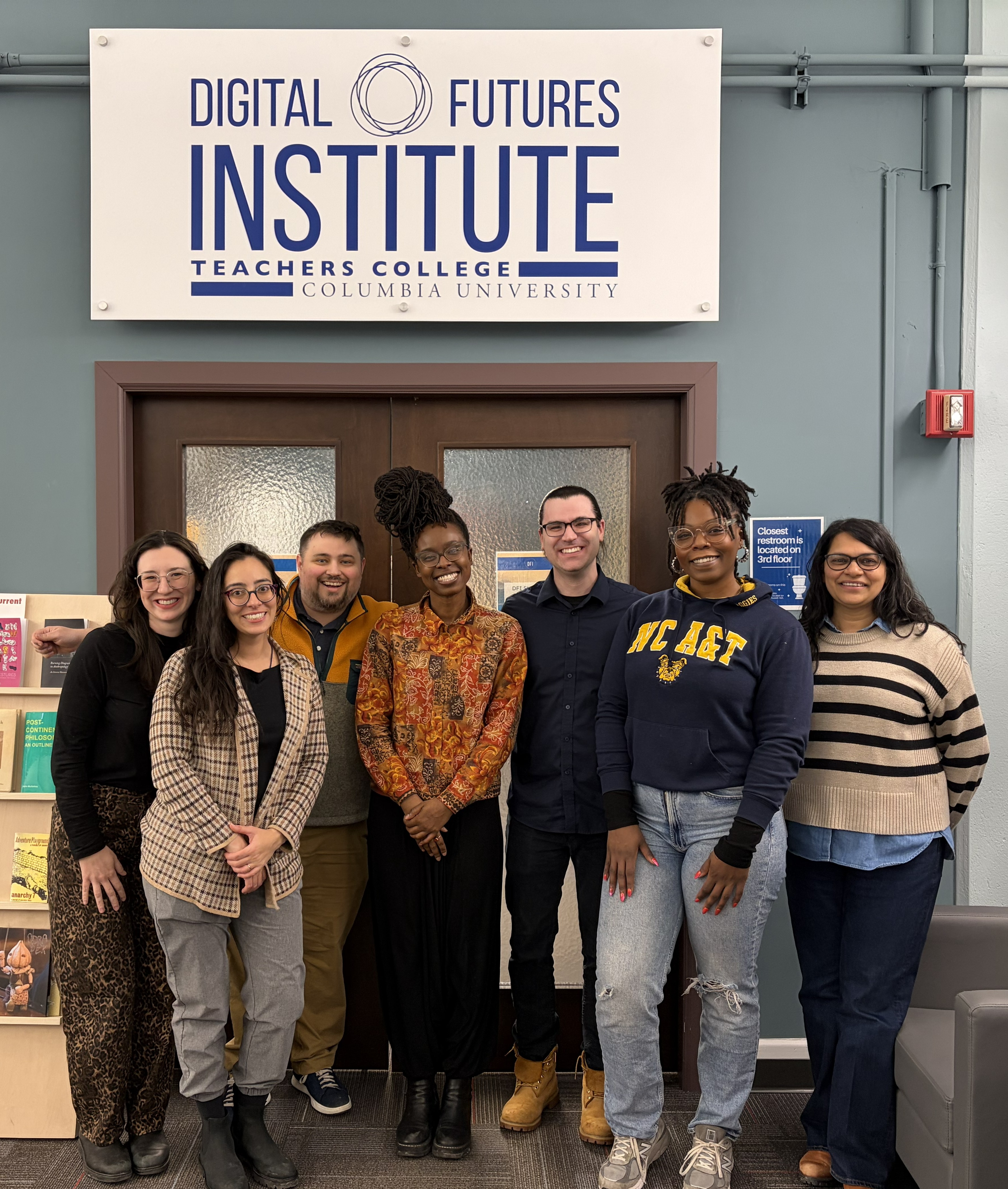
The ERIN Fellows cohort and DFI directors met for a February 2026 workshop at Teachers College, Columbia University.
By Kristin Gorski, Director of Operations, and OreOluwa Badaki, Research Scholar
Starting in late Fall 2025, the Digital Futures Institute has welcomed its first cohort of ERIN Fellows, made possible with funding from the Spencer Foundation. Since then, these Early Career Researchers (ECRs) have learned about and shared their innovations related to multimodality, multimedia, and research, creating a learning community and a network to support each other in developing their skills. Dr. OreOluwa Badaki, DFI Research Scholar and Co-Director of the ERIN Fellows Program, shares more information and insights into this new, cutting-edge opportunity. The following are selected excerpts from an interview conducted over Zoom on February 10, 2026. Excerpts have been edited for length and clarity.
Developing an innovation network for Early Career Researchers
Kristin Gorski: Could you tell me some background information about the Spencer ERIN Fellows Program?
OreOluwa Badaki: ERIN stands for Early Researcher Innovation Network. Funded by the Spencer Foundation and Teachers College, it's an opportunity for early career researchers who are interested in expanding their methodological toolkit. Since one of the Digital Futures Institute's pillars is multimodal scholarship, we're aiming to fortify multimodal research and innovation by equipping new generations of scholars through this program. Many Fellows are already doing this work, so ERIN aims to give them access to the time and resources that they may not already have in their day-to-day activities, so that they can really develop this facet of their work.
Kristin: How do early career researchers get involved in an innovative research program like this?
OreOluwa: The current ERIN iteration is the pilot. We are hoping to continue and to have more cohorts in the future. We're already talking with the current cohort about ways to build pathways and networks with subsequent fellows.
There was an application process that myself and Dr. Lalitha Vasudevan, DFI's Managing Director and TC's Vice Dean for Digital Innovation, designed for Fall 2025. We shared this with a wide array of networks that had many early career researchers, especially those interested in further integrating multimodality, technology, and multimedia into their research methods. We looked for applicants who already had some experience with these forms and were developing innovative projects that could benefit from the ERIN program's support.
Another important component of the program is that fellowships go to early career researchers at universities and institutions that may not have access to the sort of technological and media resources at DFI. Through our work with the ERIN fellows, we hope to extend DFI resources to initiatives, programs, students, and communities working towards similar goals.
ERIN Fellows are part of institutions and centers. They lead labs, collaborations, and classes. So the question becomes: How can what they're learning in this program support their wider networks?
Since one of the Digital Futures Institute's pillars is multimodal scholarship, we're aiming to fortify multimodal research and innovation by equipping new generations of scholars through this program.
Kristin: What is your role in this, and how do you work with the early career scholars?
OreOluwa: I have two roles. The first is as the project's Co-Director, along with Dr. Lalitha Vasudevan. I help organize and cultivate community within and around this fellowship. Through our workshops, we connect Fellows with DFI-affiliated faculty and staff who are doing innovative work in multimodal, media-based, and technology-based research. This means I’m often liaising with our faculty and staff and designing enrichment activities for the cohort members. We also have one of our DFI research assistants, Andrea Kim, on the team, who has been very helpful in supporting logistics. My second role is as a workshop facilitator, helping Fellows think through movement and embodied methodologies. So I get to participate on both ends: being a facilitator for a methods workshop, and helping behind the scenes with the project as a whole.
Providing resources and building community to deepen research innovation
Kristin: What is the group creating together in this pilot cohort? What do you plan to work on?
OreOluwa: As I mentioned, ERIN Fellows come with project ideas at various stages: some are completely new studies and some are new iterations of existing projects. Many of our Fellows applied because they wanted the opportunity to dig deep into their projects and engage with new methods.
So DFI provides resources and opportunities to connect with senior scholars and experienced researchers who are using these methods. We also emphasize the cohort model and having space to support one another and motivate one another. So each fellow has a project that they're working on, that is connected to their existing research portfolio, and the ERIN Program is designed to help them explore different aspects of their projects with the support of the workshop facilitators, the ERIN team, and each other. We're also working on a toolkit (resource hub) for early career researchers who are interested in the methods we're exploring within ERIN. Currently, this version is on Canvas; the goal is to make it more available in later iterations.
We’ve also had unexpected opportunities and collaborations arise: Cohort members are collaborating on projects outside of ERIN, have invited one another to contribute to edited volumes, and have completed articles using what they've learned from ERIN workshops.
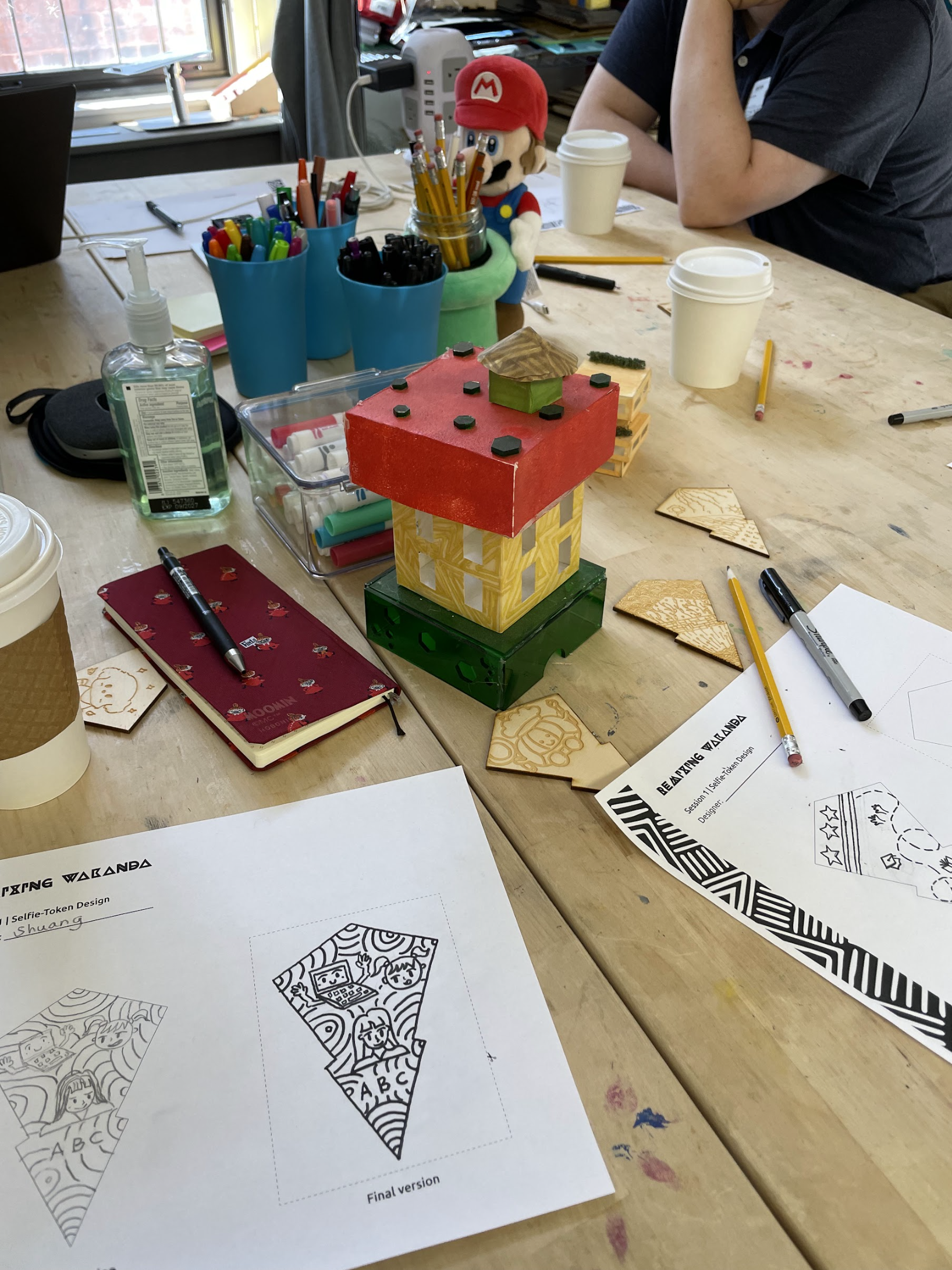
Artifacts from an ERIN Constructionism and Play workshop with Dr. Nathan Holbert—Technology, Media and Learning Program at Teachers College
Kristin: What's on the schedule for the rest of 2026 for the ERIN cohort?
OreOluwa: In addition to our final workshops, we're looking forward to the Multimodal Scholarship Showcase, happening on May 7, 2026, in DFI's Smith Learning Theater at Teachers College. We've invited ERIN fellows to the event so they can see this work they've been learning about in action, get inspired, and get more connected to the wider DFI network. This will be an opportunity to engage with the larger DFI-Teachers College community.
Soon, the ERIN Fellows will work with DFI's Media Team to learn more about educational podcasting, a central part of DFI's work. We will also host a culminating event for Fellows to share progress they've made on their inquiry projects and for all of us to reflect on the program and plan for future iterations.
Building from multimodal scholarship
Kristin: How does this relate to your work as a scholar, as someone who has a strong vision and understands the importance of networks?
OreOluwa: Thank you for that question. This is something I wish I had earlier in my journey as an early-career scholar. I appreciate the opportunity to help facilitate and cultivate that space for others. Throughout my academic career, I have done quite a bit of organizing and community-building around multimodal scholarship. When I was a doctoral student, I directed the Collective for Advancing Multimodal Research Arts (CAMRA) at the University of Pennsylvania. I also directed our Screening Scholarship Media Festival (SSMF), and during that time, I realized how powerful this space can be, not just for academia, but for making sure we are rooting the work we're doing in communities that we care about. That's what drew me to multimodal scholarship in the first place.
Carving out space for this sort of work in academia takes institutional power that sometimes students and early career researchers don't have. I appreciate DFI building space for researchers, investing time and energy in the creative, innovative, and multimodal methods that strengthen and fortify our research work. I'm grateful to be able to help facilitate these spaces, and I want to see more of them.
Through our work with the ERIN fellows, we hope to extend DFI resources to initiatives, programs, students, and communities working towards similar goals.
Kristin: Can you tell me more about modes and multimodality?
OreOluwa: To understand modes and multimodality better, I would start with the multimodal toolkit on DFI’s website, where anyone can dig deeper into multimodal scholarship. This explainer video (thank you, DFI Media Team!) breaks down both the “multi” and “modal” in the term multimodal.
Multimodal scholarship for me is about the interaction of multiple forms of communication (or modes) and why people use them. It's less about isolating specific modes and trying to distill inherent qualities in them, and more about understanding how modes interact and inform the social phenomena that we are trying to understand. It varies widely across areas of interest, research, and learning.
For example, I am a dancer and use embodied and movement methodologies in my work in ecological education. For me, multimodality comes through engaging movement and the body more conscientiously, and using this as an entry point into engaging with other modes as I try to understand how we learn with and through our environments. Check out this video for more on what this can look like in my work. The video is from DFI’s MODES exhibit, which features examples of multimodal doctoral dissertations.
In closing, I'd like to say that for me, multimodal work necessitates partnership and collaboration, so you know what you're bringing to the table, and how you can collaborate with other art forms, fields, disciplines, and industries. It’s important, therefore, to think about what your research questions are, the modes that best suit the exploration of those research questions, and who you can work with (and how) to have a more rigorous engagement with those research questions. DFI's ERIN Fellows Program supports researchers throughout this process.
To learn more about ERIN, visit its page at the Digital Futures Institute's website.