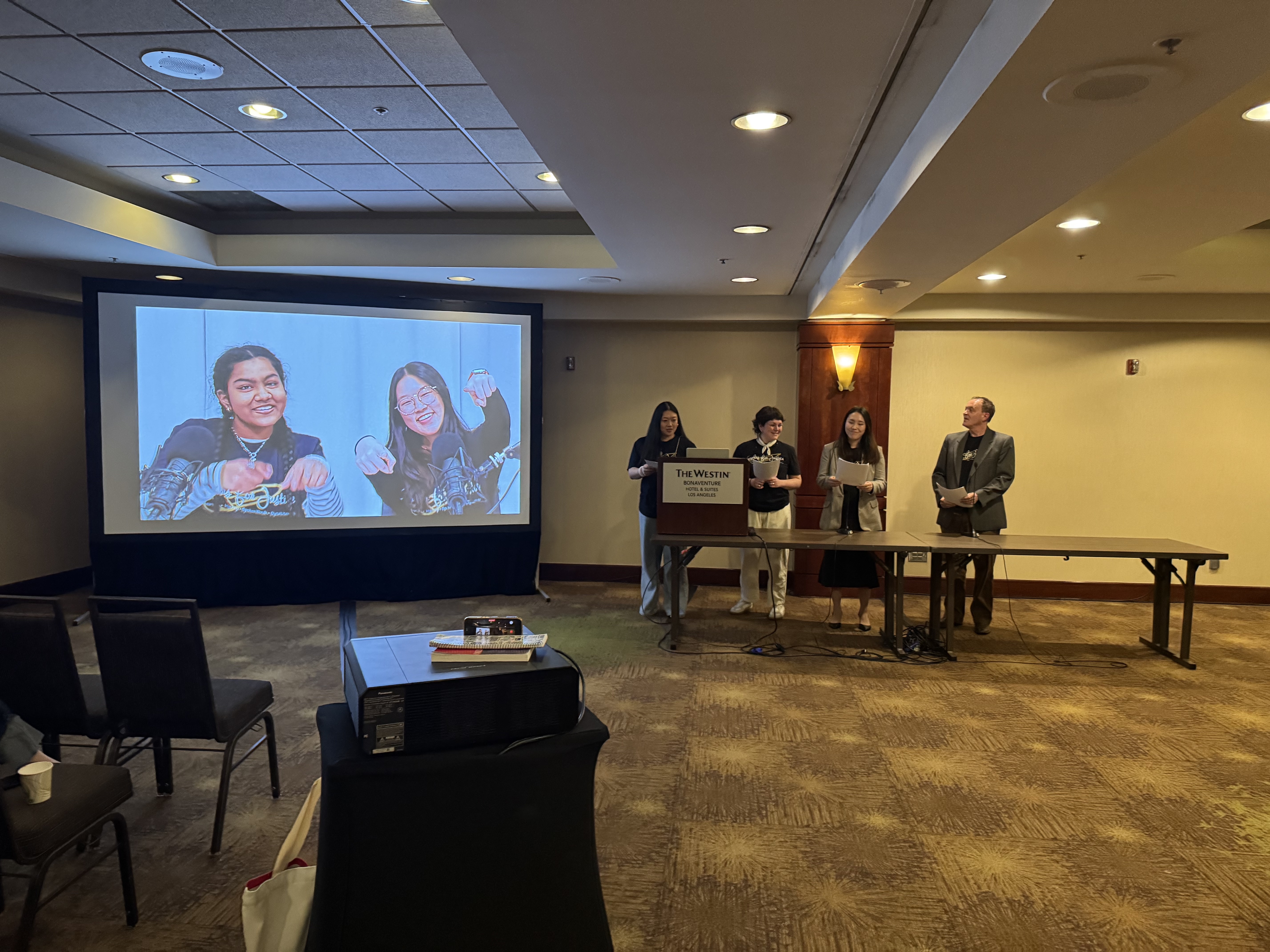
From left to right: Emily, Chloe, Yami Cao, Miranda McGough, Andrea Kim, and John McGinty presenting at the AERA 2026 Division C Shark Tank in Los Angeles, California
By Andrea Kim, DFI Research Assistant and PhD Candidate in Sociology and Education
At this year’s American Educational Research Association (AERA) Annual Meeting, four Teachers College Zankel fellows from Cyphers for Justice (CFJ) and Reimagining Educational Achievement Coalition of Harlem (REACH)—Andrea Kim (PhD candidate, Sociology and Education), John McGinty (EdD student, Curriculum and Teaching), Miranda McGough (PhD student, English Education), and Yami Cao (PhD student, English Education)—alongside members of their Youth Advisory Board, were awarded the Division C Shark Tank People’s Choice Award. Selected as one of five finalists from over 40 proposals, the project was recognized for its focus on equity and youth-centered research, with the award supporting the continued development of the Youth Advisory Board.
But this recognition did not come from a traditional presentation. It emerged from a challenge: the youth whose work grounded the research proposal were unable to travel to Los Angeles. This constraint raised a critical question. What does it mean to center youth voice, their vision, and goals when they cannot physically be in the room, particularly within academic spaces shaped by predominantly adult audiences?
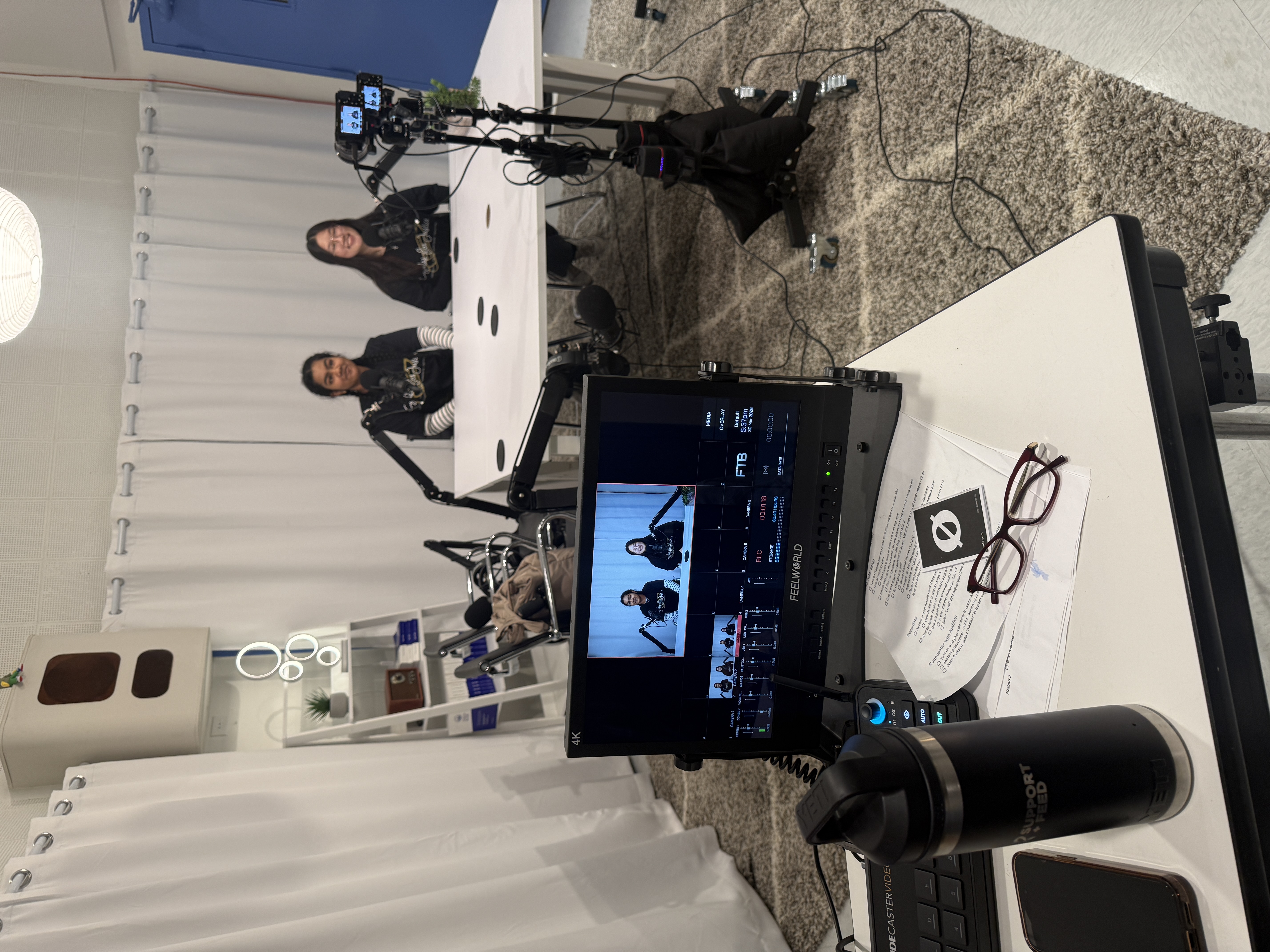
Emily and Chloe in Macy Studio B recording their responses to why their Youth Advisory Board should be funded
In collaboration with the Digital Futures Institute Media Studio, members of the Youth Advisory Board, Chloe and Emily, recorded audio reflections responding to a central prompt: Why should this youth board be funded? Through podcast-style interviews, youth spoke about their experiences as researchers, facilitators, and community leaders. They reflected on what it means to move from participant to decision-maker, and why sustaining youth-led spaces matters.
Video created from Youth Advisory Board recordings and presentation slides, featuring Emily and Chloe’s reflections, which guided the live session as CFJ fellows paused, responded, and expanded on youth ideas
These recordings became the foundation of our presentation. We produced a short video that wove together youth voices, music, and digital slides to create a more interactive experience. Thus, we designed the session as a live, co-performed experience. As teaching fellows, we stood at the front of the room, but the structure of the presentation shifted authority. We played segments of the youth recordings, pausing between clips to respond, contextualize, and extend their ideas. By moving between recorded voice and live narration, our aim was to create the feeling that youth were actively shaping the conversation in real time. This approach challenged traditional academic presentations, where knowledge is often delivered linearly and authorship is clearly bounded. Youth voices led. Adult allies responded. The “presentation” became a collaborative encounter. In doing so, it disrupted the expectation that participation must be in person to be legitimate and offered an alternative model of academic presentation.
This work sits within a broader commitment at CFJ to Youth Participatory Action Research, where young people are positioned not as participants but as knowledge producers. In this context, as CFJ fellows, our commitment to multimodal approaches created the conditions where youth can speak on their own terms, even within spaces that were not designed for them. When we expand the ways knowledge can be shared, we expand who can take part. In doing so, we begin to challenge hierarchy and reconfigure the boundaries of academic space.