Beyond Performative Allyship: Practicing Mutual Accountability and Transformative Solidarity in Education
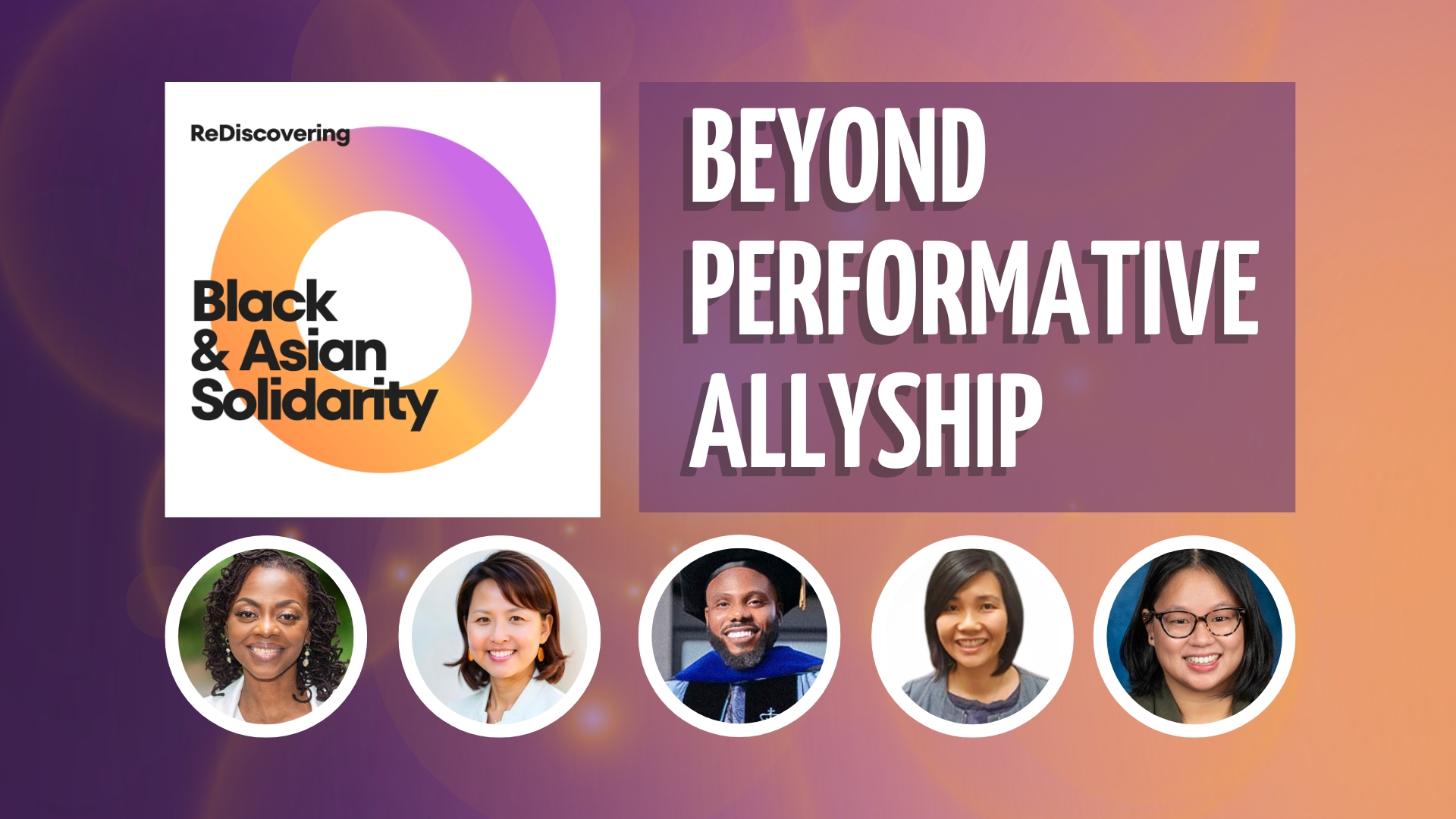
Listen to Episode
Show Notes
Highlights:
- Moving Beyond Symbolic Action: High school teacher Diana Liu shares insights from her classroom discussions regarding student concerns about performative allyship and what authentic, day-to-day solidarity looks like in practice.
- Storytelling as Liberation: Seventh-grade English teacher David Beauzil highlights how literacy, storytelling, and honoring student identities serve as tools for both learning and liberation.
- Advocacy and Racial Justice in Education: Vanessa Leung, Co-Executive Director of the Coalition for Asian American Children and Families, discusses navigating educational policy, rejecting scarcity mindsets, and coalition building across communities.
- Resisting Erasure: The collective addresses the rise of book bans and censorship—noting over 22,000 book bans in 2025 alone—and emphasizes why teaching history and preserving ethnic studies frameworks are acts of resistance.
- The Power of Showing Up: David and Diana reflect on meeting at an anti-Asian hate protest during the pandemic lockdown, which evolved into a supportive partnership through their PhD program at Teachers College, Columbia University.
- Follow the collective on Instagram and X (Twitter): @BlackAsianUnity
Episode Transcript
Judy Yu:
Hi, everybody. Welcome to the Black and Asian Solidarity Collective Podcast. We are your hosts. My name is Dr. Judy Yu.
Yolanda Sealey-Ruiz:
And I'm Dr. Yolanda Sealey-Ruiz. And we are happy that you're here for our episode. Judy, this is exciting for us, right? Because we had a chance to kick off our podcast with Dr. Akemi Kochiyama, and we had another beautiful session with Dr. Jack Tchen and Cynthia Copeland and Dr. Mae Ngai.
And here we are today, everyone, with the original members of the Black and Asian Solidarity Podcast Collective, everything Black and Asian solidarity, except for Akemi Kochiyama is not here. We also want to give a shout-out to our sister, Kyra Fuller. But Judy, how are you feeling? How are you feeling?
Judy Yu:
I'm just really excited about this opportunity that we've all built since COVID. And I'm really grateful to you, Yolanda, for actually getting us involved in Digital Futures Institute because as hard as our lives are, I'm so glad that we have a platform to record so much of our stories and history that is ever going to be changing every single day. And we're experiencing such a challenging time in our country right now. So I am very grateful that we have an opportunity to be together today.
Yolanda Sealey-Ruiz:
So am I. I want to pass it over to Vanessa who's going to pass it over to Diana and David, but I think we should have our listeners know who they are, who are the other members. So Vanessa, how are you doing today?
Vanessa Leung:
Well, thanks so much, Yolanda and Judy. I'm always so grateful to be invited into this space and be in community with you all. So I'm Vanessa Leung. I am co-executive director of the Coalition for Asian American Children and Families, as well as a mother and parent of three boys who are students of our New York City public schools. And it's always important that the space that we create to talk about what solidarity really is, transformative solidarity is something I want to also ensure that our young people have access and opportunity to explore. Diana, how are you? You're in school.
Diana Liu:
Hi, Vanessa. Yeah, I'm in school. I'm doing great for a Friday. So I'm really excited to be with you all, especially since I feel like we've all been together since day one. And so this group really means a lot to me, especially in our work with Black and Asian solidarity, where we started and where we are going with it, each and every one of us in our respective spaces as well as always together.
And so it brings me with so much joy on a Friday to be with you all, to talk about Black and Asian solidarity and what the work really means to us as educators, as just people in general moving through the world in our current society. And I really want to bring it and popcorn it to David. How are you, David?
David Beauzil:
I'm well, I'm well. Thank you, Diana. Peace everybody. And my name is David Beauzil. Just wanted to introduce myself as a Haitian American educator from Brooklyn, New York, currently teaching middle school English at 7th grade level. Also, Diana and I, we actually recently earned our PhD in English education from Teachers College, Columbia University. So we're the new grads over here, getting our feet wet in the world of academia.
So my journey in education is rooted in my own experiences growing up navigating identity, culture, and schooling systems that didn't always reflect who I was. And that's what led me to focus on my work on storytelling as a tool for both literacy and liberation. So in my classroom, I'm always thinking about how we can create space for students to not just learn, but just to be seen, heard, and valued.
So I'm really honored to be here with the collective engaging in this conversation around Black and Asian solidarity and what it demands of us as educators. So pleasure to be here.
Judy Yu:
So I know we created a series of questions within our group. So Diana, do you want to read off your question and ask the group or if maybe this question has changed? It's up to you.
Diana Liu:
Yeah, I came with this question just to give some context because I teach in Brooklyn, New York. I teach high school, 9th and 10th grade. And so in my classroom, we do talk a lot about what does solidarity look like, what does solidarity-building look like, what does allyship look like? And oftentimes my students always are so concerned that their allyship that they're engaging in is not performative, that they themselves want to make sure that whatever they're doing in their 14-year-old, 15-year-old, 16-year-old selves, that they are doing the work authentically. And that's something that they're really concerned about as we were having these conversations in our classroom.
And I always love bringing examples of what does solidarity look like, what can it look like? And so this is where my question came from, stemming from their wonderings. And so I really wanted to echo that in our podcast today. And so I'll read my question, but just know that it echoes from a lot of student wonderings from our classroom discussions.
And so I wrote, "How have we each seen Black and Asian solidarity move beyond symbolic allyship and performative actions to practices of mutual accountability, and at the same time, acknowledging that both communities are shaped differently by white supremacy, proximity to power, and respective histories?"
Yolanda Sealey-Ruiz:
Whoa. Who's going to take that on? That's a major one. I'm looking at you, Vanessa. And the reason I say that, honestly, if you don't mind me jumping in, is before we came on tonight, we were talking about the work that you do really being at the nexus of teachers, of students, of parents. And you yourself being a parent, but also a community activist and a person who engages folks in understanding policy and engaging folks in understanding the power of community advocacy, which for me, that's where I see solidarity living deeply. So just wondering what you're thinking about that question.
Vanessa Leung:
When I read it one day, I was just sharing, I think there's the simple things that I see. When CACF became part of New Yorkers for Racially Just Public Schools, there was a really important role of understanding how Asian Americans come into the space of racial justice work and acknowledging sometimes it's a little messy, but that there is a real purpose in how we approach thinking about educational justice.
And at the end of the day, making sure that we're centering those students and those families and communities that are most marginalized when we think about policy. It's not about our individual decisions that we make about kids' schooling, et cetera, but it's really about how is policy, how are systems making decisions that are going to actually be most just and equitable in providing access to quality education?
And I think one of the things when there was a rise of anti-Asian hate during the pandemic, the New Yorkers for Racially Just Public Schools said, "We actually should talk about this and make sure that folks are conscious that we can come together as a community, as a community of advocates of young people and educators to be like, "Let's uplift our AAPI folks in this space about what they're struggling with and what they were feeling."
And then it was so like, but folks were doing this together. Folks were like, "I'll take making sure we have a safety plan. I'll take and make sure we're going to bring joy into the space and have music." So there was a real kind of collaborative planning, but understanding where are moments where we need to center certain communities.
And I think it's also around, I mean, I will say at times in the advocacy space, particularly when we talk about how we're creating a better system for our kids, it becomes like we're talking about our public schools are not some commodity that we need to compete for in order to have an access to quality education. And sometimes the system has set us up to do that and so it becomes a competition.
And I will be the first to say that sometimes our AAPI community has been often used as a wedge in those discussions because they'll use the fear of what will be lost, while we sit in our scarcity mindset of we need to compete or we're not going to get. And there is also, we've had to be in space where our community was seen as like, "Well, you're just like white allies in this struggle." And part of it is that erasure of the struggles within our community and the diversity of our community gets lost.
And so I think having those relationships when folks can reflect that back has been really powerful for us to move together, even though it's a slow process in moving the ship.
Yolanda Sealey-Ruiz:
When we talk about a slow process, when we started the Black and Asian Solidarity Collective and we each started doing our research, recognizing that this solidarity between Blacks and Asians goes back to the 1800s. So indeed it is slow, which is why it has to be steady because each generation and each era presents its own kinds of challenges. But I think it's so important that folks understand that this history, this idea that we are stepping into on this timeline is not new. We are just maybe a more relevant version to the times that we're in, but this solidarity has been since the 1800s.
Yeah. I was actually thinking about Diana, David and you, that when the spike in anti-Asian hate crimes happened over the period of COVID and just seeing the pictures of you and Diana together, being with other groups supporting. So just that visual of Black and Asian solidarity, y'all went to several protests together. When Vanessa was talking, I just wanted to say that's what popped into my mind.
Judy Yu:
I also think it's important, I really appreciate everybody sharing their insight, how we need to build solidarity. And to be quite honest, I think it wasn't until COVID, and that's when the pandemic happened, it actually forced a lot of people within the Asian American community to really look at race and racism in a really personal light. Because I think traditionally many people in my community, Asian Americans and Asian immigrants have thought if I just worked hard, I put my head down, everything will be okay. And for the first time, very successful Asian Americans have realized that that formula is not working in the system.
And since COVID, all of these pop-ups and fundraising has happened, and I think I got a lot of solicitation from big corporations to come and speak now that they want to do DEI and all that kind of stuff. But now we're in a different administration where DEI is gone, the Voting Rights Act is gone. So we are in a very dangerous country that I think our rights are literally fragile with the ICE raids that's happening, and then there's no federal money for the work that we all are doing or have done. And now it has caused a great deal of competition amongst many of us in the research community and education community to try to look for any type of money, and we're competing against each other.
So the system has created this really competitive, but also hurtful way that is making us hurt one another in ways that we haven't really stepped back and really need to now look at how to strategize in a way that's holistic and healthy. But I think these unfortunate situations is actually challenging us to rise to the occasion and to use the tool set that I think in our last episode with Mae Ngai was talking about, "This is not my struggle. This is your struggle now. This is this generation's struggle." And I think they were saying, and Jack Tchen was saying is that everything repeats in a circle. It just looks differently.
So I think what ethnic studies, the framework, all the tools that they have exercised during the civil rights movement, for instance, I mean, those are really important tools that we really need to revisit because they got through some hard times that's very similar now. And it just may be it's a different group of people, but it's definitely the same idea to keep the marginalized down, to keep you ignorant so that those who have the power will continue to rise with billions of dollars. And those who are immigrant, who don't have money, if you're a female, whatever, on the systems you are in the margins. We are going to keep you oppressed and that's how it's going to work.
So I mean, it's really the same playbook. So I think ethnic studies, the Black and Asian Solidarity Collective, all the things that we're doing, I think we're trying to activate a new ground of conversations for the younger generation.
Yolanda Sealey-Ruiz:
Last thing I'll say before Diana and David come in. But Judy, as you were talking, I was actually thinking of the verb activate and with the ratcheting up of anti-Blackness, thinking we need to activate our Black and Asian solidarity. We need our Asian brothers and sisters. We need those in the white community that consider themselves as brethren to step up and to protest and to push back.
So everything that you said, now is the time for solidarity in general, but specifically I would say among Latinos and Asians and Blacks with these policies coming out against Black and Brown folk, so-called immigrant folk. We're all immigrants if you want to talk about it. None of us are Indigenous, at least not on this call, I don't think. So yeah, what you said is like, amen to that sister. We need to activate this solidarity now more than ever.
David Beauzil:
So that's such a great point that you brought up, Yolanda, Vanessa, and Dr. Yu. I'm also thinking back to how we came together in terms of the lockdown, and I think that was such a pivotal moment. And I always go back to where this really began.
So just getting deeper into this story, coming from my storytelling lens, Diana and I, and we also had Claudia with us, right, Diana?
Diana Liu:
I think so.
David Beauzil:
So we had Claudia.
Diana Liu:
I remember you. I remember you.
David Beauzil:
Right.
Yolanda Sealey-Ruiz:
I remember you.
David Beauzil:
Yes. So we had the opportunity to meet at the anti-Asian hate march in New York City during the height of lockdown. And it was a moment where the city felt heavy with grief, with anger, with fear, but there was also a deep sense of urgency. So I remember that people were showing up, not just to be seen, but to stand for something. And in the middle of that, Diana and I, we found each other. And what started as a conversation prior turned into something deeper. So we were asking the same question, what does solidarity actually look like? How do we move beyond statements into action?
So that moment didn't just stay in the streets in the march. It actually followed us into our own doctoral journeys. And as we moved through our PhD program at TC, at Columbia University, under Dr. Yoli, shout out to Dr. Yoli for being our amazing advisor, and of course, Dr. Yu for bringing me into this space. And of course, Vanessa, thank you for funding us and bringing this together as well. So I always have to be grateful for all of us as moving pieces in this journey.
We kept returning to that same commitment, thinking about how Black and Asian solidarity can live in our classrooms and our research and in the work that we were doing as educators. So we started presenting together, building together, creating spaces where these conversations could happen more intentionally. And over time, this relationship grew into something bigger than just the two of us. It became a part of what could eventually grow into this collective right here.
So for me, this work isn't abstract. It started in real time, in a real moment, and it's something that we've been carrying with us ever since. So we're here today to share that with not just everybody here, but with the world.
Diana Liu:
Yeah. And David, what you were saying, I just want to say how lucky, I want to make sure I express my gratitude, how lucky that we somehow came into the PhD program together at such a critical juncture, given the political climate that started our PhD journeys in 2020 of Black Lives Matter and anti-Asian hate. I feel like it was a very stressful and high tension time that we were living in, but how lucky we were just to happen to come into the PhD program together, being in the same cohort and I don't know, being connected. I don't feel like it's by chance. The universe has done something, has moved us in that kind of direction.
And when you were talking about how we attended the protests together, oftentimes I invite people to protest and then they're like, "Oh yeah, I'll come," but they don't show up, but you did. And I think that the start of, I don't want to say just simply showing up because it's never simple. We can find so many excuses to not show up, but time and time again, David, you have shown up, whether it be through the protest, whether it be through our conferences, that has been steady.
And when we talked about earlier in our conversations a little bit about how this work has to be slow and it has to be steady. And I think that steady piece is also so important because if we are not holding each other in a way that is steady, what foundation are we building?
And I think that because of our friendship, David, I think that it has also influenced a lot of my work in the empathy building, the bridge building, the connection creating in literacy spaces that we are in. And I also think when you were saying how we also from our work going to protests, to doing classes together, I think it's also, I just want to mention, if I can mention it here. I think that as Vanessa, you were saying how the system often pits people against one another. And I think that oftentimes could be the environment in which in the doctoral programs are also reproduced.
And we have to do the work. Me and you, David, I think we did it pretty well if I would say so myself, to do the work to resist it, to resist that kind of inherent competition of the scarcity mindset that often pervades the doctoral program and to work together and to have each other's backs and to be each other's support system in a larger layer of stressful climates and stressful academic program, I would say.
And I think that by going to conferences together and me and you coexisting, I think that also lent itself to have that visibility. Because David, I don't know, maybe it's just me, but I didn't see a lot of cross-racial friendships that often in the academic spaces or in the conference spaces that we went to. I feel like there could always be more of it, but it was a little rare. I'm not sure if that was just me observing that or I don't know.
Yolanda Sealey-Ruiz:
It's the truth. Yeah, it's the truth. And I think Judy, you and I can speak to, certainly as your advisors and Judy as a huge support on your committees, you and David were the model, just number one, for humanity of supporting one another. And David, there might've been times you didn't even know this, but Diana would check in and make sure that you were doing okay, just making sure that you were moving along. She was moving, wanted to make sure you were moving, and you did the same thing for her.
So it was beautiful for me to witness that, which I would use the word love and such a deep respect. But the two of you were a model and I have not since had, you've only been out a year or so, but I've never had that type of cross-racial, cross-gender solidarity example in students the way that it's been with you.
Judy Yu:
It's very rare. And I would say at a competitive school like Columbia an Ivy, for you both being either first gen students, because being first gen already, we have so much to risk financially, emotionally, and plus we're the first to do anything, so we didn't know what we were doing. I'm just going to speak on my behalf of my own lived experience of being in academia.
So it is really important that you have a cohort of people. And it was really beautiful to see because you are the younger generation and you are now also teaching in public schools, which I think it's really significant in illustrating that the experiences and all the isms you've witnessed in academia, you can actually teach your own students. And then you're also secondary teachers, which allows you to have multiple impact on the multiple classes that you teach per day. You see them, wow, four or five periods, each class is 30. So you're teaching over 130 kids every day on content that's really critical.
And I think that's really important and it speaks volumes of the change of you being change agents for the future generation. Because I think the younger students, K through 12, I would say they're really interested in how to navigate this world because they are on social media, they see the challenges of race, disparity, inequity, climate change, all of it, and it would be helpful to have a roadmap.
And I think I would say, I can't speak on everybody's behalf, but I would like a roadmap for myself in figuring out how to navigate this world also as a parent to two teens. And also, it's just unfortunate that we are experiencing a very unstable government right now and it causes a lot of fear, unfortunately. But I think that's where the collective comes in and each of us have sensibility and a value system that we really honor each other and seeing the bigger picture of working together cross-racially and building something better than what we have today.
Yolanda Sealey-Ruiz:
Vanessa, what are you thinking? I'll tell you what I'm thinking. I'd like to pose a question, and for each of you, if you have time to answer it from your own angle. I just last week gave a talk about book bans and just giving this number. So in 2025 alone, 22,815 books were banned, that's just in one year. So we clearly see, certainly what happened with the Voting Rights Act just a few days ago, this deliberate and determined erasure of history, whether in books or in policy. And we've been talking, we've been saying a lot of things on this episode, but really it feels like the through-line is what is solidarity, right? What does it mean to show up is what I want us to think about.
So in this age of erasure, in this age of big brother, big sister, everyone watching, some people being really motivated by fear and choosing silence, what does it mean to show up? I would just love for each of you from your perspectives just to share that. For me, what it means to show up is to understand my purpose and also be connected to community and to move accordingly. But Vanessa, what does it mean to show up in solidarity?
Vanessa Leung:
I think a lot of it is what do we bring together our strengths and expertise and perspectives into the work? Because it's also that we also each play a role that we don't have to do it all because now I'm also thinking when you're mentioning all these things, I'm like, "We all can't be in all of it." But we also have our particular strengths we bring into this. All of it's all interconnected, but we can't all be doing all of it.
And so, when we think about solidarity, it's like how do you see the intersections? How do you bring your strengths into this work? And then how do you connect those things and align it? Because then it's important for our immigrant rights activists to be leading that charge and we support that. But how do then we also connect that to how healthcare and our health advocates are doing this work? And now the Federal Department of Ed has been ...
They're purposely doing all this, but we can't be caught up in trying to chase things. But I think there's roles that people play. We have to just stay aligned and in communication to really be able to move our community forward.
Yolanda Sealey-Ruiz:
That's good, Vanessa. That's good.
David Beauzil:
And I'm thinking in this moment, just to add on to what you're saying, Vanessa, and to answer what you're talking about, Yoli, where curriculum is being censored in a sense and educators are being silenced. Speaking out is no longer optional. It's almost now an ethical responsibility. So as an educator, as a teacher, I understand that what I choose to teach or not teach basically shapes how my students understand themselves in the world.
So when policies try to erase histories, especially histories of solidarity between Black and Asian communities, continuing to teach them becomes almost an act of resistance. So our histories remind us that solidarity is not new from the third world liberation fronts to grassroots organizing in our communities. So there's always been moments where we stood together against oppression. We've just had to do that research. And we've actually had to do our own research within this collective to see that we've had Black and Asian solidarity since the past.
So bringing those histories into the classroom does a few things. It disrupts that narrative of division and it gives not only us educators, but students a blueprint for what's possible. So in these spaces that we have, like classrooms and constrained spaces sometimes, we find ways through the text that we choose, the questions we ask, the discussions we facilitate. We keep those stories alive because erasure thrives in silence, but our work is what refuses that silence.
Yolanda Sealey-Ruiz:
That's good, David.
Diana Liu:
And I guess just to connect that with David. David, that was so beautiful.
Yolanda Sealey-Ruiz:
So good.
Diana Liu:
And it makes me, again, I think one of the many reasons why love being connected with you as fellow educators, knowing that you're in a classroom and doing this work, it just makes me feel really, again, so grateful that you're in a classroom. The students definitely benefit from your presence.
And I think that for adding onto David, I would say showing up, I agree, means purposely choosing to teach when society might say otherwise. To choose to deliberately select a text and have those difficult conversations that may occur in the classroom rather than ignoring it or not address it, but to talk through, I think is also in a way showing up for our students. Even though we may not know or have that roadmap of how we might navigate, but to know and show that, hey, with our students, we are navigating this unknown together, I think is also a way of showing up for our students, especially in the context of uncertainty.
I think that that is really important that we don't always hold the answers nor should we be expected to hold all the answers, but to model or not even model, but to go with our students and navigate that uncertainty and those critical moments of how do we move through them. Because it will not be smooth sailing moving through them most of the time, but we're doing this together and with community. I think that's one way I would say of showing up.
And in addition, I think for me personally, I think showing up is rooted often, for me personally, rooted in also attuning into the silence and seeing and reading what do people need? What do people really need to feel supported and to feel cared for? Because this is long work and this is heavy work and this is difficult work. So sort of attuning and reading into the spaces of what do you need? How can I show that I care for you? How can I ensure that you feel supported?
And I feel like David, me and you do this probably all the time at school. How do we support our colleagues? It could be as simple as, "Hey, I got a bag of tangerines and you got to have your vitamin C. This is allergy season. We got to have our vitamin C. Here's some tangerines for you." And even an act that small could mean a lot for someone on a very difficult day.
And those kinds of small acts of care, I don't think they're performative. I think it's rooted in deep care knowing that that kind of small acts of care are also consistent too, it's not just a one-off, "Oh, I dropped tangerines for you from my Chinatown. There we go, done." But it's again, a long-term commitment towards the people in our community in that way of showing up.
And I think that that is also similar in the ways that we show up for our students too. There are the very little things that we do each and every day for students in our classroom as a way to show up, I think is so important too.
Yolanda Sealey-Ruiz:
So good.
Judy Yu:
And Diana, you're generally a very caring person. You're so thoughtful. And so I remember when I got COVID for the first time, you got everybody together to mail me a care package. I never had that done. I was like, "This is the sweetest thing. She sent me honey sticks."
Yolanda Sealey-Ruiz:
That's Diana.
Judy Yu:
But I think you all are really just special human beings. But I wanted to address Yolanda's question about education as erasure and how do we resist and contest that.
So when I became a first grade teacher, Asian American studies for elementary school students work was not available. So I literally created my own curriculum. And I would say for us to do the same in today's times. You don't need a curriculum, to be honest. You got to just ask your students to write their own stories. It's not in a published book, so write your own story.
And that's really the case for many of us who started out teaching before all the big publishing companies or even the things today. And they're really just low tech. And something I remember what Jack says, there's really low-tech things that you can just simply do. And I learned this from also Dr. Daniel Solorzano, who is my former professor at UCLA. He had us do ethnography projects as student teachers where we made home visits to our student. We've picked one student. I don't think we could do that now, but this was a critical piece in my experience as becoming a teacher.
In Los Angeles, I went to visit my student, Samisi, who happens to be Tongan. I didn't even know where Tonga was on the map, to be honest, as a 25-year-old. So I had to look it up. I'm like, "Where is this island?" And I went to his home. His mom was so sweet, and she was showing me the mats that she weaved from these indigenous grass that she was able to get. And she made these beautiful mats as a gig while she worked at the airport as a full-time job.
And I learned so much about visiting and just him being so sweet and he was just so excited to show me his home, which was very humble. And I think things like that is really, it's like simple things. It is either breaking bread, visiting someone's home, getting to know each other as a human being instead of posting things online or not, just the disconnect that we have that is happening right now is actually hurting us more than we think it's benefiting. I think we do have to go back to times without phones and figure out how do we build community? Do we have lunch? Do we go walk in a park? I mean, simple things to just bond with each other.
And then another thing I was thinking was if there isn't curriculum available, then we write our stories, we interview people, we go to field trips, things that are very one-on-one human that I think we have really lost touch with because of technology and AI and how to make things simple. And I don't think we're making our lives more simple with technology, we're actually making ourselves even more lonely.
And I think if anything, we need to learn from our elders. I really think we've lost our way. I think our generation and those that are trying to build this new civilization, I think we have lost our way in many instances. And we really have to go back to our value system of being good people and being good to our neighbors and figure out how can we rebuild a new society almost. So I just wanted to share that with you all just as a comment.
Yolanda Sealey-Ruiz:
No, Judy, that's so good. And as we close this episode, it just emphasizes, David and Diana, I think about your research as well, but David specifically around storytelling. And everything you said, Judy, sitting with elders, hearing their stories and finding the connection because there's nothing new under the sun, right? That was said in the book of Ecclesiastes. This is not new. What can we learn from those, our ancestors, our elders who experience something similar so that we can figure out the lesson for the moment that we're in?
So I just want to say thank you to all of you for being my sisters and my brother in the work of Black and Asian solidarity. May our bond never be broken, and I'm just excited about what's in store.
Judy, you writing the Spencer grant for us and bringing together young people through Vanessa and having a Black and Asian solidarity conference of young people, I mean, talk about showing up. You show up for us all the time, always thinking about how can we fund what it is that we're trying to do in the world. So I just want to say on behalf of all of us, Judy, thank you for your love and commitment to the Black and Asian Solidarity Collective to constantly look for ways that we can keep going because you do need money to do some of these things. And I just want to also say thank you to DFI for the fellowship that allows us to come together the way we did today.
So I'm going to throw it back to where we started. I'm going to throw it back to Vanessa as we end here, but I just want to say thank you. I love all of you and I'm just grateful for our relationship. Vanessa.
Vanessa Leung:
Thank you. I'm going to emphasize storytelling is so important. It's how we actually also talk about how we advocate for what we need. It's actually through those stories. And it's also important for us to know who we are and then be able to connect. I think oftentimes, I don't know, as an immigrant, as child of immigrants, our stories were not important.
And oftentimes many immigrant families don't want to talk about what their stories were. And I think it is creating that space when it's just those questions out of just care and curiosity really helps strengthen that solidarity across our communities. So, so grateful for all of you and all the work you all do for our young people.
Judy Yu:
Thank you to you for the work that you do, Vanessa, and David and Diana and Yolanda. And thank you.
David Beauzil:
Just to reflect on this conversation, it reminds me that solidarity is a responsibility and a possibility. Even in these moments of division, we have the power to choose between connection, to choose understanding and to choose each other. And that choice repeated over time is what creates real change.
Follow us on Instagram and Twitter @blackasianunity. That's it, @blackasianunity. And you'll find us, an update of all our upcoming events, presentations, and information that we have about Black and Asian solidarity.