Uncovering History and Resisting Erasure: Black and Asian Solidarity in Education and Beyond
Listen to Episode
Show Notes
Highlights:
- Origins of Ethnic Studies: Mae Ngai details how ethnic studies emerged directly out of student activism, from the late 1960s San Francisco State strike to Columbia University's 1996 hunger strike that created the Center for the Study of Ethnicity and Race (CSER). She contrasts the current administrative underfunding of higher education programs with thriving K-12 ethnic studies initiatives in New York City.
- Reframing Difference & History: Cynthia Copeland addresses the critical need to value cultural difference rather than measuring society against whiteness. She highlights how historic spaces—such as the African Burial Ground located opposite an ICE detention center—serve as vital sites for decolonizing history and confronting exclusion.
- Eugenics & Modern Surveillance: Jack Tchen traces the history of American eugenics centered in New York during the Gilded Age, explaining how policies like the 1924 Immigration Act established exclusionary quotas. He connects historical methods of racial sorting to modern AI technologies, predatory data, and surveillance regimes.
- Grassroots Action & Activism: Panelists emphasize local community action, supporting youth activists, and building upon historic frameworks like Freedom Schools and Bob Moses's Algebra Project to empower the next generation.
- Mae Ngai: Lung Family Professor of Asian American Studies and Professor of History at Columbia University.
- Cynthia Copeland: Public historian, educator, and President of the Institute for the Exploration of Seneca Village History.
- Jack (John Kuo Wei) Tchen: Clement A. Price Professor of Public History and Humanities and Director of the Price Institute at Rutgers-Newark.
Resources & Works Mentioned
- I've Got the Light of Freedom: The Organizing Tradition and the Mississippi Freedom Struggle by Charles M. Payne
- Drylongso: A Self-Portrait of Black America by John Langston Gwaltney
- When I Don't Sleep, I Dream (Wifredo Lam exhibition at the Museum of Modern Art)
- Ghost in the Machine (Documentary linking AI with eugenics)
Episode Transcript
May Niiya:
Hi, everyone. My name is May Niiya, and I'm the assistant director at Columbia University Center for the Study of Ethnicity and Race, which you might hear referred to throughout this presentation as CSER. And we're hosting this webinar alongside our partner at the Teachers College, the Black and Asian Solidarity Collective.
For those non-affiliates who are not familiar with Columbia, CSER is Columbia's primary space, interdisciplinary space, for the study of ethnicity, race, and their implications for thinking about culture, power, hierarchy, identity, and community. We offer an undergraduate major and minor in Ethnicity and Race Studies, as well as an MA program in American Studies. And we strive to do robust programming, and relevant programming like this webinar, throughout the school year. I'm actually an alum of the MA program in American Studies at CSER, and Professor Ngai was my professor, so I'm especially excited to be putting on today's panel.
I want to really thank the members of the Black and Asian Solidarity Collective at Teachers College who came to CSER with this webinar idea, and really are the driving force behind it. So that will be Judy, Yolanda, and Vanessa, who you'll be hearing from shortly. I also want to thank our panelists, who you'll also be hearing from, and our co-sponsors at the Asian American Institute at Columbia, and Barnard's Asian Diaspora and Asian American Studies.
So Judy, I'll hand it over to you.
Judy Yu:
Great. Thank you so much, May. And I just want to give deep gratitude to May Niiya for helping us pull together on this community, building a webinar. Which is really a service to everybody from K through postdoc, to everybody who wants to learn about history, ethnic studies, and ways to better the future.
My name is Judy Yu, I'm the co-founder of the Black and Asian Solidarity Collective. I'm also the principal investigator of the Spencer Foundation of a research project called Building Racial Solidarity Across Black & Asian American History in K-20 Education. And I'm really just excited to be here today with my co-PIs, Vanessa Leung and Yolanda Sealey-Ruiz, who's been working with me in building this collective in bringing research practice into our classrooms and higher education institutes.
The purpose of today's webinar is really to give an overview of the historical underpinnings of ethnic studies, of how it started, where it's going today, and how we foresee it in the future. I am so grateful and delighted to have Jack Tchen, Mae Ngai and Cynthia Copeland to be our esteemed panelists today, because they are such brilliant historians, but really they are also very deeply grounded in community.
So after our conversation with the panelists, we will have respondents Q&A, and followed by the public Q&A. But right now I would like to introduce you to Vanessa Leung. Vanessa?
Vanessa Leung:
Thank you so much, Judy, and thank you so much to the panelists and for leadership of May and Yolanda. Just because this is so important, I am probably the only one that is not connected to an academic institution directly, but it is really important that we see that partnership with community-based organizations, and community has an important role in how we can continue to center our histories. And why that's important in community space, particularly for our young people. It gives them a sense of who they are, it gives them the sense of their connection to community, but to history at large. And that provides that opportunity for our young people, for our community leaders, for all of our stakeholders to actually understand that when you look at history, there's opportunities to take action, there's opportunities to connect and collaborate, to make sure that we can and center the needs of those who are struggling.
I am co-executive director of the Coalition for Asian American Children and Families, CACF. We were founded 40 years ago, by service providers, who felt that it was really important for government to really understand our growing and diverse AAPI community. And hold them accountable, to not just understanding, but meet the needs of those struggling the most. And to this day, we are a coalition now working with 160 organizations across the state, but also creating space for our community, our young people, our parents and caregivers, to be part of that ecosystem of advocates who are really charged to creating change that they want to see.
And so for that, history is important for us to learn and for us to take those lessons. And when that's not available, we do that in community. We see that in history at many points, but we know that as New York City and New York State has taken some opportunities to bring Black, Latino, and Asian history into the classroom, they can do that a little bit better. Now that we have a New York State portrait of a graduate that takes lessons, but takes criteria that actually speaks to a lot of what ethnic studies provides for our young people to not just be academically prepared, but to become critical thinkers and global citizens, and reflective. Those are the things what ethnic studies can provide, the tools for our young people to really be productive participants of society. So thank you all for joining us today, and so grateful for being in this space.
Yolanda Sealey-Ruiz:
Vanessa, thank you so much for that framing. I am grateful to be with these three esteemed panelists and my sisters, Judy and Vanessa, and the work that we do. And I also want to say thank you to you, May Niiya, as well.
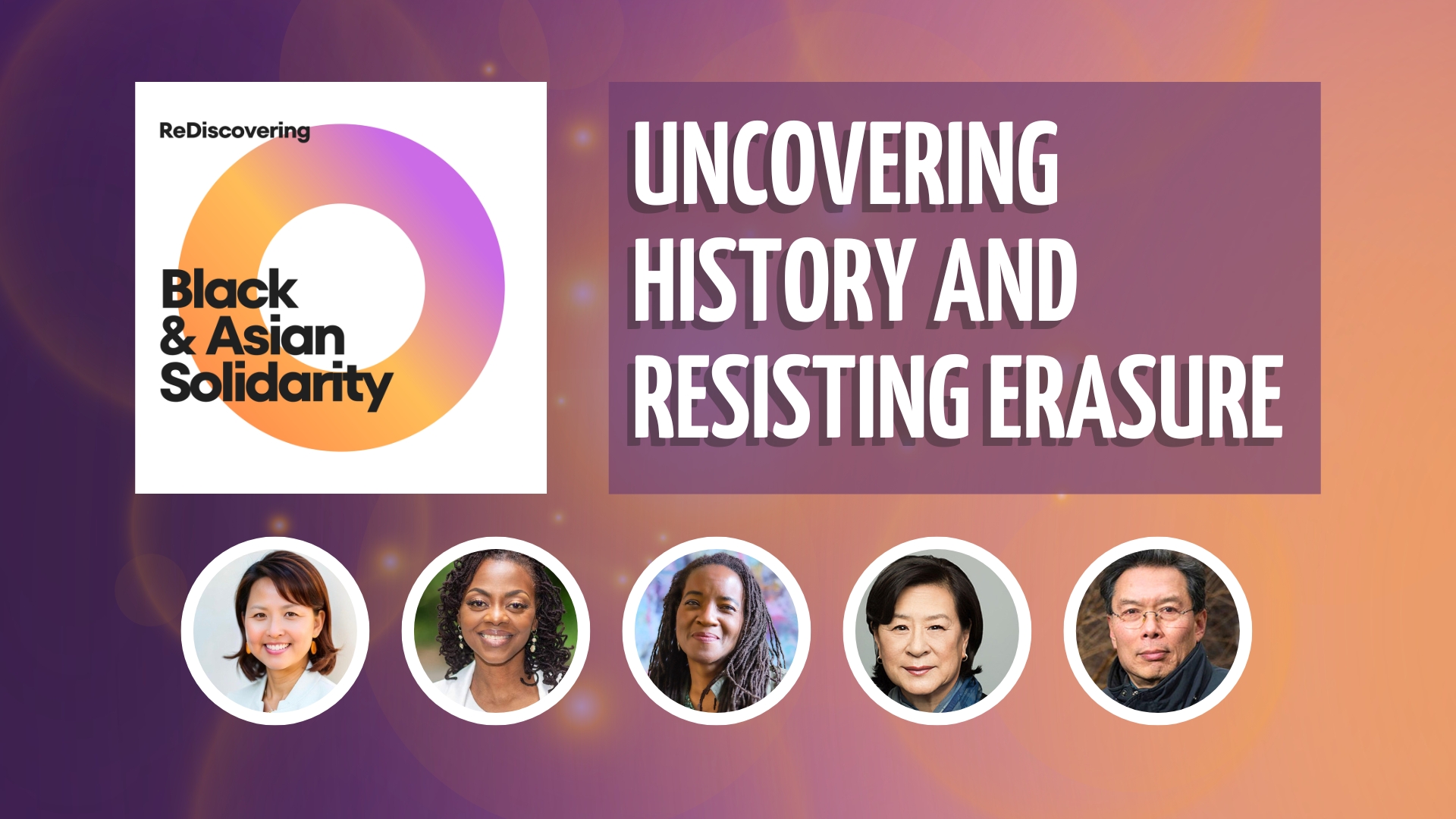
I want to begin by quickly, before I introduced our amazing panelists, to say thank you to Joe Riina-Ferrie and the Digital Futures Institute at Teachers College. We are actually recording this as one of our podcasts. And I want to say a little bit about the work, we do work in different areas, but we recently received a grant to run the Rediscovering Black and Asian Solidarity Podcast. It's a four-episode podcast series that explores the deep and often overlooked history of Black and Asian solidarity in the US. And so through this lens of intergenerational dialogue, we hope to bring forth historical truth telling and a collective memory. Each episode features voices of those who are fighting for Black and Asian solidarity, including youth activists, educators, as you see from today, historians, and community organizers. And this particular podcast is especially timely in this era that we are living where stories are being erased. So Vanessa, thank you for everything that you said. Resistance is still high, for sure, whether they want us to believe it or not. But solidarity and love, really, is what is going to carry us through.
And so with that, I would like to offer a very limited introduction. Their lives as well as their careers are beautifully layered, and this is just a little bit about them. Mae Ngai, welcome. May Ngai is the Lung Family Professor of Asian American Studies and professor of history at Columbia University, where she teaches Asian American studies and immigration history. She has been affiliated with the Columbia Center, CSER, right?
Did I get that right?
Mae Ngai:
Right.
Yolanda Sealey-Ruiz:
With CSER?
May Niiya:
Yes, that's correct, CSER.
Yolanda Sealey-Ruiz:
I'll try not to think about Rome, but with CSER since 2008, and was the co-director from 2019 to 2023. She is author of the award-winning books, Impossible Subjects, in 2004, The Lucky Ones, 2010, and The Chinese Question, 2021. She's also co-editor of Corky Lee's Asian America, 2024 publication. She has written about Asian-American and immigration history and policy for the New York Times, The Atlantic, The Economist, The New York Review of Books, and Other Publications. Professor Ngai is active in efforts to bring Asian-American and immigration history to community institutions. She is a trustee of the Tenement Museum and works with the Museum of Chinese America and the New York City Department of Education to bring AAPI curriculum to public school teachers. A warm welcome for Professor Ngai. Thank you.
Cynthia Copeland is a New York-based public historian and dear friend-
Cynthia Copeland:
Right.
Yolanda Sealey-Ruiz:
... but in her life, she is a New York-based public historian and educator who has directed and consulted on many projects related to the legacies of enslavement, including Manhattan's African Burial Ground. Additionally, she is co-founder and director, and she serves as president of the Institute for the Exploration of Seneca Village History. She co-chairs the Reparations Commission of the Episcopal Diocese of New York. She teaches at NYU's Steinhardt School of Culture, Education, and Human Development in the Department of Teaching and Learning, and facilitates dialogue, teaching and learning workshops of the Center for Trauma Resilient Communities, Crossnore Communities for Children in North Carolina. Welcome, Cynthia. Thank you for being here.
And last but not least, Jack Tchen. Jack Tchen is a historian, curator, dumpster diver, and teacher... I love that, and teacher surfacing the disappeared stories othered by systems of power and wealth. Dr. Tchen is the Clement A. Price Professor of Public History and Humanities, and Director of the Price Institute on Ethnicity, Cultures, and the Modern Experience at Rutgers Newark. He is founding director of the APA, the Asian Pacific American Studies Program and Institute at New York University, NYU. He co-founded the Museum of Chinese in America.
His 10 years of work on anti-Asian xenophobia, a two-hour PBS documentary on the Chinese Exclusion Act and exhibition at the New York Historical Society led him to focus on the intersectional history of American eugenics. Via a series of exhibitions, conferences, and performances, he has been retelling New York City US history from the largely disappeared and unperceived frames of the rights of nature, settler extractive colonialisms, and the Nordic eugenics hierarchies of fit, elite, white Protestants versus the world's unfit others. Thank you for this work. He has served on the New York City Panel on Climate Change, NPCC. He has been working with the Munsee Lenape elders. We're on the Munsee land here, as well as 13 other tribes, since 2016, alongside honoring enslaved in the region by documenting, sharing and decolonizing the history of Newark and the larger region, while also questioning the Dutch's claim to have purchased Manhattan in 1626.
Please, let's give it up for these amazing scholars, historians, and people who are doing warrior work in the world. Thank you so much for being with us.
Judy Yu:
It's our great honor to start with Dr. Mae Ngai. She will be speaking to us about centering the importance of comparative ethnic studies during dangerous times in higher education. Professor Ngai?
Mae Ngai:
Good afternoon everybody. Thank you so much for having me today. It's great to be with you and great to see old friends, and make new friends, so thank you everybody.
I'm going to talk a little bit about the general background that we're living in now, that's what I was asked to address. And ethnic studies has always been, it's always been a struggle to even exist on our campuses, and it's an ongoing struggle to not be marginalized here. But in these last several years we have been, I would say, under a steamroller, which is part of the attacks in general on DEI in higher education, which in turn is part of a general attack of authoritarianism and against democracy in this country.
And with regard to ethnic studies, as well as I would say women in gender studies, queer studies, we have always been about not just representation, although that's important, it's not just about identity, although that's important, but about telling a true story of this country and our place in it, and the place of this country in the world. And we have always often been lacking in that history. So it's about history, about community, and about relations of power.
Now, at Columbia... Well, so I want to say that ethnic studies, as a field in academia, is the product of student activism. And maybe we can go to the first slide. Thank you, May Niiya.
We think of ethnic studies as being something that's, I guess you could say institutionalized throughout America now, but it wasn't always the case. It's a product of the civil rights and social justice movements of the late 1960s and 1970s, starting in California with the San Francisco State strike, the historic strike there that created Black studies and then ethnic studies. And included such things as hiring more faculty of color, creating majors and curricula supports for students of color, et cetera, et cetera. And that spread, especially on the West Coast.
And in the East Coast, ethnic studies and Black studies, there were not a small number of programs in the '70s, but it didn't really get going until later and that's another story, but we have our struggles. In Columbia in 1996, the students held a strike that included a hunger strike and the occupation of Hamilton Hall, and they won the creation of an ethnic studies program, or center, and that's the origins of CSER. Now, the center started in 1998, and I will say that it has been... We've had our ups and downs, but it's been an ongoing effort to build this program. And by the time I was co-director of CSER, we have an extremely robust program. We had, the last year I was teaching there, 80 majors and minors. That number goes up and down a little bit, but that's the scope of the popularity of the program. It's bigger than some departments' major enrollment.
Our major is Comparative Race and Ethnic Studies, and the students... It's also, I think, an important place of cultural programming, and also student support, because it's a safe place on campus for students of color. So CSER has played an extremely important role.
Maybe we can go to the next slide.
In 2022-23, we embarked on a campaign to become a full academic department. CSER has been and remains a center, which is the lowest kind of unit on the academic totem pole, we don't have our own full-time faculty. Half of our classes are taught by adjuncts, despite the high enrollments, and we had a formal academic review that recommended that we become a full department. And so we had a year-long effort to study the question, we had focus groups, we invited speakers from other universities who come, and I think notably, these events were very well attended and they were co-sponsored, or they were planned jointly by our faculty and our students.
Next slide, please.
One of the highlights of that year was a big teach-in that was held where several hundred students came and people who had been active in the original hunger strike in 1996 returned to talk to us, and it was a really fabulous event. And as you can see in the smaller picture, it was a real kind of interactive, dynamic event.
Next slide.
And then later in the spring, there was a rally on campus, where the students continued to press for ethnic studies.
So I just wanted to share with you those few slides, I don't have a lot more, but what I want to say is that CSER is the only academic unit at Columbia University that is the product of student activism, and that's something that we are very proud of. And it shows how students, when they're organized and persistent and strategic, can really win things that improve education, not just for themselves but for the university as a whole. And right now, I think that we are... Well, where are we right now at Columbia?
Well, CSER's executive committee submitted a formal proposal for a department in 2023. The administration never responded one way or the other, which is a violation of the process of the university, a formal process. So they have just ignored us, and have continued to starve us. One worries that they're trying to starve us to death. They've cut our budget. They don't hire people who have left for one reason or another. We've always had to fight for every penny, every faculty line, every course, et cetera, et cetera. And now, I think given the general climate against DEI in academia, including Columbia, this is an uphill fight. So I do hope that the students will continue to organize. The faculty, of course, is resisting these attacks.
But I just want to end by saying this. I was told I have two minutes left. Even though, in the university level, the attacks on DEI and ethnic studies are ferocious, and part of a larger attack on democratic education. I want to point out at the public school, at the K-12 level, it's a very different story. In New York State, as well as many other states, not all 50 states, but many other states, ethnic studies is alive and well. In New York in particular, the New York City Board of Education, or Department of Education, has a robust program of ethnic studies. And as was mentioned in the introduction, I'm working with MOCA and the Department of Education to sponsor a three-day workshop with public school teachers. It'll be actually next week, on how to use the curriculum that's developed, that we all had input into developing this curriculum, how to use that in our classes. And we'll have, I think, 25 to 30 public school teachers from fourth grade to high school from all five boroughs. We had twice as many applicants that we could serve.
So hopefully, this will be an ongoing thing. And I do think that where this connects to Columbia, is that why these programs exist, is because of the people's struggles. On the campuses it's the students organizing, and the reason why we have K-12 curriculum is because the communities are organizing, demand of the communities. And I will leave you with that, because I think that is where our hope for the future lies, is by continuing to mobilize our students and our communities. Thank you.
Judy Yu:
Thank you so much, Dr. Ngai. We really appreciate your historical underpinning of the birth of ethnic studies from the West Coast to the East Coast, especially at Columbia University.
It's my most honor to introduce to us Cynthia Copeland. Cynthia is going to discuss about the intersection of ethnic studies in today's current events. Thank you, Cynthia.
Cynthia Copeland:
You're welcome. Thank you for having me, welcome all. I'm so glad that you're here to learn a little bit more, and to activate yourselves to be able to get out there and serve as models for your students, and go out into your communities, and put pressure on some of our legislators. Because our current events are such that, as you heard from Dr. Ngai, the attack on DEI is very serious. And not only can you feel it within the halls and institutions of our spaces of education and learning, whether they be formal spaces or informal spaces for learning, we're really feeling the crunch.
And as we discussed, or as you heard, this idea of the background and the history of understanding ethnic studies, or multicultural education, or culturally relevant pedagogy, that we hope that our educators are aspiring to, if not getting a real handle on how to do that work within the classrooms. It is really important for us to understand that ethnic studies was truly a cultural turn. It was a major cultural turn, in the mid to late 20th century, and then it started to take on a big and greater permanence into the 21st century, as our country is changing ethnically.
We're having more and more people from all over the globe coming to the United States in particular to come and live, to take advantage of the economic situations, to take advantage of what we called civil rights, et cetera. And the United States is also sort of responsible for that migration that we're seeing, because we're going into some of these spaces and extracting materials, resources, it's impacting environments, and so people are coming here because they feel that there's nowhere to go in their own countries. And so, of course they would want to land in the space, the land of plenty.
However, once they're here, the doors are being shut, recently. As we all know. When we think about why that is happening, the big question that I'm often wrestling with, with ethnic studies and multicultural studies, is why is it so hard to value difference? That is such a big question, to put such a... We need to put a value on difference, and this rush to determine what is normal, whiteness as being normal, and measuring everything against whiteness. It's jarring for our young people, who are trying to understand and get a grasp of who they are in the world, in these spaces.
I submit to you for your consideration that what is actually normal is difference and diversity. That is what is normal. And also, within that difference and diversity, it's universal. We have this universality, right? It's that way everywhere. However, within that space of difference and diversity and normal, there's also exclusion. Right? So suddenly the difference becomes what was once for us considered normal, is also the flip side of this idea of being exclusionary. And so, these are issues that we are grappling with today with our ethnic studies during these dangerous times, and we're trying to figure out ways to address that and still give our students, our young people, our educators, who perhaps were not necessarily educated to be able to teach children and young people in this sphere of what it means to embrace ethnic studies.
And I think that the importance and the connection to learning one's history is that, obviously, it is important to value and to center other people's histories and their experiences into the fold. And if we have this sort of understanding and this acceptance of the variety of people that we have, we can work to restructure and to transform the curriculum, we can work to transform and restructure spaces that we traverse when we are outside. This idea of developing equitable knowledge to gain understanding, not just to get the facts, because often people feel that ethnic studies and multiculturalism is about learning about other people's cultures, but not necessarily knowing anything about our own. And so, when we have the sort of facts and we just sort of leave it there as a place of knowledge, that is not making us have a greater sense of understanding. And so, we think that that is very important as well.
When I think about the African Burial Ground and its connections to where we are today in the intersection of ethnic studies, it is a place... It's kind of interesting, because the burial ground is actually located across the street from 26 Federal Plaza, which is an ICE detention center. And if you can imagine, about nine months ago, the burial ground was actually closed down because the Parks Department, or the National Park Service which operates and manages the burial ground, they were concerned about... They said it was a temporary pause on research and donations, et cetera. They said that the staffing changes were there, they wanted to make sure that people were safe being in those spaces, and therefore the burial ground was shut down.
Now, that's one of the first places that you can go to learn about African American history and enslavement. And when you have that negative space, it is such that children and visitors don't really get to get a sense of that history, which is so important in understanding how our country began.
Again, I'm running out of time here, but I just want to say that the more exposure that people have to their own histories, it helps to de-mythify the dominant narrative, it helps people to decolonize the spaces that they're in, and really helps them to understand the ideas of conquest and colonization. And it helps to develop new narratives, it helps to sort of take back the story and find your place within the space where you are. And I think I'll end there, and we'll have more of a conversation as we get into questions and answers a little bit later. So thank you, and I'll pass it on over to Jack.
Judy Yu:
Thank you so much, Cynthia. Just before Jack presents formally, we just want to let our audience know that if you have questions for our panelists, to please place it in our Q&A function in the webinar below. That would be great. It is my most greatest honor to have Jack Chen here, who will present on eugenics, the impact of the past and present, and offerings of the ethnic studies and community organizing community. I am also a former student of Jack's, so in coming in full circle, this is actually a very special experience for me as well. So take it away, Jack.
Jack Tchen:
Thank you all so much. It's really great to be with you all, each and every one of you. And it's also to say that there's way, way too much history to talk about here, but I think certainly for myself, but I'm guessing for each of us. We are resources for all of you. I was asked to put together some slides, but I didn't have time, quite frankly, but I'm going to make available a small slide deck that will share some of the basics that I'll be going over.
Eugenics is a term that oftentimes isn't known, and it's really oftentimes misunderstood. The term eugenics comes out of the compound term "good breeding", and then dysgenics is bad breeding. There is a growing and growing movement amongst Patrician elites, I would say, coming out of the Gilded Age, especially in New York, that coming out of their experiences and really having made a lot of money during the Gilded Age, and having made a lot of money through the growth of New York City. And how suddenly, with industrialization, the city demanded more laborers, and the region demanded more labors, and suddenly there was a bit of a panic amongst these white Anglo-Saxon Protestant elites. Saying that, "Wait a minute, this is not our city anymore."
So there's a sense of loss, and a sense of needing to regain that sense of this being their city, but also this is during the time of the post-Civil War period, in which there's a rapid expansion of the economy. Many, many immigrants are coming over, in part because they're being told there are jobs. And also, of course, coming out of the Civil War, the Reconstruction that was promised to happen by the Republicans is consistently opposed, and being taken apart. So African American rights are being challenged left and right. Jim Crow segregation becomes really the dominant practice of the land, not just of the South, but also the North, and the Chinese Exclusion law is also passed during this time. So I just want to give that little bit of context of the late 1800s, to really set up what eugenics was really about.
So based on that, based on the dispossession of Indigenous people, we have to remember that, based on Jim Crow segregation of African Americans throughout the country, really, and based on Chinese and later Asian exclusions, increasingly, there's this idea that there were plenty of Europeans who were arriving into New York City, for example, and across the East Coast, Northeast especially, who were really inferior Europeans. They were not the so-called Nordics, that the elites prided themselves, as they began to formulate their own ethnic racial identity. And that there were Central Europeans who were inferior. Of course, amongst them were Jewish immigrants, coming in large numbers. And then there are these Mediterranean peoples, who were definitely inferior. Amongst them being Italians, for example.
Those large numbers that we're familiar with, in terms of the history of New York City, were seen as dangerous Europeans. Who, if you intermixed with them, would cause bad breeding, dysgenics. And that's something that they had to protect their own Nordic race from. So that's really a concise formulation of what the fears and anxieties were, and therefore what kinds of legislations, what kinds of practices, what kinds of governmentality began to emerge from these fears. I'm not going to go into great detail about this, but I should say that New York City was ground zero. New York City, Long Island, the larger metro region, was ground zero to American eugenics.
The second International Congress on Eugenics happened at the American Museum of Natural History in 1921. The second also was held there, 10, 11 years later. And the Eugenics Record Office on Long Island, in Cold Spring Harbor, was kind of the data center of the time, in which they had all these dark green cabinets, and they imagined that they were going to collect the history of all the dysgenic peoples in the nation. So they included clippings of circus acts, of sideshow acts, all of this kind of stuff. And they imagined this was going to be a complete collection of all the dangerous intermixing that was going on, all these people who were considered non-normative in physical shape, but also in terms of mental inferiority.
So out of this movement, the sense of IQ begins to emerge, intelligence itself begins to emerge as a defining feature of those who are superior and those who are inferior. The words moron, for example, idiot, for example, are technical terms that not only occur in Three Stooges films and popular culture, but really were technical terms that eugenicists used to indicate different classifications of people who were inferior. I can go on and on, and ultimately, this is something that Mae and I should talk about. But ultimately, for example in 1924, the Immigration Act, which greatly reduces the number of Europeans who can come to this country, is enacted.
In some ways, when people talk about the Make America Great Again, they're really talking about hearkening back to a time, especially during eugenics, when this kind of ideology, this kind of statistical practice, it wasn't really a science. Although people would say, "Well, it was a pseudoscience, and we're past it now," but it was really a form of statistics. Now, statistics is an interesting term because as you can imagine from the term stat, of course, we think of stat as facts and details and numbers, but it's also numbers of the state. And therefore, statistics are very much a part of a dominant culture's ability to measure, the obsessiveness of measuring, not only of shapes of noses and foreheads, and supposed indicators of intelligence and capacity. Was also measuring, increasingly, those who would be considered of lower IQ, higher IQ, those who could take certain positions in the Army. But of course it's applied, as we all know, to measuring children and schooling as well. There are many individuals who we could talk about and describe, who are involved in the increase of these testing regimes, that begin to define really how public education actually operates.
So that's a really brief capsule history, but I just want to say that, of course, this goes back to the very origins of, let's say, our region. And it goes back to the very moments in which such things, we just commemorated the Pavonia Massacre that most people in our region don't know about, which is really one of the many massacres that happened in this case in New Jersey, Jersey City, right really where the Liberty Science Center is, and Liberty State Park is. That massacre happened at a place in which there's a Dutch farmstead, there were enslaved Africans growing hops for the local tavern, but there are a group of Lenape people who had escaped violence elsewhere.
And on a winter night in February, in 1643, the Dutch leaving Fort Amsterdam across the river, rode across, attacked women and children, bayonets, a horrible scene. The same thing happened at the foot of what is now the Williamsburg Bridge, where the Corlears Hook Massacre happened, and these massacres were all part of the process of basically dispossessing Indigenous people off the land. So we have to go back to the colonial period, and acknowledge that this kind of thinking, this kind of possession was happening. But then also, we have to move forward, and I'm going to end soon with this.
To this day, the ways in which data is used, we can call predatory data and surveillance is used, is still based on fundamental principles coming out of the eugenics era. I would only recommend all of you to look at, for example, a film that appeared at Sundance, and will be made available on PBS on Independent Lens, I believe in August. And the film is called Ghost in the Machine, and it's really linking AI, artificial intelligence, with eugenics. Really, centered around the fundamental question of how does the American formulation of intelligence come from, and how is it being basically extended into the era of artificial intelligence? And how we think of the tech billionaires as all geniuses, and how they think of themselves as geniuses, but also how that's causing a massive disruption of our economy of even greater scale than, for example, the railroads went across the nation.
So we're facing a period of time in which eugenics is not simply a pseudoscience, we can say that, but it's really a method of sorting people, of being fit and unfit. And increasingly that sorting process is affecting basically, of course, African Americans, African diasporic people, Asian Americans, Latino Americans, Indigenous Americans, but it's also affecting all people now. The 99.99%, we have to figure this out more accurately, but in this era of billionaires, AGI, and a surveillance capability, and its ability to sort, is really having a profound effect on all of this today. I'll just end right there.
Judy Yu:
Thank you so much, Jack. I've been in touch with Jack Tchen for over 20 years for a real reason, because I was supposed to be the timekeeper, but I'm like, "Just keep going, Jack."
I mean, within the past eight to 10 minutes, if you haven't gained some sort of chills in your spine, I hope you have learned something that we really have yet to unveil in so much of our work, and even in our schools. So right now, we are going to pivot to our questioning for our panelists, if you will, and we're asking each panelist to spend one or two minutes for a question that each respondent has created for he and she. So if you will, I'm going to ask Yolanda to be the first respondent to ask questions, and after the three questions, we have enough time for the Q&A in the audience.
And I thank you for putting in your questions, the public, putting in your questions, because they are really important questions that we want to get to. Yolanda, can you take it away for us?
Yolanda Sealey-Ruiz:
Yeah, I had to recover for a moment. My mind really is just... It's riveting, it's vibrating, and I'm so grateful. I really honestly want to yield my time, because I feel in many ways, all of you answered this, but Cynthia, you were very specific about the role of history and our responsibility.
So the question that I had formulated was, in this moment when our histories are being misrepresented, being erased, being contested. And I'm also thinking in light of the recent UN resolution, recognizing the enduring impact and the truth of enslavement as being one of the most inhumane crimes in history. I'm just wondering about our collective responsibility. Not just the historians, that this is the everyday person, down to the student, the teacher of ELA, the art teacher. What really is our responsibility to preserve and to tell and protect our histories, in our families, within the school structure, but whatever spaces we inhabit?
I'm just thinking of the role of the quote unquote "public historian" from the kindergartner all the way up to, I don't know, the grandmother. What is our responsibility while all this is happening?
Cynthia Copeland:
Well, I would say that resistance is future-focused, and I think in any way that we can resist. That means educating ourselves, that means taking action, that means getting our oral histories together, that means looking at our localized studies that are within the wider societal structures. Look for the patterns and the trends that undergird our society, and that we have to determine ways to disrupt that. We have to stake a claim in who we are, and make sure that we're there. We need to force policymakers to live into the ideas of the Declaration of Independence. We're talking about the semi-quincentennial right now, and the ideas that are there from the Declaration of Independence and the Constitution, what does it mean to live into this aspirational ideology of becoming?
Marginalized folks know what that means, and we're out there teaching and talking all the time, and so we can't give in, we've got to dig in our heels, and just provide ourselves with a space to get out there and resist. One of the things that the National Park Service, again, is managing the African Burial Ground, but it's also managing sites that have our scientific information, and they're erasing our scientific information, stating that there's no such thing as climate change. They're erasing Indigenous history at the sites that are in these public spaces that belong to the people. And so, I think whenever you can go out into those spaces, go in numbers, make demands, write to folks, and just take some action. And so I think that that is our responsibility.
Mae Ngai:
Yeah, I 100% really agree with that. I want to add that, right now, things look really bad, and it's kind of daunting, and even scary what we're confronting in this country. And what's going on in the world. And so I want to say that, to do what Cynthia is saying, think local. Start with yourself as an individual. "What can I do? What am I doing already? How can I add to that? Or how can I tweak that?" Start with yourself. "What can I do?" And then, find a group. Maybe you're already in a group. It's your church, it's your classroom, it's your labor union, it's your neighborhood block association. Let's go to where we're already organized.
One of the things that was so impressive about the resistance to ICE in Minnesota, was that these were... I mean, there were the people who were doing the patrols, which was kind of awesome, following ICE around. But there was also this huge grassroot network of people who were buying groceries for their neighbors, taking their kids to school. That looked spontaneous, but actually it wasn't, because they grew out of neighborhood block associations and WhatsApp groups. People who had been previously talking to each other about, I don't know, the trash, or walking dogs or something. And now they're talking about, "How do we help our neighbors? How do we protect them?"
So, everybody is already... We're social. Humans are social animals, we're social beings. Everybody is already engaged. I hope you're not just at home doom scrolling. You came to this webinar, so you're interested in change. So start with whatever group you're already in, and talk to your coworkers, your family members, your peers and do what you can. Because the thing is so big, there's no central strategy, there's no central committee telling you what to do. We've got to figure it out ourselves.
Jack Tchen:
I'll just jump in and make three quick remarks. Yeah, absolutely agreed. I think it's such a tough time, because we're in a meta crisis right now, where many seemingly separate crises are converging. And of course, global warming and climate change is amongst the biggest of the umbrella type crises. And even there, I think if we think locally and eco-regionally, then it's possible. The places we know the best, and the places we can have the greatest impact, are the places that we can really do things effectively.
I'm also a strong believer in what we do, which is in the practice of public history, we necessarily have to listen deeply. It's not simply research and being in the archives, but it's listening to people who are telling us their stories. And not just listening in a way of recording the stories, but listening to what's really being said, and having the honor and unique opportunity to learn what concerns people. Both in terms of their past, but especially in terms of what they're saying about now, and their hopes for the near future, and their future future.
John Langston Gwaltney is someone I have learned a great deal about, I would recommend people taking out the book that came out a while ago called Drylongso. We'll post it. D-R-Y, Long, L-O-N-G-S-O, Drylongso. Just so.
And the other thing I would just quickly say is go, even though it costs a lot of money, if you're a New York State resident, you can go to the Museum of Modern Art on Friday nights for free. And there's an exhibit by Wifredo Lam that's just closing. It's only going to be open for another couple weeks, but Friday nights, there's two Friday nights to go see it. It's called When I Sleep, I Dream. And Wifredo Lam's mom was Afro-Caribbean, and his dad, Chinese, indentured. And his artwork, his modernist artwork, is oftentimes mistaken as somehow old French modernism and surrealism. But it's really a decolonizing aesthetic that's taking the island of Cuba, his home, and the sugar cane, and the villages in which the sugar cane workers were there, African and Chinese and Caribbean. Some mixtures of people. And we can begin to see the incredible imagination, and the incredible expression of creativity, that emerges from that art.
So I really, really encourage everybody to go see that exhibit before it disappears. It's a rare opportunity, and I think that kind of nurturing spirit of what culture and the work we do can bring about is so important, because I think it makes us understand how interconnected we really are.
Judy Yu:
Vanessa? Thank you so much, Jack.
Vanessa Leung:
No, thank you so much. And it made me rethink a lot of... I think one of the things, I think as a child of immigrants, oftentimes we're told that our stories aren't important, or that there's pride, you hear them all. But I think a lot of it is grounded in stories, and what is the experience, and that experience is also really important for those who are creating policies know that these experiences exist. And know the full spectrum of what, perhaps our young people are facing as they're thinking about policies that are created.
I always think about historicizing is important, but it's also taking action. So I mean, thinking about, looking at the history of Freedom Schools. Or how community-driven learning spaces, to this day, is as a form of resistance for our students. Do you see that, or how would you imagine that being implemented now, in this moment?
Cynthia Copeland:
Okay, I'll go first again. I was hoping we could rotate a little, but I do think that the Freedom Schools are just a wonderful model. They've never gone away. Their significance is something that, first of all, people need to look at the history of Freedom Schools, because not everyone knows what they are. And then I think that, again, this idea of localization, how those Freedom Schools will operate in a certain location will be different from place to place, and space to space. And so it's really important to listen to the youth, hear what their issues are, what is of concern to them, and be able to provide tools to the students. I often think that they have, they're armed with their phones and their video cameras, and they all want to be on TikTok and on Instagram. If they do things that are a little bit more constructive and instructive, so that they can tell really rich stories in their own voices and put those items up there, so that we can have a greater understanding.
Also, the Educational Video Center is one of the oldest organizations for developing youth voice, and they're over 40 years old, started by Steve Goodman. I think that this idea of not just putting the camera in your hand, just shooting away, there is a purpose and an intention as to how you tell these stories. It's research oriented, but it's also putting your story out there. And that is a great way, I think, to listen, to have film festivals for these young people. And to just have the young people, we need to pass the baton to them, and of course, mentor them and be alongside them. But it is time for us to hand the world over, and have us listen to those folks, so that they can understand that it's their world now. And sadly, we didn't do such a good job as older folks, to hand it to them. So got to work with them.
Jack Tchen:
I would just recommend a book that one of my colleagues has just republished. It's called I've Got the Light of Freedom: The Organizing Tradition and the Mississippi Freedom Struggle, with a new preface by Charles Payne. I highly recommend this. This gives you a deep understanding of people who were involved in these movements, and were organizers, what they thought they were doing, what they said. And basically, how they were organizing Freedom Schools as well, as part of that process. It's really something that comes out of years of research, and even though it was published a number of decades ago, it's really ever fresh today. So I would definitely recommend this as a resource.
Mae Ngai:
I will second that recommendation. I think Payne's book is one of the very best books on the civil rights era of the 1960s. Absolutely. It's a big book, it's a great read, and it's all about the people on the ground. And it also has a lot to say about contradictions within the movement. How people who were in Mississippi, organizing on the grassroots, they didn't always agree with Dr. King and the leadership of the civil rights movement. And so, I'm not saying one or the other is correct or whatever, but I think it also, we can learn from that in terms of, how do we deal with contradictions? How do we deal with differences in philosophy, even amongst our own ranks? We don't always agree on everything. And right now is a time when I think we can come together and agree on the really big existential issues, like what is the future of democracy in the United States and the world?
That's a pretty big question, but there's a lot of room for different opinions, and there's a lot of room for people to do different things as well. People don't always have to do the same thing. And I think that's part of what makes the resistance, right now, actually makes me very hopeful. Because people are doing all kinds of things at different levels and in different ways. So thanks for that recommendation, Jack. I didn't know it was reissued. It's wonderful.
Cynthia Copeland:
Yeah, thanks Jack. And also, we're losing a lot of those civil rights activists.
Mae Ngai:
Yes.
Cynthia Copeland:
They're all dying now.
Mae Ngai:
Yeah, Jesse Jackson.
Cynthia Copeland:
So if you can manage, we just lost Jesse Jackson, we lost Bernard Lafayette, we lost Joanne Bland, we've lost Dr. Linda Laurie. So I mean, they're all just sort of going away, so we need to get down there and start talking to these folks and collecting their stories.
Jack Tchen:
Part of the good news is that Bob Moses, who of course people know as having been involved in so much of this, and the key strategist afterwards formed The Algebra Project and did that work for many, many decades. And very successfully, as a way, a progressive approach towards showing and demonstrating why mathematics is so important. And it turns out that his son, Omowale Moses, has now picked up that practice and is continuing in that tradition. So the good news is that there's generations picking up on this, and that's a critical part of the story as well.
Yolanda Sealey-Ruiz:
And if I can add to just that point, Jack, I was so pleased to have Omo as part of the Racial Literacy Book Talk. And when I asked that question, individually, what each of us should do? I feel like with the racial literacy work I'm doing at TC, it's particularly to have authors who are doing exactly what Omo is doing, or banned book authors. So I don't need to go off on a pedestal, "Read banned books," I just want to have you meet the authors and then go buy the books. So yes, Omo is an amazing human being.
Jack Tchen:
Omo really just came out with a book, and it was really about his grandfathers, who was a preacher, talking about White Peril. And that's how I was able to connect with Omo, because the whole idea of Yellow Peril was flipped around by the grandfather being very aware of the White Peril that he was really, he was naming the challenge that faces so many of us.
Mae Ngai:
Yeah.
Yolanda Sealey-Ruiz:
And Jack, he talked about you doing his book talk. Okay, no more interruptions. We talked about that and the relationship in the conversation, so yes, no more interruptions.
Judy Yu:
So we're going to pivot now to our panelists, because you all offer points of history in certain times, but I want to turn the mirror to you all. And for you all to look within. And I have the question of asking, how do you see your own lived experiences as resources and scholarship during these dangerous times? What have you learned from the past that you may share with our present generation, in helping us anchor ourselves during uncertain times, especially with the rise of the use of AI and technologies as informants of knowledge today?
Mae Ngai:
Okay, I'll go first, give Cynthia a break. I don't know what to say about AI. I don't use it, I don't know how to use it. I think it's very frightening how it's being used. And so, I think a lot of people just use it as a shortcut. I mean, forget about using it to write your school papers, but people just use it in daily life to find out stuff. And I would think, have your brain do the work. Take five extra minutes, do your own work. So I'll just say that. I'm too old to learn AI, and I don't want to go there.
But I want to say, I don't know if I should be saying this, I'm going to be retiring this year. So I've had a long career as an educator, as a scholar, but before that as an organizer, a community activist and labor organizer. And so, I went to high school in the '60s, that's how old I am. But I say that only to say that I grew up during the civil rights movement, and the radical movements of the Black Panthers, and other people of color, and labor activism. And we were just remarking on losing Jesse Jackson. I worked on his campaigns for president. So I've been through all that.
And I want to say that, there's so many things we can learn from the past, but what I'm learning now is that young people today, the social justice movement today, the resistance today, a lot of it is really new. And while we can learn from the past, I'm actually learning now from young people, and from organizers today. And I'm actually not a fan of the OGs saying, "This is how we did it, so you should do that." I mean, we responded to conditions at the time, and we made mistakes too. Let me just say, we made a lot of mistakes, and some of it wasn't pretty.
So I think, like Charles Payne's book, there's great things we can learn from older movements. But I think for those of us who are of middle age, or OGs, I think we have to really embrace what young people are doing today. In fact, that's what we did in the '60s. We said, "You old people, you don't know what you're talking about. We're going to do it a new way." And so today's young people are doing the same thing, and I learn a lot from them. And I don't understand it all, I'll admit. I maybe don't agree with all of it, but it's this generation's struggle. As Cynthia said, we messed up the world, we weren't able to save it. And we're hoping that the next generation will do a better job of it. And so, I'm there to cheer you all on, and learn from you. So thank you for having me today.
Jack Tchen:
I'll just say quickly that, the only reason I was born is because of the Chinese exclusion laws, and because of eugenics immigration policies. So for me, it's personal, but I wasn't aware of how those historical legacies impacted the very reason I was born.
So I'm an anchor baby, and I'm someone who comes out of the fact that because of eugenics policies, that even though technically Chinese exclusion was repealed, the quota coming out of the 24 immigration laws that Mae has written about, really limited the number of Chinese to 105 people a year. So we didn't fit those quotas. Our lives didn't fit those quotas, so that basically, I was born on American soil. So much of what's going on now, I directly empathize with, and learn from the people who are facing these same dilemmas now.
And so, I think it's a circular process. Hopefully we can provide something that's useful, but they also are teaching me a great deal in the classroom, about how their lives actually exist now. And what they need to do, what they are doing.
Cynthia Copeland:
I am a military brat. My dad was in the Coast Guard, and we moved around a little bit, but I spent a lot of time on Governor's Island. Which was probably where I get my love for history, finding arrowheads, things that were just left behind, the archeology of the spaces. Just having to be very flexible, meeting new people, because you do these tours for three years and then you're moving and then you're meeting somebody else, and you just have to be flexible and you have to learn. Sometimes people are not as flexible, but in my case, my parents offered me this opportunity for learning.
And my deep interest in African American history really is because my dad, he enlisted, but he went through the ranks and became an officer. But I can't imagine what he went through as a Black officer in a very white militarized space. We're talking New London, Connecticut, et cetera, et cetera. And my dad doesn't always talk about the pain, and the harms that he experienced, and the sacrifices he made, so that his kids could learn and have opportunities. And so I do a lot of this work really on behalf of my parents, my dad in particular, who at 95 at this point, he just turned 95 a couple of weeks, months ago, and is still going. I do wish that he could tell me some more of his incredible stories of being a Black steward, and what that meant. And what that meant for all these other Black and Filipino individuals who became part of that particular branch that was part of the military, and is now Homeland Security.
But it's a strange kind of existence to be able to grow up in those spaces, but it gives you an interesting perspective on how the world functions, and how the world operates. And so I think that that experience is what gets me sort of going, and in spaces and places to dig deep, and to try to understand who we are and what my role is in this world, and how I can work with others.
May Niiya:
We're running out of time, but we do have some audience questions, so I'm going to try to synthesize a couple of them into one final audience question for the three panelists. The question is about coalition building, and ensuring that the ethnic studies that we teach and we practice is inclusive. So there's a question in the chat about the historical lack of representation of South Asians in Asian American studies. There's a question in the chat about how struggles around Palestine fit into the current conversation. So my question for you three is, how do we ensure that the ethnic studies that we practice and preach is inclusive, solidaristic, and inclusive of all different types of struggles?
Mae Ngai:
I don't know. We just have to do it. I mean, I think we're more aware now of the need for coalitions, and solidarity. Part of the growth of CSER has been from a center that had kind of envisioned itself with tracks, like Latino Studies, Asian American Studies, and then we added Indigenous Studies. And now, you can still do that as a student if that's what you want, to craft your major. But what we promote is a more overall comparative framework, Comparative Race and Ethnic Studies. And we also promote a more global and transnational perspective. So I think ethnic studies has evolved to a more comparative, global, transnational, and I would say because of that inclusive, kind of discipline.
And then, we have to do it. We have to reach out to people who have not been so involved in the past, and get them involved.
Jack Tchen:
Speaking about say, Chinese American and Japanese American studies, they really emerged from community studies movements. This was before academia acknowledged these were worthy areas of study, and I think we could say the same about Black studies and all these other areas of study. So community, the emergence coming out of people in communities who had to do this work, and they in the daytime were full-time engineers, full-time military people, whoever they were. And part of what I do is I try to stay in touch with people like that now, who are doing that work now, and collecting things and documenting things. So I think that's part of it.
How long it takes to get acknowledged in academia is a complicated story, and we'll see where things are going to go with academia. I mean, there's I think a collapse, I think in many ways, of the future of how academia will be able to continue, and to assume that these kinds of areas of study will be incorporated. So I think ultimately it's up to a lot of our citizen action, and how can we make these archives collected and safe and available, and how can we work with the community organizations that we do have in really promoting that history and getting to the point where universities again will have to make these hires. Which is part of what happened over the past four generations of scholars. It takes generations of scholars to be able to get to the point of winning the big prizes, and that's part of the structure, the institutional structure of that.
Cynthia Copeland:
Yeah, and I would say that access to each other's spaces is very important, but at the same time, I think we have to be respectful of folks having their own affinity groups, and needing to understand who they are and how they're operating in this very schizoid space called the United States, that tries to pit every group against each other. And therefore, the competition is there, because the lack of resources and access, and what's available, and zero-sum game, all of that stuff just has to... We have to get rid of that, and come to understand that the humanity, and come with some humility to each other, so that we can really be open and hear each other's stories, and share. And we will find that within our differences, we do have more commonality, but this idea of respecting who we are and where we came from, and really wanting to know each other's stories.
And as Yolanda said initially, thinking about bell hooks and this idea of love, and how we can be able to, we don't talk about that as part of this lived experience in the family of humans. And so, we really need to get back to that. Empathy is not a dirty word. It's what we need in order to move ourselves forward. So that's what I would offer as what we need to do.
May Niiya:
Thank you so much to everyone, to the Black and Asian Solidarity Collective for pitching this webinar idea, and to our panelists for spending their time on this Tuesday afternoon to come speak with us.
I know that for myself, ethnic studies really changed the trajectory of my career. And in this job as the assistant director at CSER, it's really the most gratifying part of my job is seeing how ethnic studies is changing the lives of my students on a day-to-day basis, so thank you so much.